
There’s a possibility I don’t see many people discussing when it comes to $ROBO.
What if we’re right about the direction… but wrong about the scale?
The Fabric Foundation is clearly oriented around a future where autonomous systems participate economically. Robots performing tasks, AI agents coordinating work, machines transacting without constant human oversight.
That premise feels intuitive.
But intuition has misled this industry before.
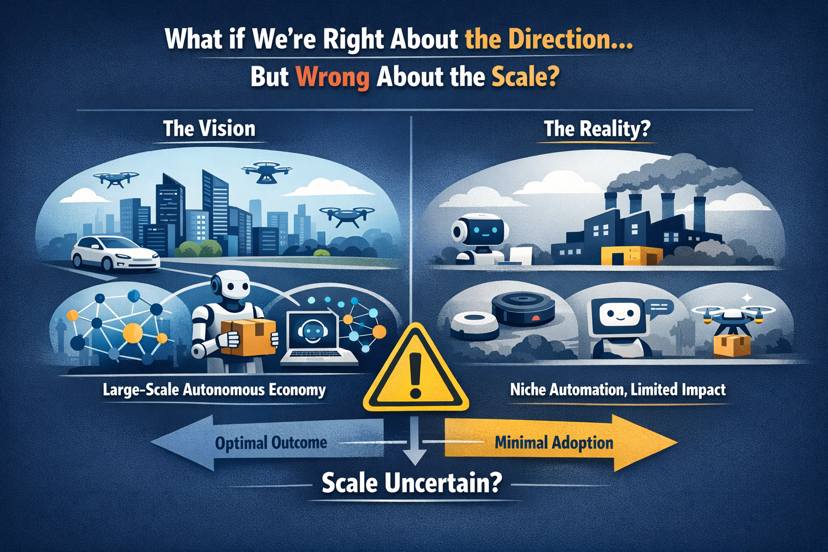
Crypto tends to assume that every technological shift becomes open and decentralized by default.
History doesn’t always support that.
A lot of the most powerful digital infrastructure ended up consolidating around a handful of platforms. Not because decentralization failed conceptually — but because convenience and efficiency often win in the early stages.
And machines, unlike humans, optimize ruthlessly for efficiency.
They don’t care about ideology.
That’s the part of the Fabric thesis I keep circling back to.
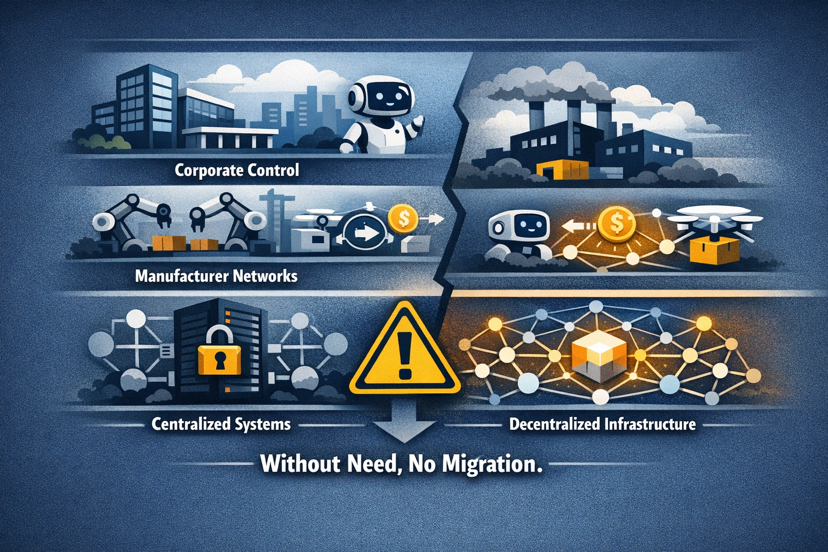
For a decentralized coordination layer to matter, autonomous systems actually need a reason to leave centralized ecosystems.
If AI agents are operating inside a major corporate environment…
If robotics networks are controlled by manufacturers…
If machine-to-machine transactions remain internal…
Then neutral infrastructure never becomes necessary.
And necessity is what drives protocol adoption.
To be clear, that doesn’t mean Fabric is misreading the future.
It might simply be preparing for the moment when centralized systems begin to collide with each other.
When different machine ecosystems need to interact. When proprietary rails stop being enough. When interoperability becomes a real economic constraint.
That moment could create demand very quickly.
But the timing of that shift is still… uncertain.
Another thing I’ve noticed about infrastructure bets is how quiet the early signals tend to be.
You don’t see massive user spikes.
You see small integrations. Developer experiments. Systems quietly testing whether something works better than the alternatives.
For a long time, it all looks insignificant.
Until suddenly it isn’t.
I’ve learned to respect that phase more than I used to.
But I’ve also learned that not every early infrastructure thesis survives long enough to reach maturity.
Some disappear before the ecosystem catches up.
Some get replaced by simpler solutions.
Some remain technically impressive but economically unnecessary.
So when I look at $ROBO, I don’t feel certainty.
I feel tension between two plausible futures.
One where autonomous systems eventually require neutral coordination layers — and Fabric ends up looking early rather than speculative.
And another where machine economies remain largely contained within centralized platforms.
If that happens…
Then this entire thesis starts to feel like architecture built for a world that never quite arrived.
I’m not ready to choose between those outcomes yet.
But I am watching one thing very closely.
Whether machines start interacting across boundaries they can’t easily control.
Because if that behavior emerges…
Everything about this conversation changes.
#ROBO @Fabric Foundation $ROBO
