Let’s be honest: the way we build robots right now is pretty "walled garden." Usually, one company controls all the data, the brain, and the decision-making. While that works for a vacuum cleaner, it’s a massive bottleneck for the future of general-purpose robots. That’s where Fabric Protocol $ROBO comes in.
Supported by the non-profit Fabric Foundation, this isn't just another tech stack—it’s an open, decentralized network designed to let humans and robots actually work together in a way we can trust.
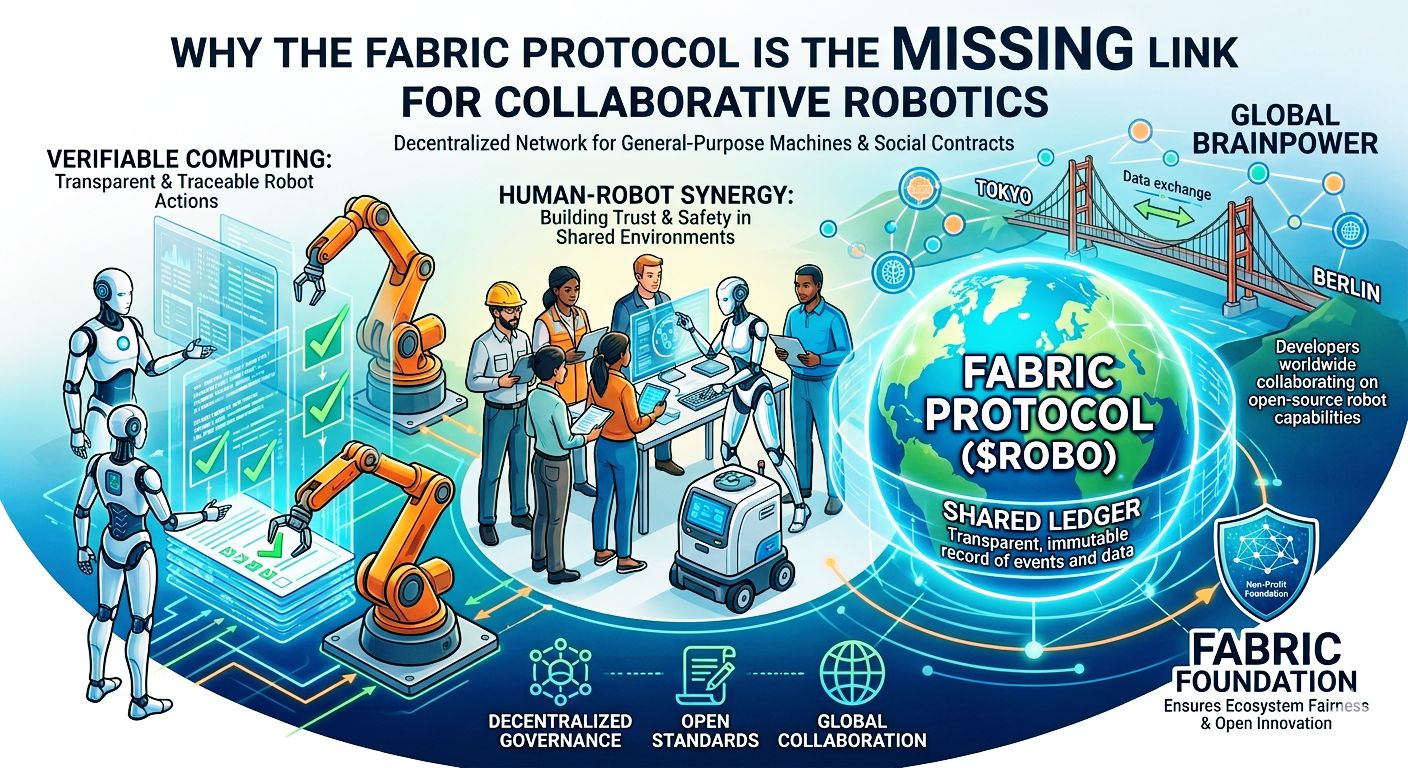
The coolest part of the protocol is something called verifiable computing. If you’re going to have an autonomous robot in your space, you need to know it’s doing exactly what it’s supposed to do, with no hidden "glitches" or unauthorized tasks. Fabric makes every action and calculation checkable. It’s essentially a "trust but verify" system for machine brainsUnlike the closed systems of the past, Fabric is all about open innovation:
A Shared Ledger: Think of it as a transparent record of events. By using a public ledger to coordinate data and computation, everyone stays on the same page.
Human-Robot Synergy: The protocol allows "agents" (the robots) to share data and interact with humans safely. This makes them way more adaptable to real-world chaos than a standard pre-programmed machine.
Global Brainpower: Because it’s decentralized, a developer in Tokyo can collaborate with one in Berlin to test and improve a robot’s performance in real-time.
At the end of the day, the Fabric Foundation is there to make sure the ecosystem stays fair and doesn't get monopolized. They’re focused on long-term research and setting the standards that will eventually make robots a seamless part of our daily lives.
By combining decentralized governance with verifiable tech, $ROBO is basically building the "social contract" for the next generation of machines.@Fabric Foundation #robo #ROBO $ROBO