
Most people think of robots as machines that work by themselves. A robot vacuum in your house. An industrial arm in a factory. A delivery bot navigating a sidewalk.
Each machine is trained on its own. Each system is closed. Each company builds its own little world of robots.
But what if robots weren't alone? What if they could actually work together—not just as a nice idea, but as a coordinated team?
That's where Fabric Protocol gets interesting.
---
The Real Problem with Robotics
Everyone talks about how artificial intelligence is advancing. But robots face a different challenge entirely.
Training robots is extraordinarily expensive.
Robots need to learn by doing things in the physical world. They need human guidance. They need real environments. They need enormous amounts of time.
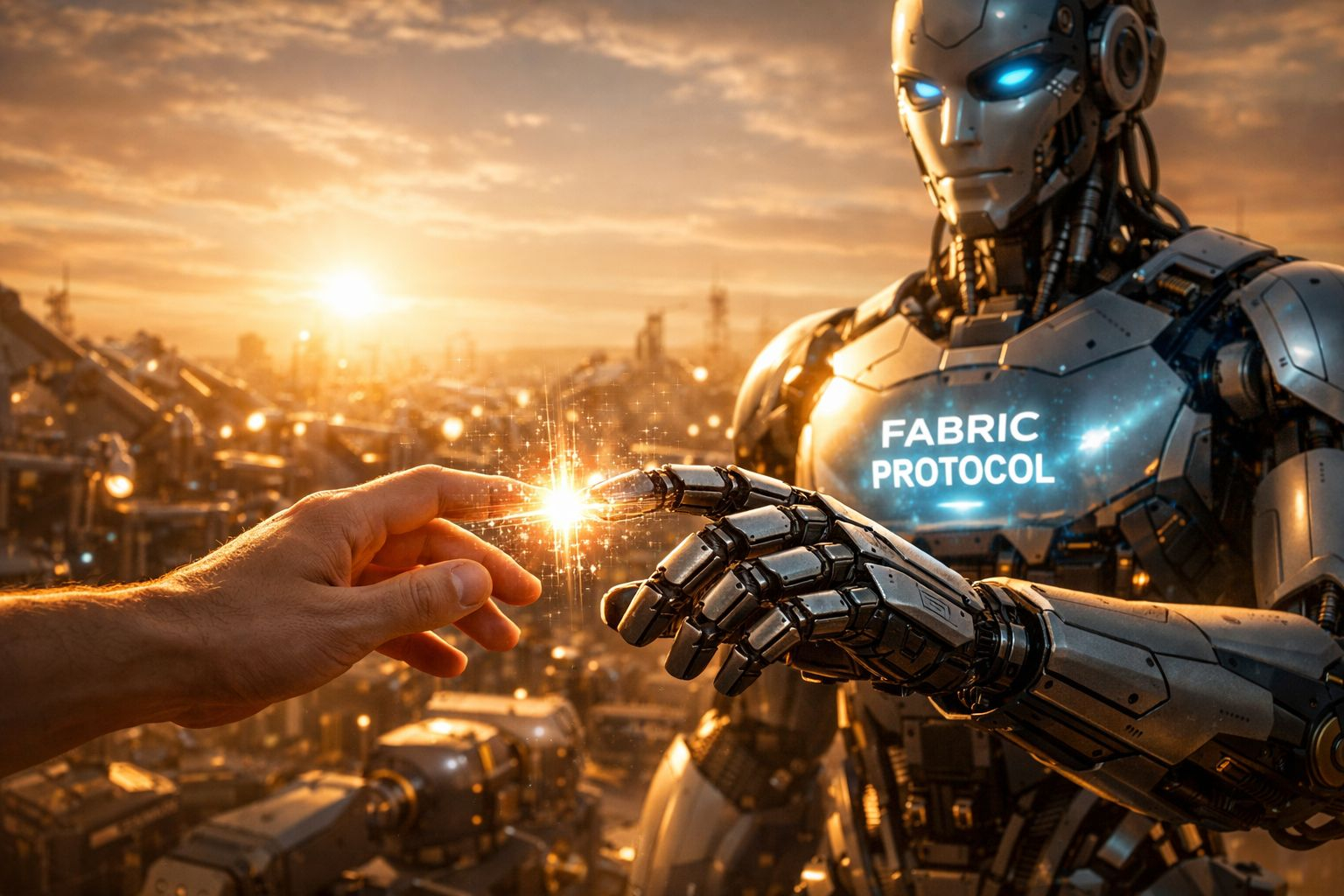
And here's the inefficiency: every robotics company does the same thing—trains robots, collects data, builds models, and starts again. That data stays locked inside one organization.
This means progress in robotics is painfully slow. Thousands of robots learn the same tasks over and over, but they never share what they've learned.
Fabric Protocol is trying to solve exactly this.
---
Making Robots Work Together
Fabric's vision treats robots like parts of a connected team. Each robotic system can share:
· What it knows
· How it learns
· How it makes decisions
Imagine a warehouse robot in Singapore learns a more efficient way to stack boxes. That knowledge could be shared instantly with robots in factories worldwide, so they can learn from it too.
Suddenly, robots aren't isolated anymore. They're part of something larger.
It's like how the internet connected computers decades ago. Fabric is attempting the same thing—but for machines.
---
Humans Are Still Essential
What makes Fabric interesting is that it doesn't assume robots can learn entirely on their own.
Humans remain necessary.
The protocol is designed for people to contribute:
· Learning examples
· Behavior guidance
· Performance checks
· Quality validation
Instead of contributing for free, people get rewarded through the protocol's economic system. This means the future of robotics might not be built solely by corporations—it could be built by a global community.
---
Making Sure Robots Are Honest
Another critical piece: Fabric wants to ensure robots can be trusted.
If machines are learning from each other, we need a way to verify what they're actually doing. Fabric's system tracks:
· Data provenance
· Robot identities
· Decision-making processes
This creates transparency. Instead of blindly trusting one company's claims, users can verify robot behavior themselves. It's an attempt to make robotics open and accountable—something the industry has struggled with.
---
Why This Idea Matters
Honestly? When I first heard about Fabric Protocol, I wasn't sure what to think.
Part of me thought it sounded too ambitious. Robotics infrastructure, coordinated machine networks, global participation—that's a lot.
But another part recognized something important: the robotics industry doesn't have its internet yet.
Every company is still working in isolation. If something like Fabric works, it could fundamentally change how robots develop. Instead of thousands of separate systems, we could see machines working together for the first time.
---
The Bigger Picture
When people talk about intelligence, they often focus on software and algorithms. But the physical world still matters.
· Factories
· Logistics
· Construction
· Delivery
· Healthcare
· Agriculture
These industries will depend heavily on robotics in the coming decade. When that happens, the critical questions won't just be about individual machines. They'll be about:
· How robots work together
· How knowledge is shared
· How humans collaborate with machines
· How data moves between systems
Fabric Protocol is looking at the infrastructure for that future—a system where machines, humans, and intelligence can actually work together.
---
Still Early. Very Early.
Some of the most important technologies start small and unnoticed.
The internet began as a research network. Blockchain started as an obscure experiment. If robotics becomes the transformative industry many expect, protocols like Fabric might become the backbone that lets machines finally work as a team.
Not just as tools. As participants.
Honestly? That idea feels both exciting and a little strange. 🤖
---
What's your take on the machine economy? Drop your thoughts below. 👇
#FABRIC #ROBO #MachineEconomy #Aİ #Robotics @Fabric Foundation
---