
The first time I took a closer look at ROBO, something about it felt different.
Most AI-related tokens today focus on intelligence models, data infrastructure, or digital agents. ROBO, however, seemed to be asking a deeper question:
What happens when robots need an economy of their own?
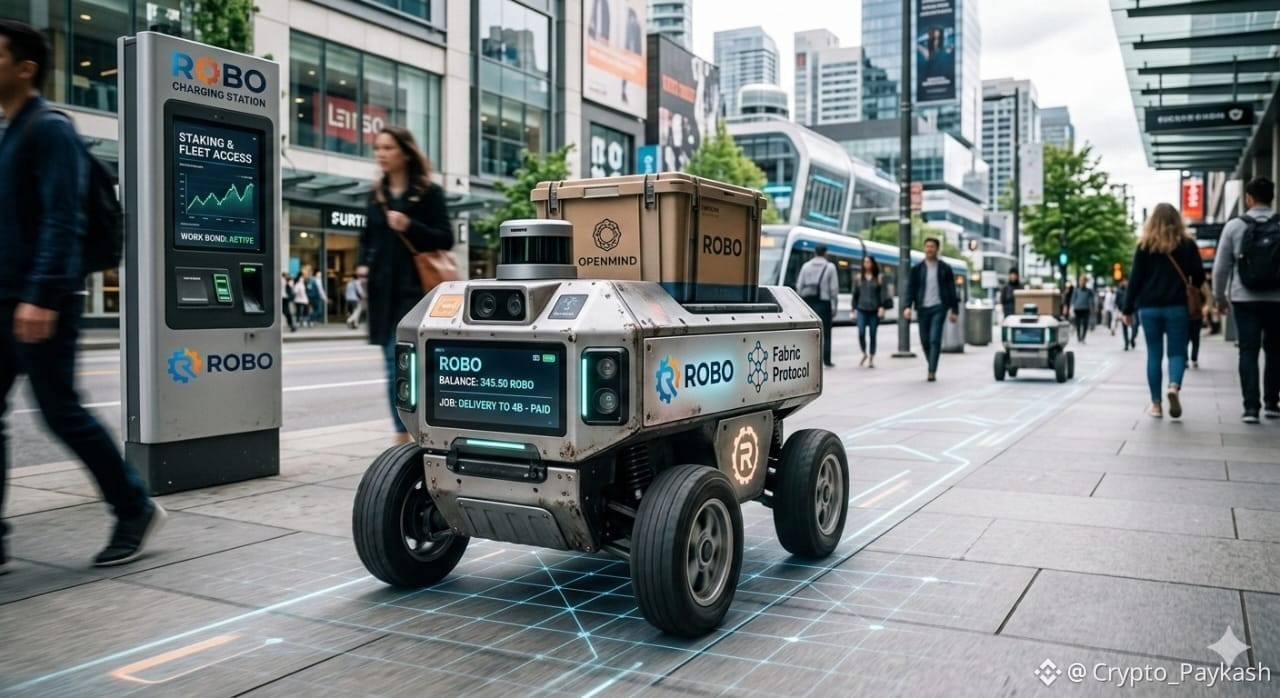
At first glance, that idea might sound distant or even speculative. But when you step back and observe the direction technology is moving, it starts to feel far less theoretical.
Artificial intelligence is spreading across industries. Robotics research continues to accelerate each year. At the same time, blockchain networks are gradually becoming coordination layers for digital systems.
ROBO sits right at the intersection of these three trends.
The mission from the Fabric Foundation is summarized in a simple but bold phrase:
“Own the Robot Economy.”
When I first read it, I paused for a moment. It sounds ambitious, but the underlying concept is surprisingly practical.
Robots cannot open bank accounts.
They cannot hold passports.
They cannot verify identity through traditional financial systems.
Yet if robots begin performing real-world tasks—whether in logistics, infrastructure, manufacturing, or services—they will still need a way to receive payments, verify actions, and interact economically.
Fabric approaches this challenge through blockchain infrastructure.
At the center of the system is ROBO, the network’s native token. Robots operating within the Fabric ecosystem would rely on on-chain identities connected to Web3 wallets. Any payments, verification processes, or coordination inside the network would be handled using ROBO.
On the surface, that structure seems straightforward.
But the mechanism underneath is where things become more interesting.
The Fabric network is launching initially on Base, which already processes roughly two million daily transactions across its ecosystem. That level of throughput provides the capacity needed for early deployment.
As adoption grows, Fabric plans to transition toward its own Layer 1 chain, which would allow the network to capture value directly from robot activity.
Understanding this helps explain how the token economy is structured.
Participants stake ROBO in order to coordinate the activation of robot hardware within the network. Importantly, this does not mean users own fractions of robots. Instead, staking acts as a coordination mechanism.
Staking signals participation in the network’s initialization and can provide priority access when robots begin performing tasks.
And that detail matters.
When autonomous robots first become operational within an economic network, someone has to determine how tasks are distributed, validated, and rewarded. A staking layer creates an organized way to allocate those opportunities while aligning incentives between participants and the long-term success of the system.
Beneath that coordination layer sits another economic loop.
A portion of the network’s revenue is designed to purchase ROBO on the open market. This mechanism directly links token demand to real activity within the ecosystem. If robots are performing work and generating value, the network itself becomes a buyer.
Historically, feedback loops like this have helped create sustainable economic dynamics in blockchain systems.
Developers and businesses that want access to the robot network must also stake ROBO. Builders creating applications that interact with robotic capabilities are required to hold tokens in order to participate.
This requirement ties ecosystem growth directly to the underlying asset.
What stood out most when I studied the model is how different it feels from many AI token projects.
Most focus on training models or building purely digital agents.
Fabric focuses instead on the infrastructure that allows machines to operate economically in the physical world.
It is a quieter layer of technology. But historically, infrastructure often proves more valuable than the visible applications built on top of it.
Of course, the concept remains early.
According to the International Federation of Robotics, there are currently around four million industrial robots operating worldwide. Most exist in highly controlled environments such as manufacturing plants.
Expanding that ecosystem into open economic networks introduces serious technical challenges.
Autonomous machines must be secure.
Their activity must be verifiable.
The surrounding economic systems must prevent manipulation.
Those risks are real.
But the broader pattern across technology is difficult to ignore.
Artificial intelligence is expanding into automation.
Robotics capabilities continue to advance.
Blockchain networks are evolving into coordination layers for decentralized systems.
When these trends move together, entirely new intersections begin to appear.
ROBO sits quietly within one of those intersections.
It does not promise instant transformation. The idea remains experimental. The robot economy could develop slowly—or accelerate rapidly if AI and robotics breakthroughs continue.
What matters most is the direction of the foundation being built.
Infrastructure rarely looks exciting at the beginning. But when new technological systems mature, the projects that focused on coordination layers often become the ones everything else depends on.
If autonomous machines eventually require transparent, decentralized economic infrastructure, the work being built within Fabric may turn out to be far more important than it appears today.
And that possibility is exactly why ROBO remains one of the projects worth watching.