
just stumbled across a section in Midnight's tokenomics whitepaper that completely changed how i think about who can actually use this network...
everyone focuses on NIGHT and DUST mechanics. hold NIGHT, generate DUST, execute transactions. simple enough. but buried in section 4 is a completely different access model that Midnight is quietly building — and it has nothing to do with holding NIGHT at all.
the part that surprises me:
Midnight is designing a capacity marketplace. a system where NIGHT holders who generate more DUST than they personally need can lease that generation to other users — users who have zero NIGHT, zero DUST, and potentially zero knowledge that a blockchain even exists underneath the application they're using.
the whitepaper describes this explicitly. a DApp operator running on Midnight needs DUST to process user transactions. but instead of requiring every user to hold NIGHT, the operator can lease DUST generation capacity from NIGHT holders and cover transaction costs on behalf of their entire user base. the end user just uses the app. they never touch a token.
what caught my attention:
the off-chain broker model is the first version of this. a NIGHT holder designates their DUST generation to a lessee's wallet directly. the lessee gets usable DUST. payment between the two parties happens completely off-chain — cash, stablecoin, bank transfer, whatever they agree on. no on-chain settlement required for the lease arrangement itself.
brokers can sit in the middle of this. a specialized broker manages relationships between multiple NIGHT holders leasing capacity and multiple DApp operators needing it. brokers coordinate designations, collect payments from lessees, distribute payments to lessors, and take a fee for the service.
this is essentially a B2B infrastructure market operating on top of Midnight's token mechanics. and it can run entirely off-chain in its first version.
still figuring out if:
the off-chain model requires trust between parties. a NIGHT holder designating their DUST generation to a lessee has to trust that lessee will actually pay. a broker intermediating this relationship becomes a single point of failure — if the broker mismanages payments or disappears, lessors lose income and lessees lose capacity.
the whitepaper acknowledges this and describes future protocol upgrades that would enable ledger-native capacity leasing — an on-chain mechanism where payment and designation happen atomically without trust assumptions. but that version doesnt exist yet. the launch version is the off-chain trust-based model.
and heres the part that keeps me thinking — Midnight also describes something called Babel Stations. a service that lets users submit transactions using non-NIGHT tokens as payment. ETH, stablecoins, potentially even fiat. the Babel Station operator covers the DUST cost and gets reimbursed in whatever token the user offered. this takes the capacity marketplace concept even further — you dont need NIGHT, you dont need DUST, you dont even need to know what either of those things are.
the vision is essentially a blockchain where the token mechanics are completely invisible to end users. developers build apps, operators source DUST capacity from the marketplace, users pay in whatever they have. the entire NIGHT/DUST system runs underneath without most users ever interacting with it directly.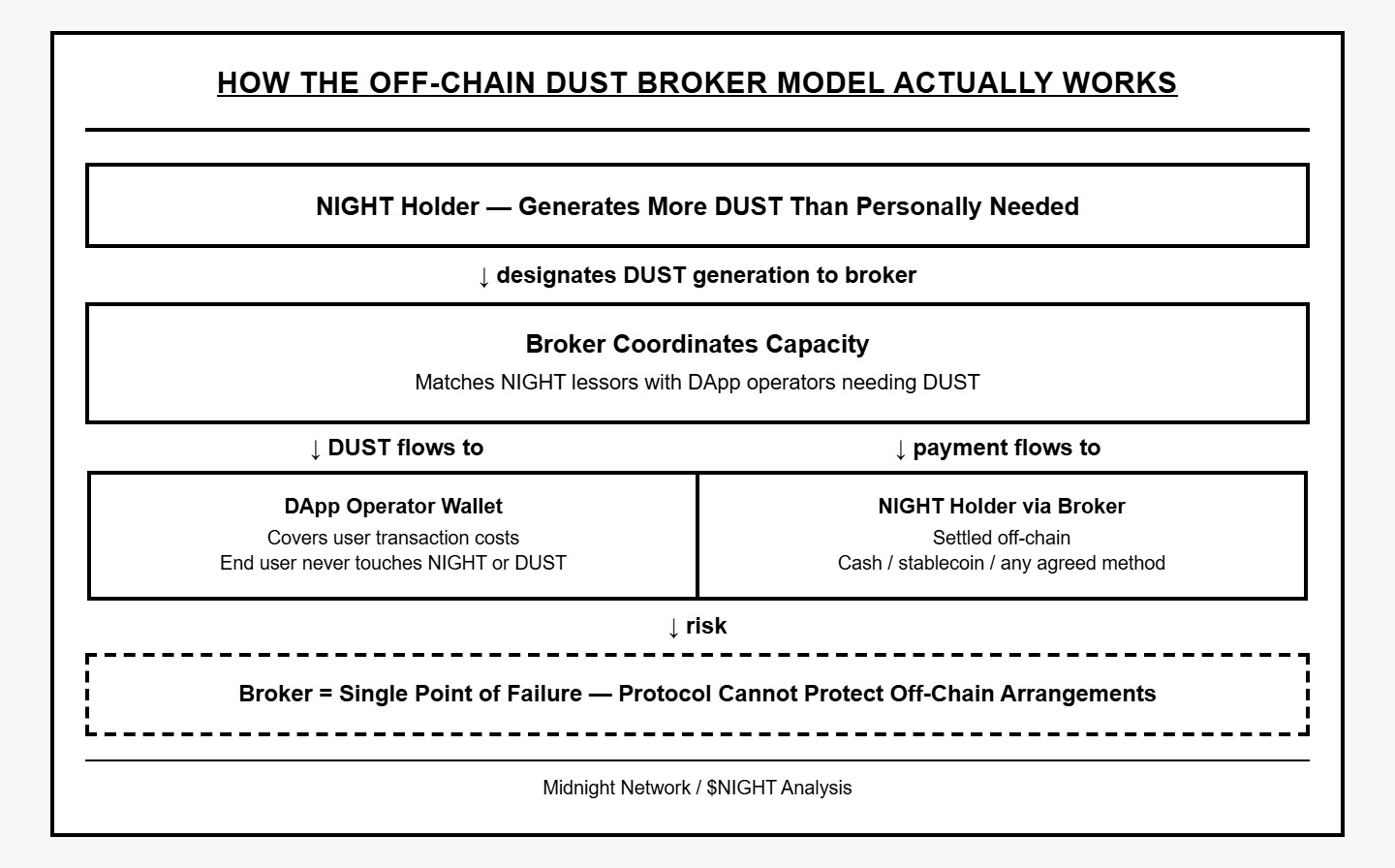
honestly dont know if this abstraction layer makes Midnight genuinely more accessible or just adds complexity and trust dependencies that create new failure points before the on-chain marketplace version is ready.
what do you think — elegant infrastructure design that could make Midnight invisible to end users, or a trust-dependent off-chain layer that introduces risks the protocol itself cant protect against?? 🤔
#night @MidnightNetwork $NIGHT
