
Crypto Infrastructure Research Brief – Delhi se
The conversation around robotics in crypto often moves faster than the infrastructure behind it. Narratives about autonomous machines, decentralized factories, and AI-driven robots can easily capture market attention. But beneath the excitement lies a deeper question: can a blockchain network actually coordinate machine labor in a sustainable and measurable way?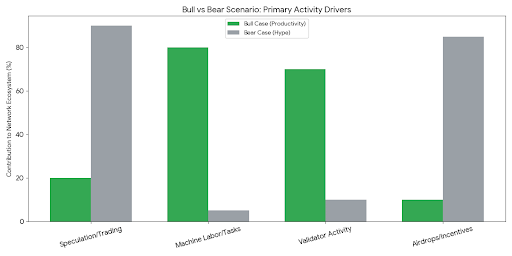
Fabric Protocol positions itself within this challenge. Rather than merely presenting robots as a futuristic story, the project proposes a structured, on-chain coordination market where machines, tasks, and capabilities interact economically. In this system, the ROBO token becomes the backbone of participation, incentives, and productivity across the network. The real question is not whether robots sound exciting—it’s whether the network can retain meaningful activity once speculation fades.
Current Market Signals
Fabric is in an early narrative stage of market discovery. The project has a market capitalization of roughly $96 million with a circulating supply of ~2.2 billion ROBO tokens. Daily trading often reaches tens of millions, indicating strong liquidity. Listed on Binance Spot under the Seed Tag, ROBO is actively undergoing price discovery. While trading is high, infrastructure activity still needs to prove itself.
What Fabric Is Building
Fabric creates a coordination layer for machine labor, focusing on three layers:
Robot Infrastructure: Physical or software machines capable of tasks.
Programmable Skills: Modular capabilities like navigation, object recognition, data processing, or labor.
Tokenized Work: Completed tasks generate measurable output verified and rewarded on-chain.
Here, ROBO is less a speculative asset and more an economic coordination tool, aligning incentives with productive output.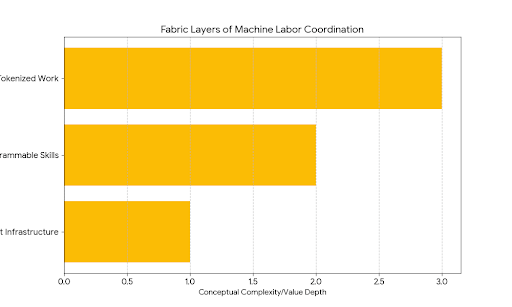
The Key Challenge: Retention
Every protocol experiences phases: speculation, coordination, and productive usage. Most new protocols fail when activity disappears after incentives fade. Retention is the true test, not hype.
Early Network Observations
Current signals indicate most activity stems from airdrops, token distribution, and exchange movements rather than large-scale machine work. While this is normal for early-stage protocols, network effects remain a hypothesis, not reality.
Fabric’s Innovation: Measuring Non-Gameable Work
A robust network must reward real productivity. Fabric aims to link incentives to verifiable task completion, efficiency, energy usage, performance, and compliance metrics. By focusing on measurable output, the protocol aligns incentives between machine operators, builders, and participants.
Bull vs Bear Scenarios
Bull Case: Repeatable machine tasks executed, validators verifying real work, developers integrating capabilities, and users paying for services.
Bear Case: Activity dominated by speculation, token trading, or incentive farming.
The Fabric Thesis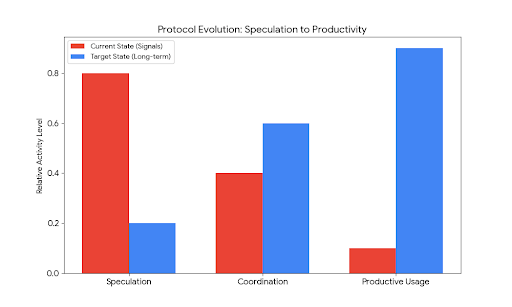
Fabric’s real bet is not robotics hype. It’s whether machine labor can be coordinated through an on-chain economic system. Success depends on sustained participant retention, measurable task execution, and a gradual shift from speculation to productivity. Until then, retention—not narrative—is the metric that matters most.
@Fabric Foundation #ROBO $ROBO
