
Fabric Protocol — The Idea Behind the “Internet of Robots”
In the early days of the internet, computers existed as isolated machines.
They were powerful individually, but their real value only appeared once they were connected.
Networking turned separate devices into a global system.
Robots today may be at a similar stage.
Across factories, warehouses, and logistics systems, machines are becoming more capable. But most of them still operate inside closed ecosystems controlled by individual companies.
A robot from UBTech in a warehouse cannot coordinate with a robot from AgiBot in the same building. A delivery unit from Fourier Intelligence may complete a task, but there is no universal infrastructure that allows it to verify work, receive payment, or coordinate tasks across systems.
Each robot lives inside its own technical silo.
This is the problem Fabric Protocol is attempting to address.
The “Internet of Robots”
While the Internet of Things focuses on devices sharing data, the concept behind Fabric goes a step further.
Machines wouldn’t just exchange information.
They could coordinate tasks, verify work, and settle transactions autonomously.
In theory, this turns robots from isolated tools into participants in a networked economy.
Fabric’s architecture revolves around several core components:
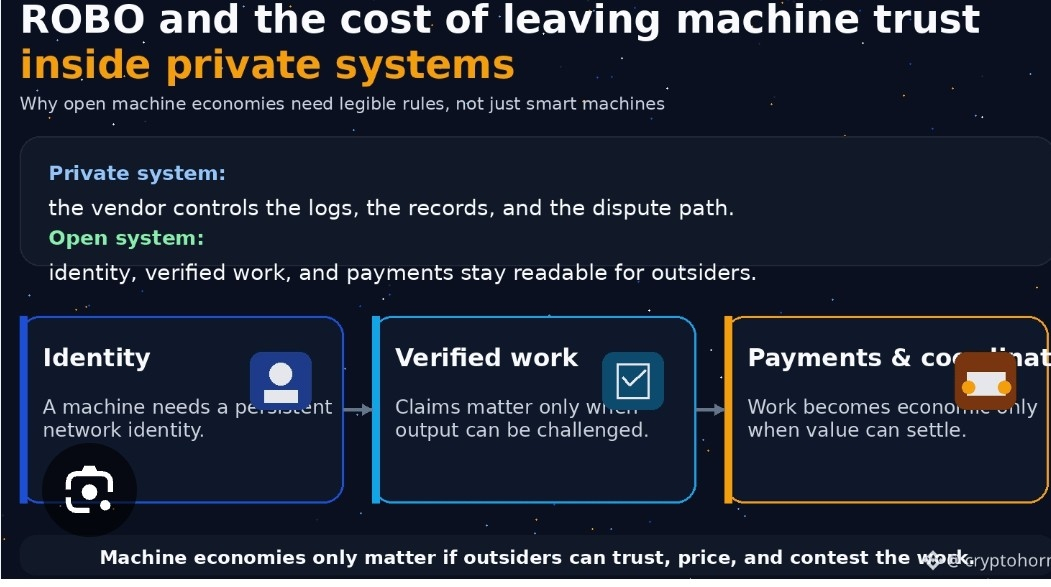
1. Universal Machine Identity
Every robot receives a unique on-chain identity.
This identity is manufacturer-agnostic and globally readable.
In principle, this means machines from different companies could recognize each other and interact without relying on centralized registries.
2. Open Task Marketplace
Tasks could be distributed through smart contracts.
Robots would compete for work based on verified capabilities — location, hardware specifications, or performance history.
Instead of a company assigning tasks to its own fleet, the network could theoretically allocate work to the most efficient machine available, regardless of manufacturer.
3. Proof of Robotic Work
Fabric proposes a verification system known as PoRW (Proof of Robotic Work).
The goal is to create a cryptographic record confirming that a physical task was actually completed in the real world.
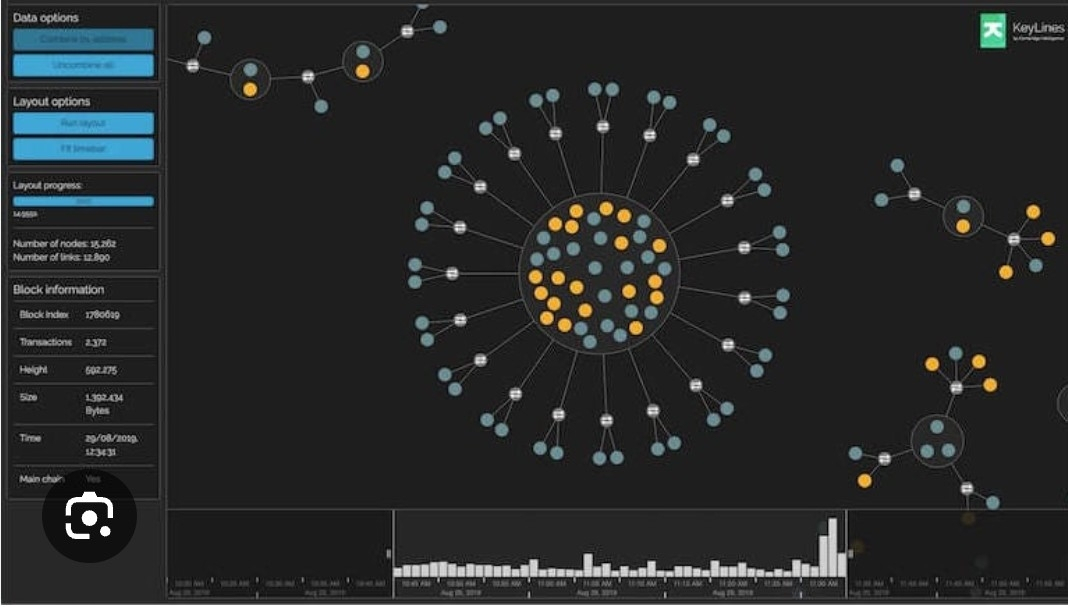
If it works as intended, the blockchain becomes a verifiable log of machine activity.
4. Native Economic Layer
The token ROBO functions as the settlement layer of the network.
Registration fees, task payments, coordination costs, and staking requirements would all be denominated in ROBO.
This makes the token part of the protocol’s operational infrastructure rather than simply a speculative asset.
The Hardware Bridge Problem
Many blockchain-robotics ideas fail at one critical point: the connection between software logic and physical machines.
Fabric attempts to solve this through OM1, an operating layer designed to act as a translator between robot hardware and the blockchain system.
OM1 was developed by OpenMind Robotics, co-founded by Jan Liphardt, a Stanford bioengineering professor.
In theory, robots running OM1 can:
register their identity on the network
receive tasks from smart contracts
perform those tasks physically
submit verified results back to the protocol
If widely adopted, this would reduce the integration barrier for manufacturers.
The Bigger Structural Question
One argument behind Fabric’s design is that robot infrastructure may eventually become critical public infrastructure.
If the coordination layer for global robot fleets were controlled by a single company, that entity could theoretically influence:
which robots receive tasks
which work gets verified
how payments are distributed
That kind of concentration would create enormous economic leverage.
Fabric’s decentralized architecture attempts to avoid that scenario by distributing control across network participants.
The Real Challenge
Technically, the concept is ambitious.
But the biggest question may not be technology.
It’s adoption.
Robotics companies guard their data carefully.
Operational logs, training data, and hardware performance metrics are extremely valuable.
Convincing companies to connect their machines to a shared protocol may prove difficult.
Final Thought
The idea behind Fabric is not unreasonable.
If robotics continues expanding into public infrastructure — logistics networks, hospitals, cities, and transportation systems — transparency and coordination could become increasingly important.
But like many infrastructure projects, its success will depend on something simple:
Whether enough real-world participants decide the network is worth joining.
Until then, it remains an interesting attempt to build infrastructure for a machine economy that may still be forming.