

When people talk about the future of robotics, the conversation almost always starts with the machines.
Better hardware. Smarter AI. Faster movement. More advanced capabilities.
The spotlight naturally falls on the robot itself.
But the longer I watch this space, the more I feel that the real story is not the machine. The real story is everything around it.
Because a robot completing a task is only the beginning.
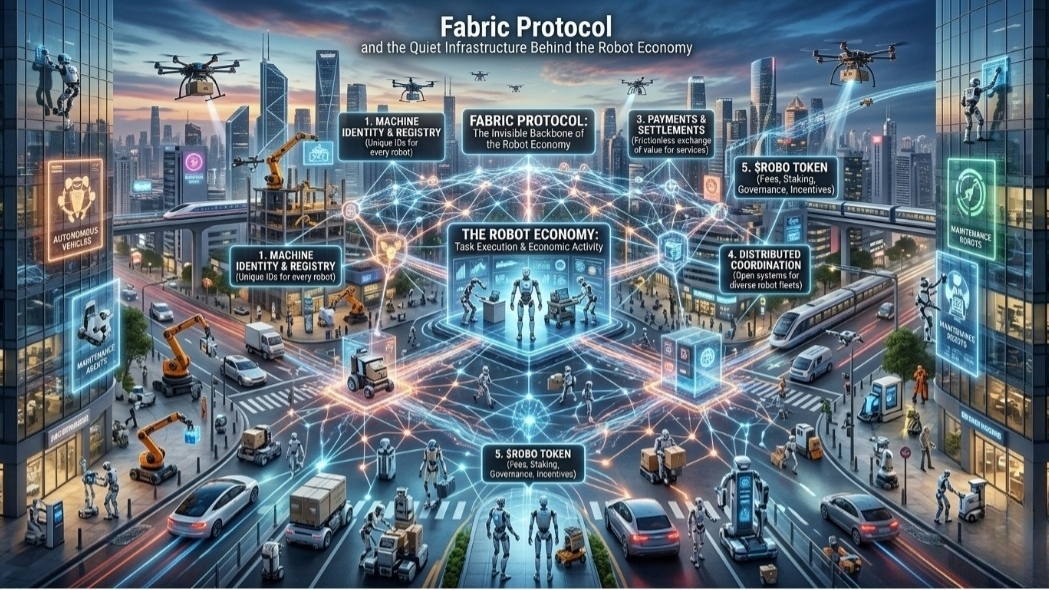
If machines are going to operate beyond laboratories and controlled corporate environments, they will eventually need something much larger than intelligence. They will need a system that allows them to participate in economic activity. They will need identity, coordination, payments, rules, and a way to prove that the work they performed actually happened.
That is the gap Fabric Protocol is trying to explore.
And what makes the idea interesting is that it approaches robotics from a different angle. Instead of asking how machines become smarter, Fabric is asking how machine activity becomes structured.
Think about how human economies function. A city does not work simply because people live there. It works because there are shared systems that allow strangers to interact safely. Registries track ownership. Payment networks move value. Contracts define responsibilities. Public records establish trust.
Without those invisible systems, everyday economic activity would collapse.
Fabric seems to be asking whether machines will eventually need something similar.
If robots, autonomous agents, and AI-driven systems begin performing tasks in the real world, they cannot rely entirely on private platforms. They will need open systems that allow different machines, developers, and operators to coordinate their work in a way that others can verify and trust.
That is where the Fabric Foundation positions its protocol.
The idea is not simply to build robots. The idea is to create infrastructure that allows robotic work, machine data, and autonomous coordination to exist within a shared network. In that environment, contributions can be recorded, tasks can be verified, and participants can interact without needing a central authority to control every step.
That concept might sound abstract at first, but it touches a very real challenge.
Machines can already perform useful work. What they cannot easily do yet is prove that work in a way that fits into an open economic system.
Fabric tries to address that through verifiable computing and a public coordination layer where tasks, data, and machine activity can be tracked through a shared ledger. In theory, that makes it possible for developers, hardware operators, and contributors to collaborate around robotic systems without being locked inside a single organization.
Of course, ideas like this always sound cleaner on paper than they do in practice.
The robotics industry itself is still evolving quickly, and no one knows exactly how machine economies will develop. Hardware standards are still shifting, software environments are still competing, and large companies continue building their own closed ecosystems.
That means Fabric is operating in uncertain territory.
But uncertainty does not necessarily make the idea weak. In some ways, it is exactly where infrastructure projects usually appear. The early internet also looked chaotic before common protocols helped organize it.
Fabric is essentially asking whether something similar could happen with machines.
The role of the $ROBO token fits inside that larger design. Rather than existing purely as a tradable asset, it is meant to support the internal mechanics of the network. Fees, staking, participation, and governance all revolve around the token’s presence in the system. In theory, this links economic incentives to actual activity taking place within the protocol.
Whether that structure succeeds will depend on adoption, not marketing.
Fabric will only matter if developers, operators, and robotic systems actually begin using the network to coordinate tasks and share resources. If that activity grows, the protocol becomes useful infrastructure. If it does not, the idea will remain an interesting experiment.
That is the reality every early infrastructure project faces.
Still, there is something refreshing about Fabric’s direction. Instead of chasing short-term narratives, the project is trying to address a deeper structural question. If machines are going to become part of our economic systems, then the frameworks that organize human collaboration may need to evolve to include them.
Fabric is exploring what that framework might look like.
It is not promising instant transformation, and it does not claim that robots will suddenly dominate global industries. Instead, it is attempting to build the underlying systems that could make machine coordination possible in the long run.
And those kinds of systems rarely attract attention at first.
They tend to sit quietly in the background until one day people realize that everything around them depends on them.
If the robot economy truly expands in the coming years, the projects that quietly built the infrastructure for machine coordination may end up being far more important than the machines themselves.
#Robo @Fabric Foundation $ROBO
