
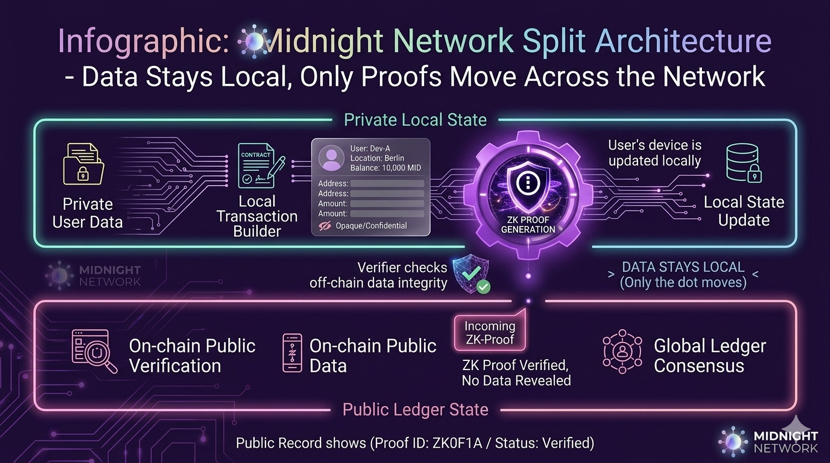
I caught myself doing something strange the other day.
Reading through a private workflow concept on Midnight Network, and instead of thinking about how it works, I kept thinking about how it changes. Not at launch. Not in theory. But after people start using it.
Because that’s where things usually get real.
At the start everything is clean. A developer designs the system around minimal disclosure. Users reveal only what they need to reveal. The rest stays local. Protected. Untouched. The logic is tight. The boundary is clear.
It feels solid.
Then usage begins.
A transaction gets flagged somewhere in the flow. Someone asks for a bit more context to move faster. Not a lot. Just enough to avoid delays. Later another request comes in. A partner wants slightly richer data for reconciliation. A support team wants better visibility for edge cases.
None of it feels dangerous.
That’s what makes it dangerous.
I’ve seen this pattern outside crypto too. Products don’t usually break because of one bad decision. They shift because of many good ones. Each one justified. Each one solving something real.
Infographic: Flow showing small disclosure increases stacking over time inside a product lifecycle
Weeks pass. Then months.
The system still works. The proofs still verify through
Zero-Knowledge Proof.
From the outside nothing looks wrong.
But if you compare the current version to the original one, something feels different.
The boundary is not where it used to be.
Not broken. Just… moved.
That’s the part I keep coming back to with Midnight. The tech is designed to let developers prove outcomes without exposing raw data. That part is powerful. It solves a real problem this space ignored for too long.
But the protocol can’t decide how much a product chooses to reveal over time.
That decision sits with people.
And people respond to pressure.
Deadlines. Users. Partners. Regulations. Growth targets. Each one pushing a little. Each one asking for something that sounds reasonable in the moment.
Infographic: Split view showing original privacy boundary vs expanded boundary after real-world pressures
Put enough of those moments together and the system evolves into something slightly different than what it started as. Still private by definition. Still secure by design. But shaped by decisions that slowly stretched the line.
I don’t think this is a flaw in Midnight.
If anything it highlights where the real challenge is. Not just building private infrastructure, but maintaining discipline around it once real usage begins.
Because the hardest part isn’t proving something without revealing it.
It’s deciding, again and again, not to reveal more than you should.
That’s not a technical problem.
That’s a human one.