
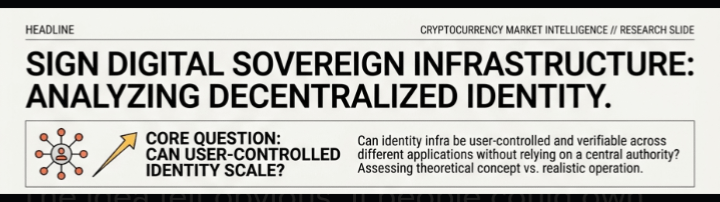
 1. The real bottleneck for Sign is not credential issuance, but credential verification at scale
Thesis: Sign’s success depends less on creating credentials and more on making verification fast, cheap, and composable across applications.
System claim: Verification, not issuance, is the true scaling constraint for credential-based systems.
Mechanism: On-chain/off-chain verification flows, zk-proof usage, and verification cost structures.
Non-generic: Most focus on issuance; this flips attention to operational validation load.
Chinese-style fit: Hidden infra bottleneck, not surface feature.
Originality: 9/10
Strength: 9/10
2. Sign may be misunderstood as an identity layer when it is really a distribution coordination engine
Thesis: The real value of Sign is not identity, but coordinating who gets what, when, and under what verifiable conditions.
System claim: Token distribution is fundamentally a coordination problem, not an identity problem.
Mechanism: Credential gating, eligibility logic, and distribution routing.
Non-generic: Reframes entire category positioning.
Chinese-style fit: “Not X, but Y” with system reframing.
Originality: 9.5/10
Strength: 9.5/10
3. The real test for Sign is not proving credentials, but making them usable across fragmented ecosystems
Thesis: Credentials only matter if they can be reused seamlessly across chains, apps, and contexts.
System claim: Interoperability, not proof validity, determines real adoption.
Mechanism: Cross-chain credential standards, composability layers, API integration.
Non-generic: Focuses on usability layer, not cryptography.
Chinese-style fit: Adoption bottleneck framing.
Originality: 8.5/10
Strength: 9/10
4. Sign’s real challenge is not Sybil resistance, but incentive alignment between issuers and verifiers
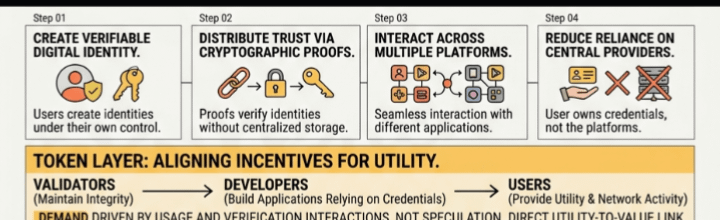 Thesis: Even perfect credentials fail if issuers and verifiers don’t share aligned incentives.
System claim: Credential systems break not from fraud, but from misaligned participation incentives.
Mechanism: Issuer reputation, verifier trust models, economic incentives.
Non-generic: Goes beyond standard “anti-Sybil” narrative.
Chinese-style fit: Operator behavior + incentive design.
Originality: 9/10
Strength: 9/10
5. Token distribution only works if eligibility logic becomes infrastructure — and that’s where Sign is quietly positioning itself
Thesis: The real product is not tokens or credentials, but programmable eligibility as a system layer.
System claim: Eligibility logic is becoming a core primitive in Web3 distribution.
Mechanism: Rule engines, credential gating, programmable conditions.
Non-generic: Focus on logic layer, not assets.
Chinese-style fit: Hidden infra abstraction.
Originality: 9.5/10
Strength: 9.5/10
6. Sign is not solving distribution fairness unless it solves verification latency
Thesis: Slow verification undermines fairness by creating timing asymmetries in access.
System claim: Latency is a hidden fairness problem in token distribution.
Mechanism: Proof generation speed, on-chain settlement delays.
Non-generic: Connects performance to fairness.
Chinese-style fit: Subtle system dependency.
Originality: 8.5/10
Strength: 8.5/10
7. The market may be overestimating credentials and underestimating credential lifecycle management
Thesis: Issuing credentials is easy; maintaining, updating, and revoking them is the real system burden.
System claim: Lifecycle management is the real operational cost center.
Mechanism: Revocation systems, updates, expiration logic.
Non-generic: Focus on long-term state management.
Chinese-style fit: “boring but critical” layer.
Originality: 9/10
Strength: 9/10
8. Sign’s architecture only works if developers treat credentials as programmable state, not static proofs
Thesis: Static credentials limit composability; programmable credentials unlock real utility.
System claim: Developer mental models determine system adoption.
Mechanism: SDK design, credential composability, dev tooling.
Non-generic: Developer usability as core thesis.
Chinese-style fit: Dev layer as growth bottleneck.
Originality: 8.5/10
Strength: 9/10
9. The hidden risk in Sign is not fake users, but over-fragmented credential standards
Thesis: Competing formats could break interoperability before adoption scales.
System claim: Standardization failure is a systemic risk.
Mechanism: Schema design, cross-platform compatibility.
Non-generic: Focus on fragmentation risk.
Chinese-style fit: Coordination failure.
Originality: 8.5/10
Strength: 8.5/10
10. Sign’s real competition is not other identity protocols, but manual distribution workflows
Thesis: The biggest barrier is replacing existing off-chain coordination systems.
System claim: Adoption depends on displacing entrenched processes, not beating competitors.
Mechanism: Automation vs manual airdrops, tooling efficiency.
Non-generic: Competes with behavior, not protocols.
Chinese-style fit: Real-world adoption lens.
Originality: 9/10
Strength: 9/10
11. The success of Sign depends on whether credentials can become portable trust units
Thesis: Credentials only matter if they carry trust across contexts without re-verification.
System claim: Trust portability is the core scalability factor.
Mechanism: Attestation reuse, trust propagation models.
Non-generic: Trust as transferable asset.
Chinese-style fit: Abstract system property.
Originality: 9/10
Strength: 9/10
12. Sign is not a distribution layer unless it solves recipient selection at scale
Thesis: The hardest part isn’t sending tokens, but deciding who qualifies efficiently.
System claim: Selection complexity dominates distribution systems.
Mechanism: Filtering logic, eligibility computation.
Non-generic: Focus on selection, not execution.
 Chinese-style fit: Hidden computation layer.
Originality: 9/10
Strength: 9/10
13. The real scalability question for Sign is not throughput, but verification cost per user
Thesis: Unit economics of verification determine whether mass adoption is viable.
System claim: Cost per verification is the key scaling metric.
Mechanism: Gas costs, zk efficiency, batching.
Non-generic: Economic lens on infra.
Chinese-style fit: Practical constraint framing.
Originality: 8.5/10
Strength: 9/10
14. Sign’s token only makes sense if it becomes structural to verification demand
Thesis: The token must be tied to verification usage, not just distribution events.
System claim: Token value depends on being embedded in core system activity.
Mechanism: Fee models, staking, verification incentives.
Non-generic: Token as necessity, not reward.
Chinese-style fit: Token-as-infrastructure.
Originality: 9/10
Strength: 9/10
15. Sign’s real unlock is not better airdrops, but making distribution programmable like smart contracts
Thesis: Distribution becomes infrastructure when it’s programmable, not manual.
System claim: Token distribution is evolving into a programmable primitive.
Mechanism: Smart contract integration, rule-based distribution.
Non-generic: Reframes airdrops as infra layer.
Chinese-style fit: System abstraction shift.
Originality: 9.5/10
Strength: 9.5/10
🔻 FILTERED TOP 7 (Strongest → Weakest)
1. Sign may be misunderstood as an identity layer when it is really a distribution coordination engine
2. Token distribution only works if eligibility logic becomes infrastructure — and that’s where Sign is quietly positioning itself
3. The real bottleneck for Sign is not credential issuance, but credential verification at scale
4. Sign’s real competition is not other identity protocols, but manual distribution workflows
5. Sign’s real challenge is not Sybil resistance, but incentive alignment between issuers and verifiers
6. The market may be overestimating credentials and underestimating credential lifecycle management
7. Sign’s token only makes sense if it becomes structural to verification demand
🏆 FINAL BEST ANGLE
Final Title
Sign may be misunderstood as an identity layer when it is really a distribution coordination engine
One-Sentence Thesis
 Sign’s core value is not proving who users are, but coordinating how token distribution decisions are executed across fragmented ecosystems using verifiable conditions.
Why It Is the Best Choice Today
This angle directly challenges the dominant narrative (identity layer) and replaces it with a deeper system interpretation (coordination infrastructure), making it immediately insightful and non-obvious.
Hidden System Tension
The tension between identity as data vs distribution as coordination — the market focuses on credentials, but the real complexity lies in orchestrating multi-party decisions about eligibility, timing, and allocation.
Bigger Project-Level Implication
If correct, Sign is not competing in identity at all — it is positioning itself as core infrastructure for how tokens, access, and incentives are programmatically distributed across Web3.
Why It’s Better Than a Feature-Led Angle
A feature-led angle (like attestations or proofs) limits the discussion to components, while this reframes the entire system purpose, allowing deeper exploration of coordination, incentives, and infrastructure relevance.
Why It Can Support a Serious Binance Square Article
Opens with a strong contrarian premise
Expands into system-level coordination problems
Naturally leads into mechanisms (credentials, eligibility, distribution logic)
Supports real-world implications (airdrops, incentives, governance)
Feels like a genuine insight rather than a promotional narrative
This is the kind of angle that reads like you noticed something the market hasn’t fully processed yet — exactly what scores well.