Wait, I’m seeing that Midnight Network's federated mainnet is actually producing blocks in Kūkolu right now. The genesis block appears to be complete, and the chain looks stable so far. This is no longer the Hilo testnet that kept getting wiped. This early mainnet phase is live, with trusted validators and likely early partners helping keep everything running smoothly while they build toward full decentralization.
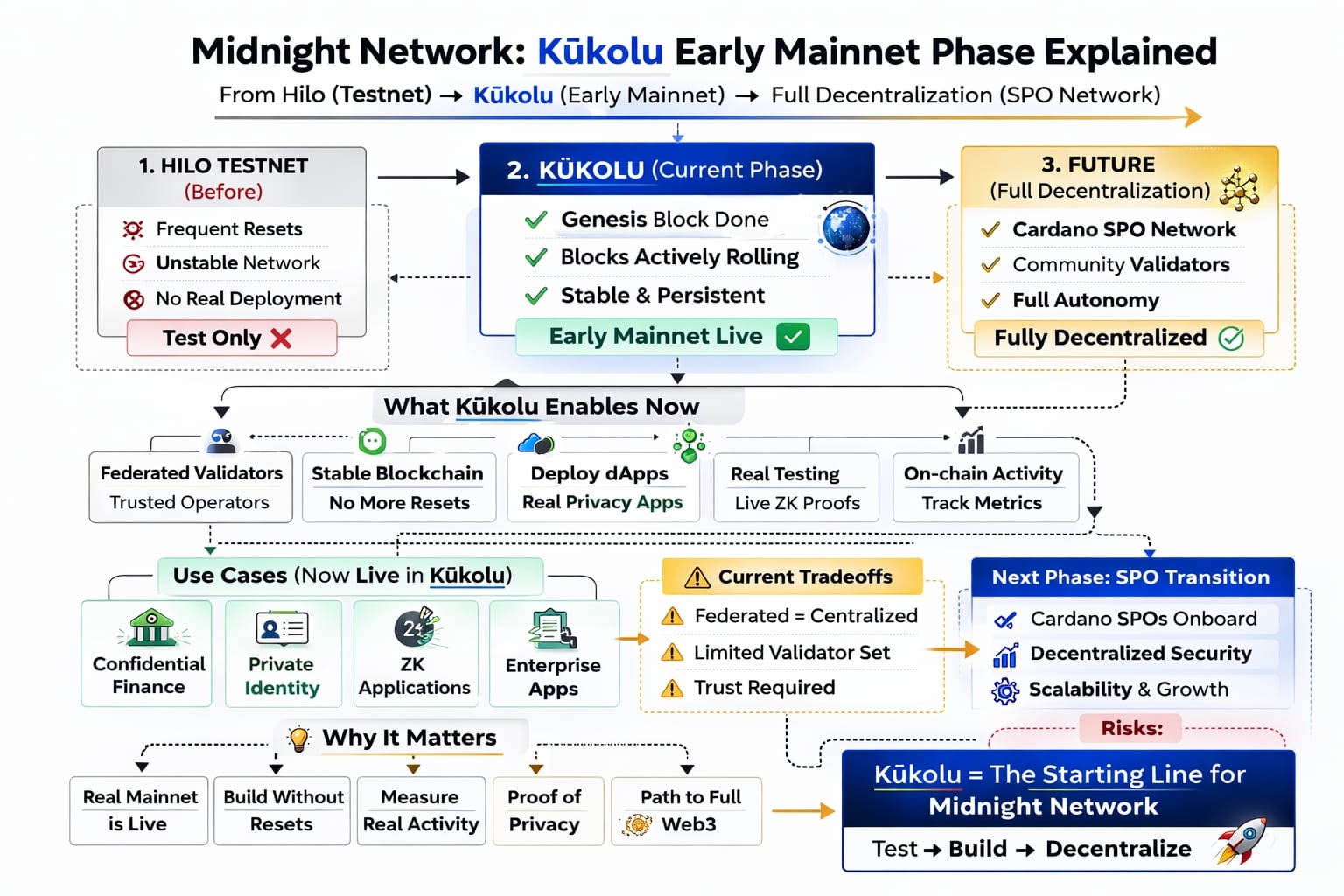 From the latest updates, it seems Kūkolu is where the network moves beyond frequent testnet resets into a more persistent environment. A small set of trusted operators is signing blocks and handling operations. They appear to provide strong security and compliance support, keeping the chain stable under load. They are federated for now, ensuring performance remains predictable before opening to the broader Cardano SPO network.
This stability is the game changer. I think developers can begin experimenting with shielded dApps here, including confidential finance tools and private identity systems, and they have a better chance of staying up. It moves away from the usual testnet limitations where resets interrupt progress. You get to test ZK proofs with more realistic traffic, fix bugs, and show privacy works without everything disappearing. That is why Kūkolu feels like a real starting line. Testnets have historically slowed momentum, especially when resets interrupt meaningful progress. But here, the chain is live, blocks are rolling, and builders can start shipping with more confidence.
It also sets up the rest. On chain activity starts becoming observable. Developer engagement can be tracked more reliably. Funding conversations get stronger when there is verifiable network activity. If your dApp is not at least testing in Kūkolu, you might be missing the phase where people can actually see the network in action. At the same time, it is not perfect. Being federated means relying on a smaller group of operators, reputable but still more centralized compared to thousands of independent SPOs.
There is trust risk in this early phase. Validator concentration increases systemic risk. The transition to full Cardano SPOs, expected after Kūkolu stabilizes, could introduce some friction. Performance might change. Coordination issues may appear. Onboarding could take time. Early dApps could feel that transition if it is not smooth. Still, if executed well, shielded apps could move toward real adoption once full decentralization is reached.
Right now though, Kūkolu looks like a controlled environment to prove Midnight's privacy is not just theoretical. The network appears stable enough for meaningful testing, and that is the foundation for the bigger decentralization step. This phase is where the real building happens.
If you are in CreatorPad or just following, Kūkolu is worth watching closely. It is live, blocks are coming, and resets seem less dominant than before. So, would you risk deploying a shielded dApp here now, or wait for full SPOs? I am curious what people think.
@MidnightNetwork #night $STO $KO $NIGHT