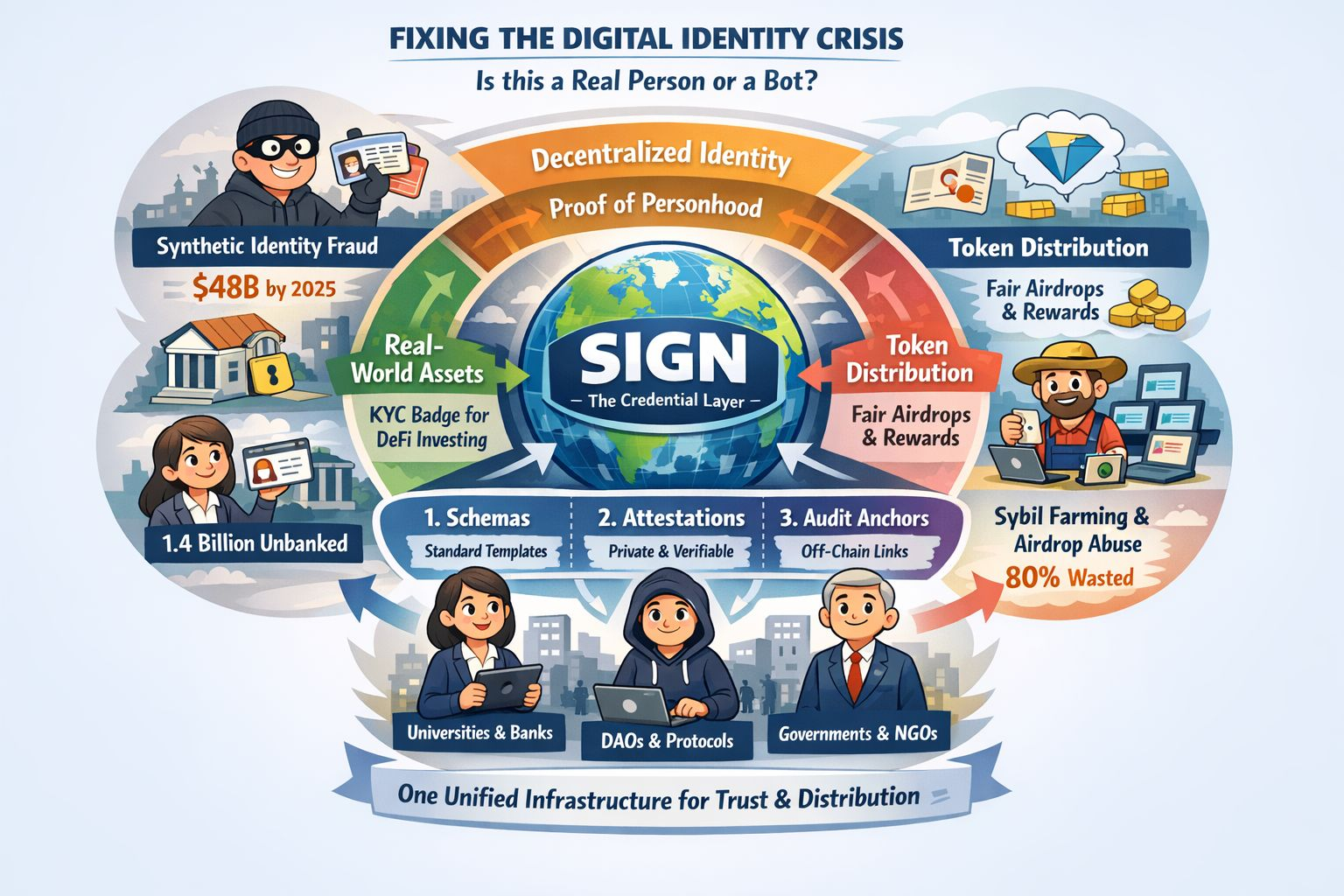
The digital economy has an identity crisis. We've built this incredible global network where value moves at the speed of light, yet we still can't answer the most basic question on the internet: "Is this a real person or a bot?"
The numbers are staggering. Deloitte projects that synthetic identity fraud—where criminals stitch together real and fake information to create phantom people—will hit $48 billion by 2025. The World Bank tells us 1.4 billion adults are locked out of the financial system simply because they lack paperwork to prove who they are. And in crypto, we're burning billions on airdrops that get vacuumed up by sybil farmers running thousands of bots, while real users get pennies. DappRadar estimates over 80% of airdrop value never reaches genuine community members.
Here's the thing: every fix we've tried is just a band-aid. Centralized KYC means handing your passport to some company that'll get hacked eventually. On-chain reputation scores sound great until you realize they're trapped inside one protocol and useless everywhere else. "Proof of humanity" projects either get gamed immediately or ask you to upload your retinal scan to a smart contract. We're building this beautiful cathedral of decentralized finance on a foundation of wet cardboard.
Sound familiar? It should. Back in 2020, every DeFi protocol was doing the same thing—forking Uniswap, building their own governance token, wiring up their own oracles, bridging to Ethereum in the jankiest way possible. It was exciting, sure, but it was also chaos. What finally fixed it? Shared rails. Cosmos showed us what appchains could do. The AggLayer started stitching everything together. We realized nobody needed to rebuild the plumbing in their house; we just needed to turn on the tap.
That's exactly where credentialing and token distribution are right now. And that's why Sign matters.
Sign isn't another KYC startup. It isn't another airdrop tool. It's the shared layer underneath all of it—the global plumbing for proving things about people and distributing value based on what they prove. Think of it as the thin strip of infrastructure that connects Real-World Assets, decentralized identity, and cross-chain token distribution, giving them all a common language for answering "who is this and what are they allowed to do?"
The technical stuff matters, but it's actually pretty elegant. Sign breaks credentials down into three simple pieces. Schemas are just templates—like an ERC-20 standard for attestations. A university can define what a diploma looks like. A DAO can define what "active contributor" means. Everyone else can read that template and understand exactly what it represents. Attestations are the actual stamps—someone saying "yes, this wallet belongs to a person over 18" without ever revealing their birthdate thanks to zero-knowledge proofs. And Audit Anchors ground everything in reality, linking on-chain credentials to off-chain legal documents or professional licenses so we're not just trusting code, we're trusting code connected to the real world.
They even built SignScan, which is exactly what it sounds like—Etherscan for credentials. You can watch an attestation get created, see who signed it, trace where it's been used. It makes the invisible infrastructure suddenly visible.
Here's where it gets interesting. Because Sign sits underneath everything, it powers three completely different systems at once.
First, Real-World Assets. Say you want to invest in tokenized Treasuries, but regulators require you to be an accredited investor. Today, that means getting whitelisted by every single protocol—a massive friction point. With Sign, you get one credential proving your accredited status. Any RWA protocol that trusts that credential can let you in instantly. Circle could issue a "KYC'd" badge, and suddenly every compliant DeFi app becomes accessible with a single click. That's not just convenient; that's structural.
Second, governance and identity. DAOs right now are either plutocracies where whales control everything or free-for-alls where bots drown out real voices. Sign lets DAOs issue participation credentials based on meaningful contribution, verified privately. Uniswap could delegate voting power to real users without doxxing anyone. No more sybil attacks, no more privacy violations.
Third, token distribution. This is the one that keeps me up at night—in a good way. Imagine if instead of every L2 building its own sybil detection from scratch, there was simply a "Sign Unique Personhood" attestation you could carry from chain to chain. When zkSync or Starknet wants to reward real users, they check for that badge. The $48 billion airdrop problem becomes a solved problem. Distribution shifts from messy one-off events to continuous, structural ecosystem building.
Look, I'm not going to pretend this is easy. Sign has three massive mountains to climb.
Coordination is the first one. Infrastructure is worthless without a network, and networks are hard to bootstrap. Sign needs universities, governments, corporations, and crypto protocols all to agree to play in the same sandbox. That's a business development marathon, not a sprint.
The tech trilemma is second. Privacy, verifiability, and cost don't play nice together. Zero-knowledge proofs are expensive. On-chain storage is expensive. Balancing all three while keeping the system secure and scalable is genuinely hard engineering.
And then there's regulation. Credentials touch GDPR, CCPA, securities laws, identity laws. Sign has to navigate this minefield without becoming centralized or permissioned, which is like trying to cross a border checkpoint while insisting you don't have a passport.
But here's the question that matters. The one that makes you stop scrolling and think:
If the United Nations decided to issue digital identity credentials to every refugee using Sign's infrastructure—proving who they are, what they're entitled to, where they can access services—what happens to every proprietary KYC silo being built right now?
They vanish. They become irrelevant. Because the infrastructure layer ate their lunch. Value doesn't accrue to the applications anymore; it accrues to the shared layer connecting them all. That's not a speculative thesis. That's a structural one.
The identity space is littered with ambitious projects that tried to build the killer app before anyone built the road. Sign is building the road. It's laying down the global rails for portable credentials, private verification, and precise distribution. This isn't about a token pumping. It's about how trust will work in the 21st century.
We're done patching leaks. It's time to build the foundation.