
 Over the past few months I’ve been digging deeper into identity infrastructure in Web3, and one project that keeps showing up in serious discussions is Sign Protocol and its ecosystem, including Sign Global. Most people associate crypto with trading tokens, but the real long-term value might come from verifiable data layers that governments and institutions can actually use.
One interesting angle is the potential connection between verifiable credentials and cross-border CBDC (Central Bank Digital Currency) systems.
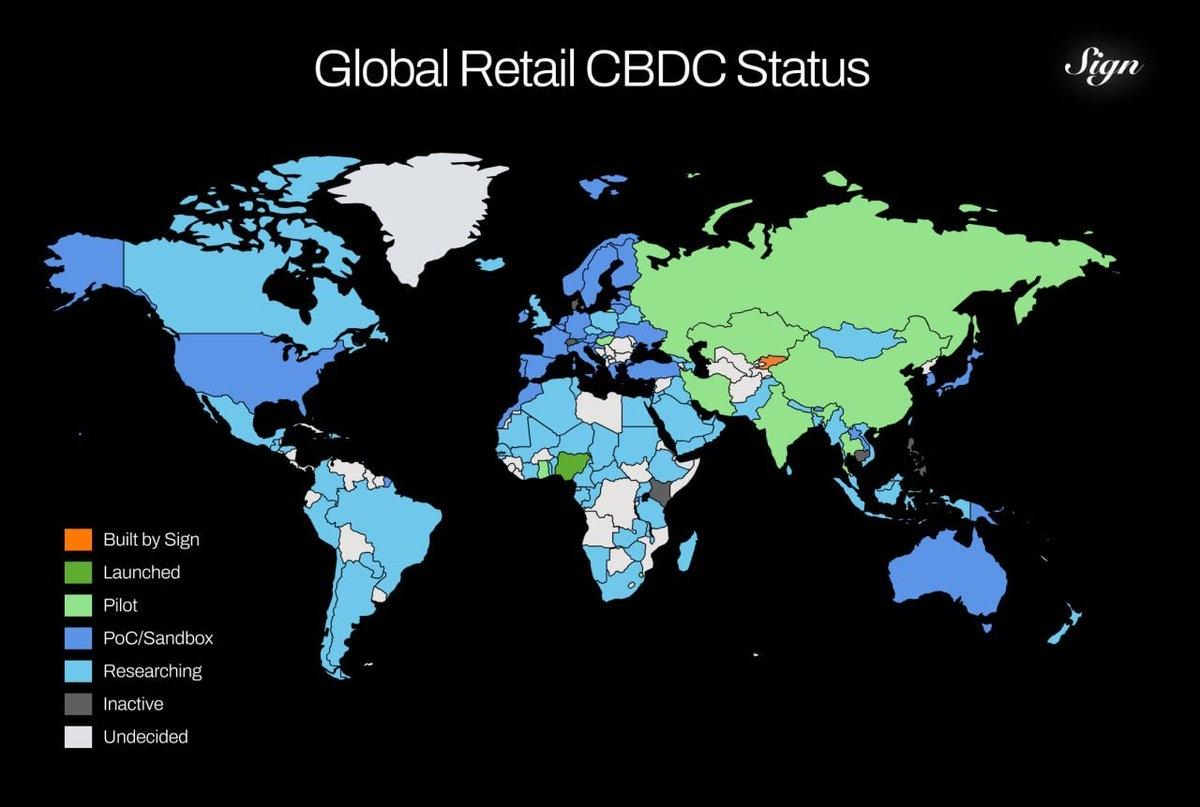
Right now, many countries are experimenting with CBDCs. According to the Bank for International Settlements, over 90% of central banks are studying or piloting digital currencies. But there’s a huge technical issue: identity verification and trust between jurisdictions.
When a payment moves between two CBDC systems, both sides need to verify that the entities involved are legitimate without exposing unnecessary personal data. This is where credential infrastructure becomes extremely important.
The architecture behind Sign Protocol focuses on on-chain attestations. In simple terms, an attestation is a cryptographic statement proving that a specific claim is valid. For example, an authority could confirm that a wallet belongs to a licensed financial institution, a verified citizen, or a compliant payment provider.
Instead of storing sensitive identity data directly on-chain, the system stores verifiable proofs. These proofs can be checked instantly without revealing private information. That’s a big deal for regulatory compliance.
If institutions building CBDC rails adopted attestation frameworks like this, cross-border transactions could become far smoother. Imagine a payment moving between two national digital currencies. Rather than repeating expensive KYC verification every time, the system could reference an existing verifiable credential issued by a trusted authority.
Another reason I’m watching this space closely is scalability of trust. Governments and financial networks typically require layers of verification: banks, regulators, payment processors. With a decentralized attestation layer, those roles could issue credentials that any compliant system can verify.
Projects like World Economic Forum have also discussed digital identity frameworks as a core requirement for future financial infrastructure. Without trusted identity layers, cross-border digital money becomes extremely difficult to regulate safely.
From my perspective as someone active on Binance Square, I see Sign’s model fitting into three major future use cases:
1. Cross border CBDC interoperability through verifiable institutional credentials
2. Compliance friendly DeFi, where protocols can verify regulated participants
3. On-chain reputation systems for users, DAOs, and builders
Of course, adoption won’t happen overnight. Governments move slowly, and infrastructure upgrades can take years. But the direction seems clear: digital currencies will require portable identity and trust verification.
That’s why infrastructure projects like @SignOfficial Protocol matter. They’re not just building another token narrative. They’re trying to solve the trust layer of the digital economy.
Personally, I think the next big crypto cycle won’t be driven only by speculation. It will be driven by real infrastructure connecting Web3 with global financial systems and verifiable credential networks could play a central role in that transition. 🚀 #SignDigitalSovereignInfra $SIGN