
@Fabric Foundation #robo $ROBO
The core of your argument is the transition from Speculative Hype to Operational Utility. Here is a refined version of that narrative:
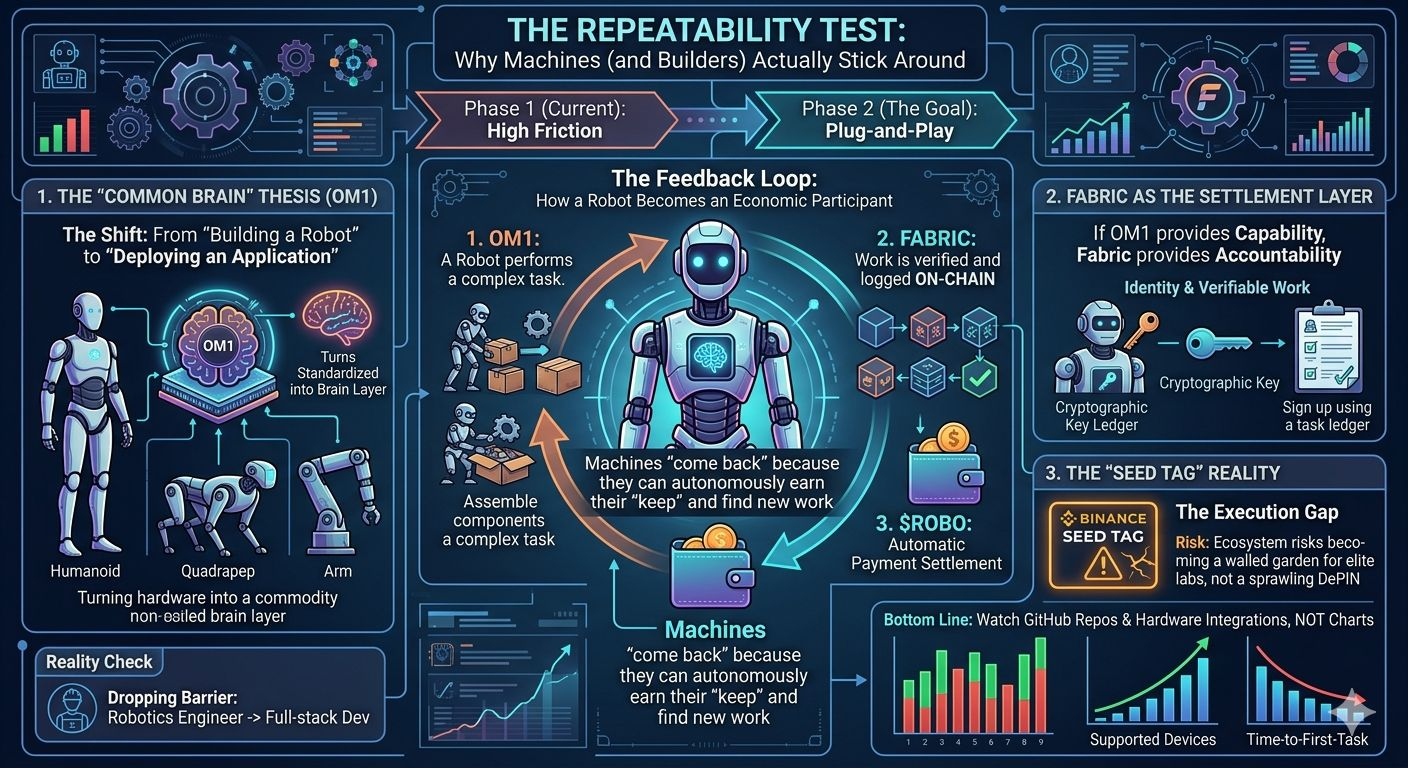
✨1. The "Common Brain" Thesis (OM1)
The biggest hurdle in robotics is not building a robot,it is making it do something else the next day without a total software rewrite. By positioning OM1 as a standardized "brain layer," the goal is to turn hardware into a commodity.
The Shift: If OM1 successfully abstracts movement, sensing, and planning into modules, a developer isn't "building a robot" they are "deploying an application" to a machine.
The Reality Check: As you noted, the "builder-heavy" nature is a bottleneck. For this to work, the barrier to entry has to drop from "Robotics Engineer" to "Full-stack Dev."
✨2. Fabric as the Settlement Layer
If OM1 provides the capability, Fabric provides the accountability. This is where $ROBO moves from a "pump coin" to a functional tool:
Identity & Verifiable Work: A robot needs a cryptographic identity to be "hired."
The Loop: A machine performs a task (via OM1) \rightarrow The work is verified on-chain (via Fabric) \rightarrow Payment is settled (ROBO).
The Retention Hook: Machines "come back" because the system provides a frictionless way to monetize idle hardware. If a robot can autonomously earn its own "keep," it becomes a permanent participant in the economy.
✨3. The "Seed Tag" Reality
The Binance Seed Tag is a sobering reminder of the Execution Gap.
Narrative vs. Infrastructure: The market can price in "the future of robotics" in an afternoon, but it takes years to iron out hardware dependencies and config files.
The Risk: If the setup remains too "messy," the ecosystem risks becoming a walled garden for a few elite labs rather than a sprawling decentralized physical infrastructure (DePIN).
The Refined Narrative: "The Repeatability Test"
"The real question isn't whether a robot can perform a task today it is whether that machine can autonomously return to the network tomorrow to find another one."
If we look at Fabric and OM1 through this lens, the "bet" isn't on a token price; it's on reduction of friction.
Phase 1 (Current): High friction, dev-heavy, hardware-specific.
Phase 2 (The Goal): Plug-and-play OM1 modules where ROBO handles the "boring" stuff (identity, logs, payments) so the builder can focus on the "cool" stuff (the task).
Bottom Line: We should stop watching the charts and start watching the GitHub repos and hardware integrations. If the number of supported devices grows and the "time-to-first task" for a new dev drops, the usage will eventually force the market's hand. If it stays a complex science project, the hype will eventually find a new home.
Does this framing help bridge the gap between your skepticism and the technical potential you're seeing?