
The other day I was sitting in the dark after iftar, scrolling mindlessly, the kind of quiet where you notice how loud your own thoughts are. Something felt off about how we treat blockchain like it's inherently open and honest, as if every transaction being visible to everyone is the only way to prove trust. We've repeated it so long it feels like gospel: transparency equals security. But the more I sit with it, the more it starts to feel like a half-truth we tell ourselves to avoid harder questions.
Earlier tonight I was on Binance Square doing the CreatorPad task for Midnight Network—clicking through the prompts, typing out a quick take on their privacy setup, watching the progress bar fill as I submitted the post. It was nothing complicated, just the usual campaign steps: read the brief, share a thought, tag the project. But midway, when I had to highlight what "rational privacy" actually means—selective disclosure via zero-knowledge proofs, not blanket hiding—I paused. The screen showed that clean diagram of public vs shielded states, and it hit me differently this time. Here we are, rewarding people to talk about a network that deliberately lets you hide parts of your data while still proving things are valid. And we're doing it on a platform built on total openness.
That's when the discomfort settled in. The common belief is that privacy in crypto is either all-in (like old privacy coins that feel shady) or nonexistent (because transparency is king). But Midnight forces you to confront that maybe we've been wrong to treat transparency as sacred. What if forcing everything into the open isn't trust—it's actually a vulnerability? Real-world life doesn't work that way. You don't hand your full medical history to a pharmacist just to get a prescription filled; you prove you need it without spilling everything. Why should on-chain interactions be any different? The idea that privacy is somehow anti-crypto, or only for criminals, starts to crack when you see a system designed to let developers decide exactly what gets revealed and to whom. It's not evasion—it's control. And admitting that challenges the foundation we've built so much of the space on.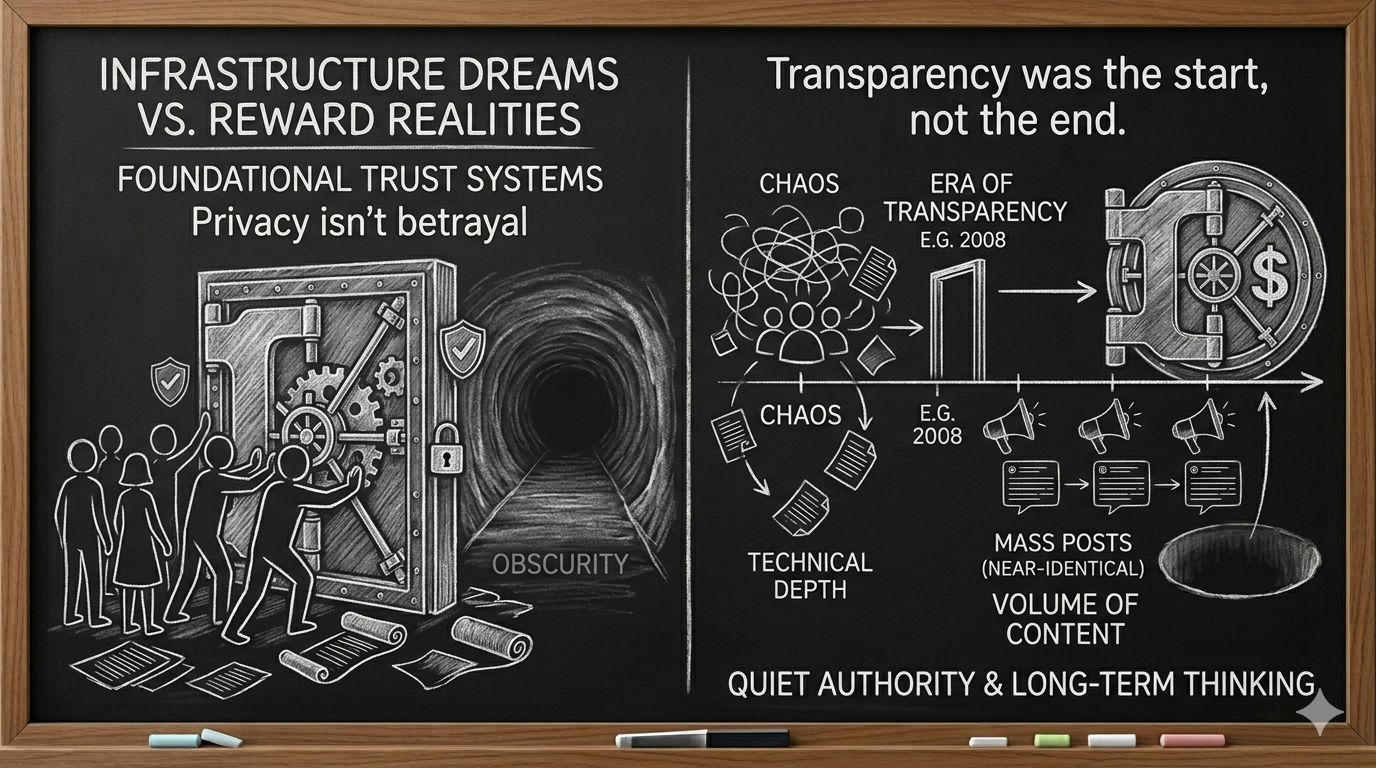
Midnight is the clearest example I've run into lately. It's not promising total anonymity; it's offering programmable privacy—zero-knowledge tools that verify without exposing. That one moment in the CreatorPad interface, staring at the term "shielded execution" while knowing the whole campaign lives in public view, made the contradiction sharp. We're publicly celebrating something that says maybe full exposure isn't always the virtue we claim.
So now I keep coming back to one thing: if privacy can be rational and selective, why have we spent years acting like anything less than full transparency is a betrayal of the ethos? What if the real risk isn't hidden data—it's pretending we don't need the option to hide it in the first place? #night $NIGHT @MidnightNetwork