

Jesse Livermore’s trading philosophy is a paradox: it is intellectually simple but emotionally brutal. To follow these rules, you must effectively go against every human instinct for self-preservation and pride.
Below are his 12 rules, followed by a breakdown of the technical "Accumulation Cylinder" depicted.
Part 1: The 12 Commandments of Speculation Expanded
1. Stop Adding to Losing Trades
In retail trading, this is called "averaging down." In professional speculation, it is called "suicide." If a stock drops after you buy it, the market is telling you your timing or your thesis is wrong. Adding more capital only increases your exposure to an error.
2. Always Have an Exit Plan
The moment you enter a trade, you are biased. Your "logical" brain shuts off and your "emotional" brain takes over. You must set your stop-loss while you are still objective (before the trade) so you don't have to negotiate with yourself while losing money.
3. Kill Your Losses Fast
Livermore believed in the "10% Rule"—never let a loss exceed 10%. A 10% loss requires an 11% gain to recover. A 50% loss requires a 100% gain just to get back to zero. Mathematically, slow exits are the primary cause of account blowouts.
4. Let Your Winners Ride
Human nature wants to "lock in" a small profit to feel the dopamine hit of a "win." But big wealth is built on the "Power Law": a few massive trades must pay for all your small, frequent losses. If you cut your winners short, you'll never cover your overhead.
5. Wait for the Market to Prove You Right
Don't anticipate; react. Being "too early" is the same thing as being wrong in the market. Wait for the price action to confirm your bias before committing capital.
6. Hope is a Death Sentence
When a trader says, "I hope it bounces," they have transitioned from an investor to a victim. Hope clouds judgment and prevents you from taking the necessary action to protect your remaining capital.
7. Don't Bet the Farm
Position sizing is more important than stock picking. Even with an 80% success rate, if you bet 100% of your port on every trade, you will eventually hit a 20% outlier that zeros you out.
8. Don't Fight the Trend
The market is a river. You can row against it and exhaust yourself, or you can turn the boat around and let the current do the work. The trend is the path of least resistance.
9. Sit on Your Hands
Livermore famously said, "It was never my thinking that made the big money for me. It was always my sitting." Once you are in a winning position, the most professional thing you can do is resist the urge to tinker with it.
10. When in Doubt, Stay Out
Cash is a position. If the market is volatile, sideways, or confusing, the smartest "trade" is to stay on the sidelines. You don't pay commissions on trades you don't make.
11. Only Go Bigger When You're Winning
"Pyramiding" is the secret of the greats. You start with a small "pilot" position. If it shows a profit, you add more. You are using the market's money to finance your increased risk.
12. Guard Your Cash
Your capital is your inventory. A store owner who runs out of inventory goes out of business. A trader who runs out of cash is no longer a trader—they are an observer.
Part 2: Breakdown of the "Accumulation Cylinder"
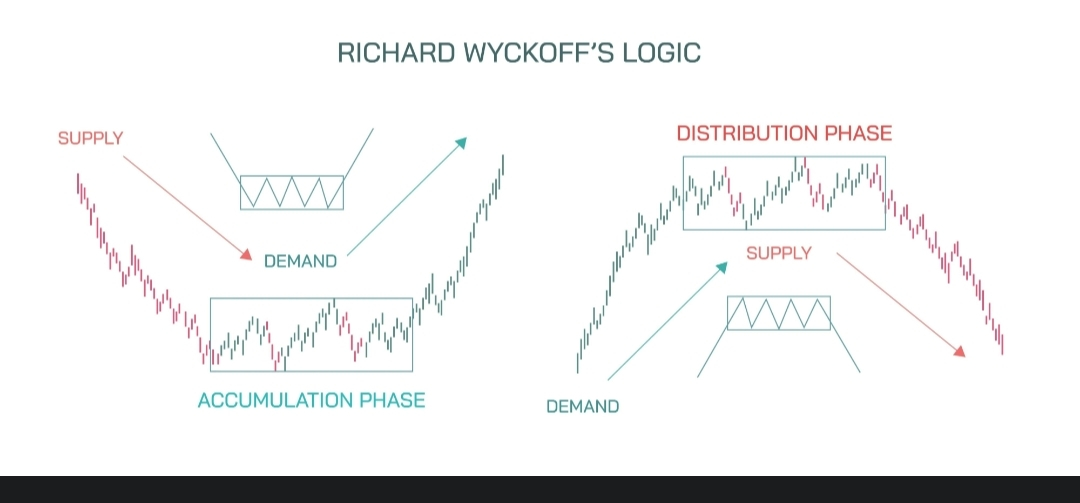
The chart in the image illustrates a classic Livermore Accumulation Cylinder (often associated with Wyckoff Theory). It tracks the transition of a stock from "weak hands" to "strong hands."
Phase 1: The Foundation (Points 1–7)
* The Cylinder: Note the diagonal trendlines forming a "widening mouth" or a channel. This is where big institutional players are quietly buying.
* Support & Resistance: The price bounces between $50 and $65. Each time it hits the bottom, "Accumulation" occurs.
* The Shakeout: Points 5 and 7 represent "higher lows." This shows that despite selling pressure, buyers are stepping in earlier and earlier, tightening the supply.
Phase 2: The Mark-Up (Points 8–10)
* The Breakout: Once the "Cylinder" is full (supply is exhausted), the price shoots up past $65.
* Point 9: This is the "Climax." The price hits $90. Notice the volume (indicated by '+' signs at the bottom) increases as the price rises—this is the sign of a healthy trend.
Phase 3: The "Normal" vs. "Abnormal" Reaction (Points 11–14)
Point 11: The first pullback. If volume is low on the drop, it’s a "Normal Reaction." But the notes say "VOLUME + / PRICE - / REACTION ABNORMAL!" The Warning: This means big players are starting to dump shares (Distribution).
* Point 12 & 13: The "Test." The stock tries to rally back to $86 but fails to make a new high. This is the Lower High.
* Point 14: The "Break of Support." The price plunges to $72 on massive volume (+++). The "Accumulation" has turned into "Distribution," and the trend is officially dead.
The Lesson of the Chart
The note at the top right, "TEST BEFORE SELLING SHORT," is the most critical. Livermore didn't short at the very top (Point 10); he waited for the "Abnormal Reaction" at Point 11 and the failed rally at Point 12 to prove the bears were now in control.
#tradingpsychology #JesseLivermore #StockMarketSecrets #RiskManagement #FinancialFreedom


