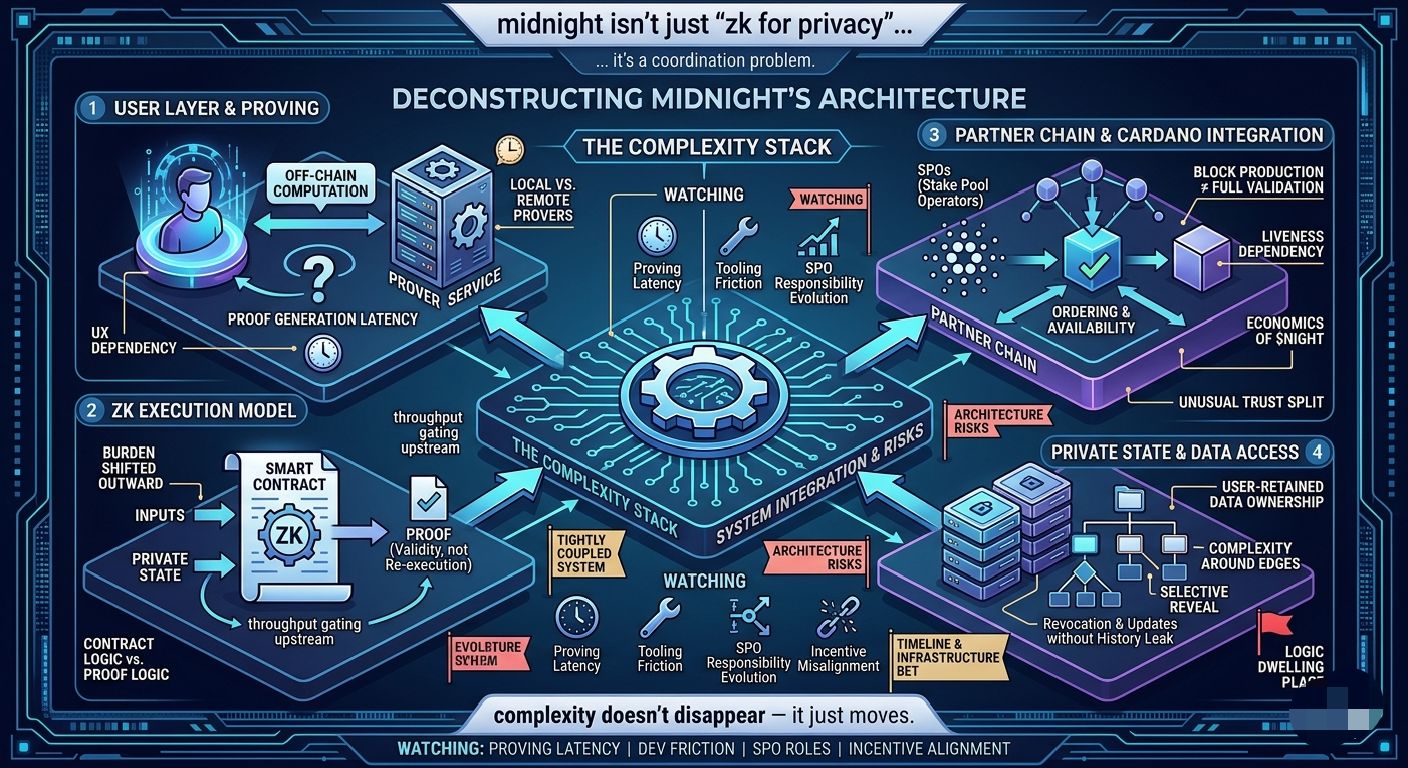
was digging into midnight’s architecture again last night, mostly trying to understand where $NIGHT actually sits in the system… and i keep coming back to the same feeling: people are compressing this design into something way simpler than it is.
the common narrative is clean — zk proofs give you private smart contracts, cardano gives you security, and the rest just kind of works.
but that framing hides most of the moving parts.
because midnight isn’t just a chain with zk bolted on. it’s splitting responsibilities across layers that don’t fully trust each other, and then hoping the interfaces between them hold up.
first piece is the zk execution model itself.
contracts don’t execute in the usual “everyone replays everything” sense. instead, you compute off-chain, generate a proof, and submit that proof for verification. the chain only checks validity, not the full computation path.
that’s efficient… but also shifts burden outward. proving becomes the real work. if generating a proof takes seconds (or worse), then “throughput” at the chain level doesn’t mean much. you’re gated upstream.
and i’m not totally clear yet how they expect this to feel in practice. are users running provers locally? are there specialized prover services? if it’s the latter, then you quietly introduce a new dependency — not consensus-critical, but definitely UX-critical.
second is the partner chain / cardano integration.
people keep reducing it to “SPOs produce blocks for midnight,” which is true but incomplete. block production ≠ full validation in a zk system. the validity is in the proof, not in the re-execution.
so SPOs are more like ordering + availability providers than traditional validators.
and here’s the thing… that creates an unusual trust split. correctness depends on zk circuits and proof systems. liveness depends on SPOs. economics depend on how $NIGHT incentives map onto that structure.
i’m not sure those layers are fully aligned yet.
third piece is private state and data access.
midnight leans into the idea that users retain ownership of their data, selectively revealing it when needed. which sounds right, but the implementation details matter a lot here.
like, imagine a simple case: a user proves they’re eligible for some financial product without revealing income details. that’s fine at the proof level. but now think about revocation, updates, or disputes. where does that logic live? how do you “undo” or evolve a private state without leaking history?
these systems tend to accumulate complexity around edges, not the core.
what i don’t see discussed enough is how tightly coupled all of this is.
zk circuits define what’s provable. prover infrastructure defines what’s practical. the chain defines what’s accepted. and cardano defines when things get finalized.
if any one of those lags, the whole system degrades in weird ways. not catastrophic failure, just… friction.
and there are assumptions baked in.
that zk tooling will become developer-friendly enough
that proving costs will drop or be abstracted away
that users are willing to manage keys tied to private state
that external validators (SPOs) don’t need deeper visibility into execution
none of these are guaranteed. they’re trends, maybe.
the timeline question sits in the background too. a lot of this design feels like it’s anticipating where zk infra will be, not where it is today. which is fine, but it means early versions might feel constrained or awkward.
and there’s some architectural risk in locking patterns too early — especially around circuits and state models. changing those later isn’t trivial.
i guess where i’ve landed (for now) is that midnight makes a strong bet: that privacy-first execution is worth the added system complexity.
maybe it is. but complexity doesn’t disappear — it just moves.
watching:
* how proving latency behaves under real workloads (not demos)
* whether devs can actually ship non-trivial zk contracts without friction
* how responsibilities between SPOs and proof systems evolve over time
* what breaks first: ux, tooling, or economic incentives
still trying to figure out if this architecture simplifies anything… or just rearranges the hard parts into less visible places.#midnight @MidnightNetwork $NIGHT