
Alright so, I'm just read @SignOfficial their full publisher reference architecture for S.I.G.N. deployments and honestly? This thing is built different. Like most crypto projects drop a whitepaper full of buzzwords and call it a day. Sign dropped an actual engineering document. the kind governments and central banks actually read before signing contracts. let me break it down 👇👇👇👇👇
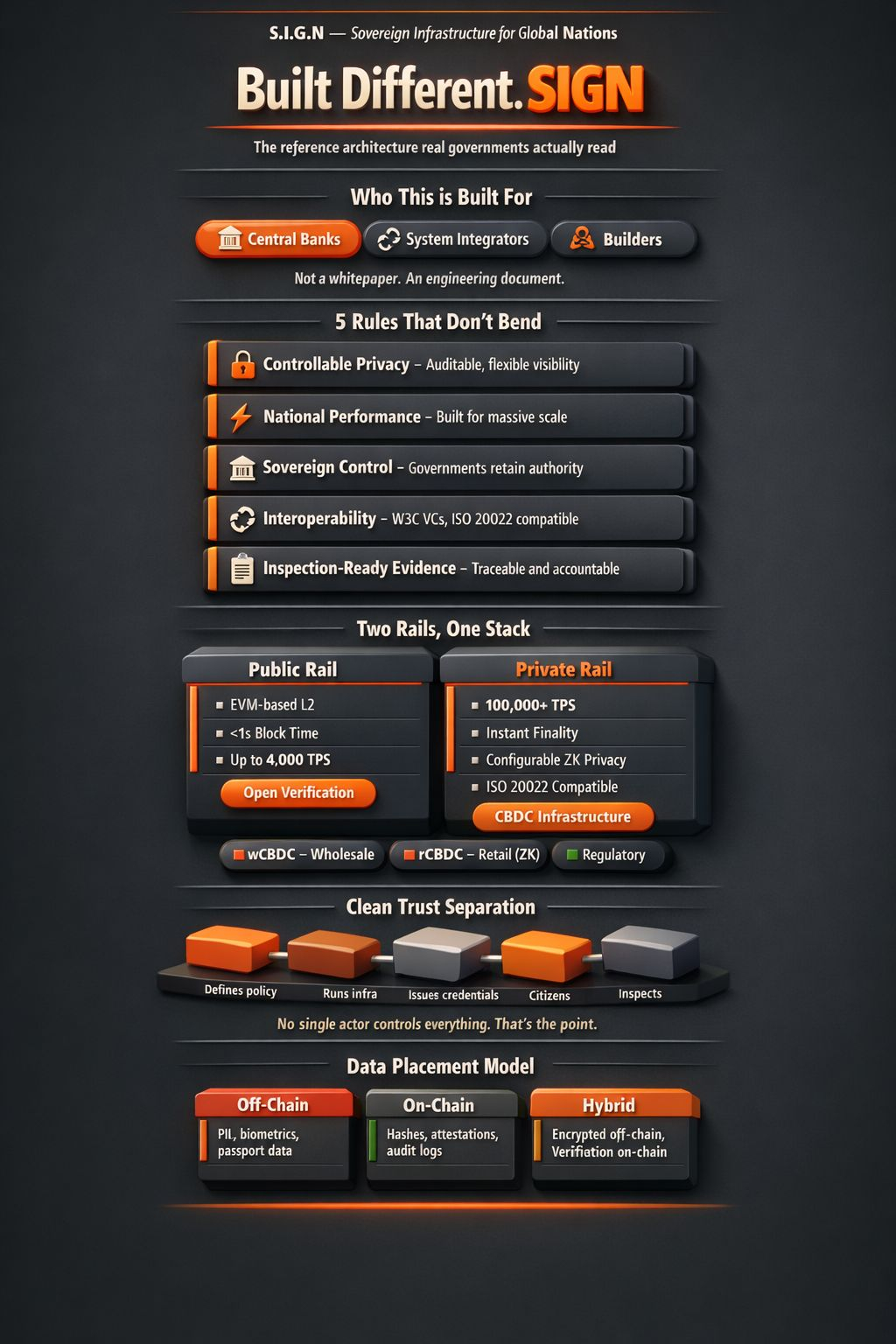
Sovereign operators, central bank infra teams, system integrators, banks, telcos, and identity vendors. Basically the people who actually run countries and the fact that Sign is talkin directly to those people tells u everything about where this project is positioned.
Five Rules That Don't Bend
Sign built the whole thing around 5 non-negotiables:
Controllable privacy — not full privacy, not zero privacy. private to the public, auditable to lawful authorities, minimal disclosure by default. exactly what regulators actually want.
National performance — built for millions of users, strict SLAs. a system that crashes when 10 million people access their benefits at once ain't sovereign infrastructure, it's a liability.
Sovereign control — key custody, upgrades, emergency controls all stay under sovereign governance. Sign doesn't take the wheel from governments, they just give em a better car.
Interoperability — W3C Verifiable Credentials, ISO 20022 compatible payments, works with both public and private rails. not a walled garden, something that plugs into what already exists.
Inspection - ready evidence for every action recorded. who authorized what, when, under which authority, with what rule version. the audit trail regulators and central banks actually need
Two Rails Running Simultaneously
Public rail is EVM-based L2, sub-1-second block time, up to 4,000 TPS. for public finance transparency and open verification. Private rail is the CBDC infrastructure just 100,000+ TPS, immediate finality, configurable ZK privacy, ISO 20022 compatible.
Separate namespaces for wholesale CBDC, retail CBDC with high privacy, and a regulatory namespace, different visibility levels for different actors within the same system.
Why This Actually Matters for $SIGN
Most projects claim to build for gov's then show u a testnet demo. Sign published a reference architecture that a central bank engineer can actually read, evaluate, and implement the data placement model alone — what goes off-chain (PII, biometrics), what goes on-chain (hashes, attestations, audit trails), and the hybrid patterns — that's real infrastructure thinking from people who've actually worked with regulators.
With live deployments in UAE, Sierra Leone, Kyrgyzstan, and Thailand got 50M+ users, $2B+ in transactions. This reference architecture isn't aspirational. it's documentation for what's already running architecture is policy. Sign just published the policy manual
Clean Trust Separatrust
This is where most blockchain projects mess up. $SIGN separates everything explicitly — Sovereign Authority defines rules and owns governance keys. Operators run infra but can't control policy. Issuers issue credentials registered in a trust registry. Holders are citizens with non-custodial wallets. Auditors can inspect evidence. no single actor can do everything. that's how u build something governments actually trust.
Forgetin about $SIREN and the infrastructure to actually prove insider trading on-chain exists. it just ain't deployed yet.
Sign building the receipts layer fr
Disclaimer: Analysis based on public documentation. Always DYOR #SignDigitalSovereignInfra