
I remember helping a friend register a small online business. The idea was clear and promising, but the process behind it felt unnecessarily complicated. The same documents had to be submitted more than once, approvals stretched over weeks, and at every step there was this quiet uncertainty about whether things would move forward or get rejected without a clear reason.
At the time, it felt normal. In many places, especially where bureaucracy still shapes how systems operate, delays are almost expected. But the more I thought about it, the more I realized the issue wasn’t just slow processes or outdated systems. It was something more fundamental.
There was no shared layer of trust.
Each department had to verify the same information on its own, not because it wanted to, but because it had no reliable way to trust what another department had already approved. So the same checks kept repeating. What looked like inefficiency from the outside was actually a structural problem on the inside.
That realization changed how I started looking at infrastructure, especially in crypto. I stopped focusing only on speed or efficiency and began paying attention to something deeper. In most real-world systems, delays don’t come from a lack of technology. They come from a lack of coordination, and coordination only works when information can be trusted without being checked again and again.
Once you see it that way, a different kind of question starts to matter. What if a government could issue a credential once, and that credential could be instantly verified anywhere without manual checks or repeated validation?
That shift in thinking is what made Sign interesting to me. Not because it promises faster transactions or follows a popular narrative, but because it challenges the foundation itself. Instead of trying to improve broken processes, it focuses on the trust layer those processes depend on.

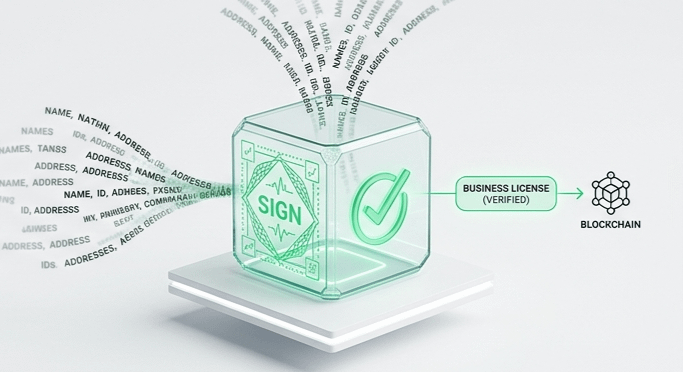
In simple terms, Sign allows credentials to be issued and verified on-chain while keeping sensitive data protected. Instead of exposing full information, it uses cryptographic proofs so that authenticity can be confirmed without revealing everything behind it. A government or authority can issue something like a business license, anchor it on-chain, and others can verify it instantly without having to restart the entire verification process.
What this really does is turn fragmented systems into connected ones. It replaces repeated verification with shared certainty and allows interactions to continue instead of constantly starting over.
This becomes very real in areas like business licensing. Many startups don’t struggle because their ideas are weak. They lose time proving legitimacy across different systems. Every new interaction feels like a reset, and over time that slows growth and limits what they can achieve.
If you zoom out, this becomes even more important in regions where digital growth is accelerating and cross-border activity is increasing. As systems expand, inefficiencies don’t stay the same, they multiply. Without a unified way to trust information, coordination becomes harder, not easier.
A shared credential layer changes that dynamic. It allows different systems to rely on the same source of truth without needing to verify everything from scratch. That doesn’t just reduce delays, it changes how quickly things can move at a larger scale.
There is already some early attention around this kind of infrastructure. Discussions are growing and interest is spreading, but attention by itself doesn’t prove much. The real test is whether these credentials are actually being used again and again in real situations.
If a credential is issued once and then forgotten, the system doesn’t create real value. Its strength comes from repetition. The more it is used across different interactions, the more useful it becomes. Without that repeated usage, even a well-designed system remains underutilized.
This is where things become clear. The question is not whether the technology works in theory. It is whether institutions trust it enough to rely on it consistently. Trust is not built through announcements or short-term activity. It builds slowly through repeated use in everyday interactions.
The signals that matter are simple but important. Are credentials being issued regularly by recognized authorities? Are they being reused across different platforms? Are they becoming part of actual workflows instead of isolated experiments? These are the things that show whether something is becoming real infrastructure or just staying an idea.
Because in the end, infrastructure is not defined by how advanced it is. It is defined by how often it is used.

A business license that can be verified instantly across borders is not just a technical improvement. It changes how quickly systems can operate and how easily different parts of the economy can connect with each other.
And in most cases, the difference between something that sounds good and something that actually matters comes down to consistency. The systems that have real impact are not the ones people talk about occasionally. They are the ones people use so often that they stop thinking about them altogether.
#US5DayHalt #freedomofmoney #iOSSecurityUpdate
