
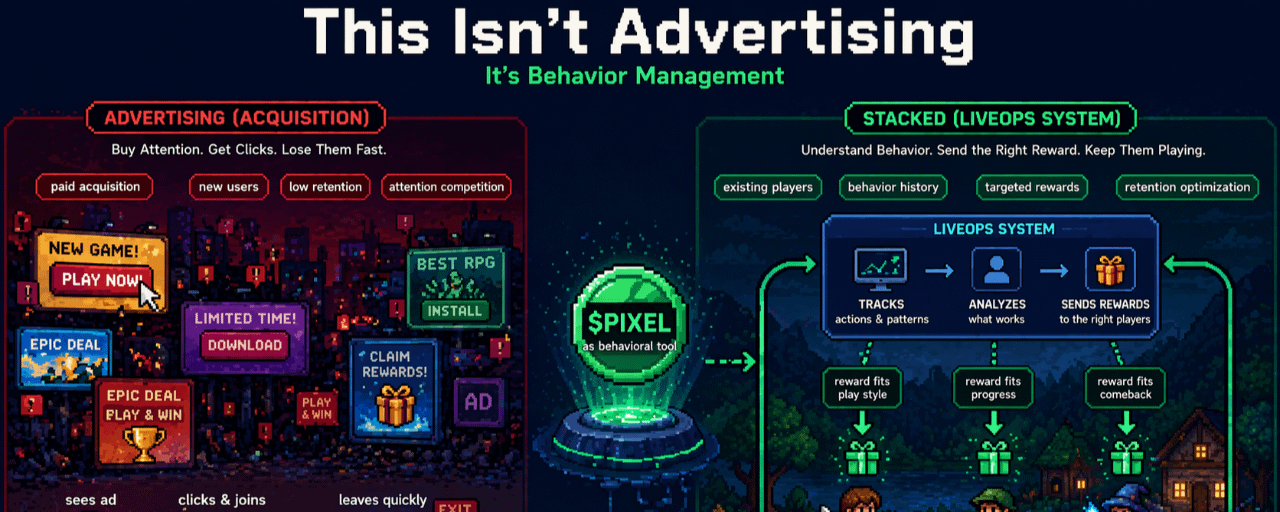
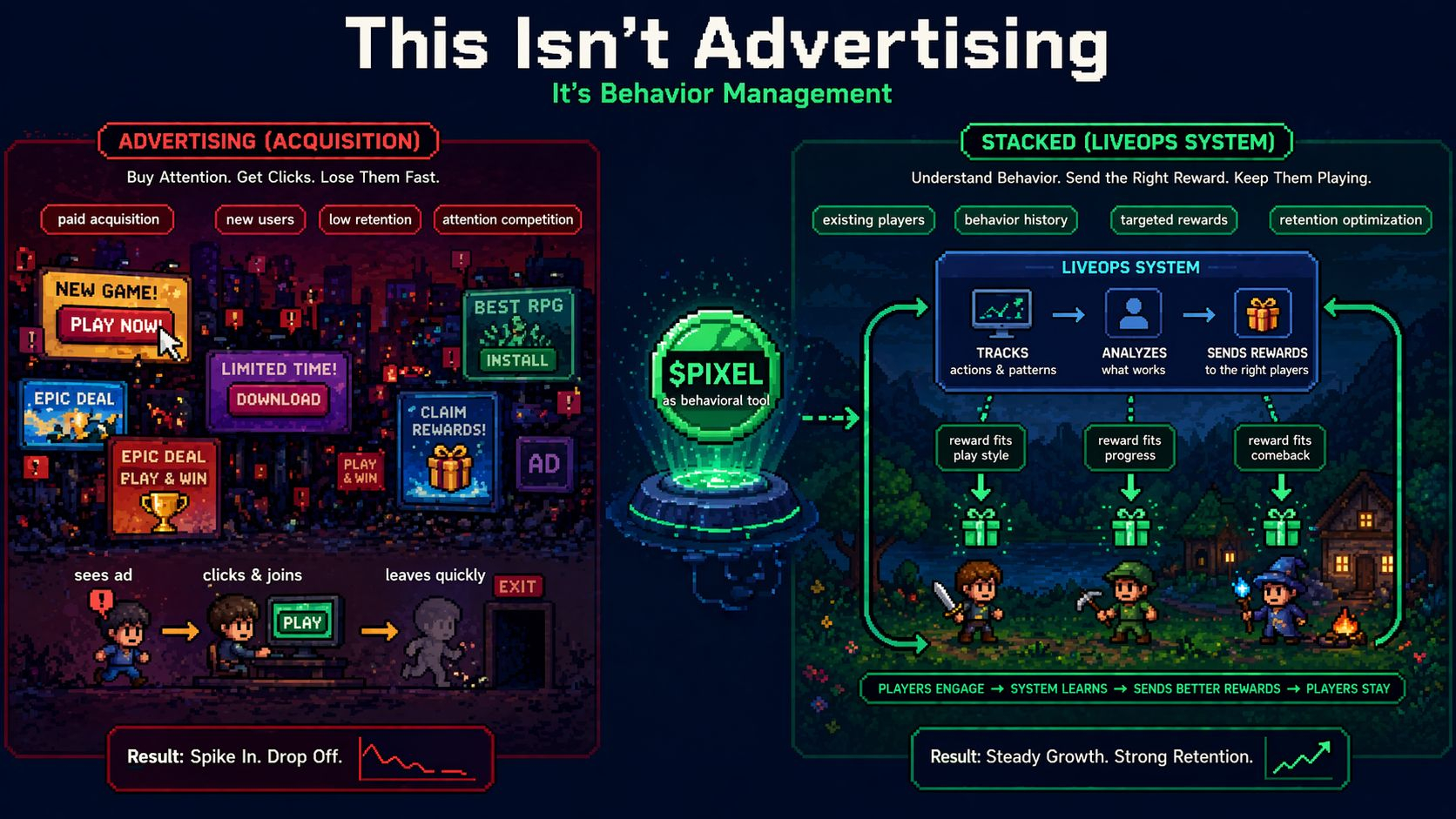
I kept seeing people talk about Stacked like it’s some kind of smarter user acquisition tool, and at first I didn’t question it much. It kind of looks like that from the outside. You spend something, players engage more, numbers go up. Easy to group it with ads or paid installs.
But the more I sat with how it actually works inside the Pixels ecosystem, the less that comparison made sense.
What changed for me was realizing that Stacked isn’t really about bringing new players in. It’s working on players who are already there. That sounds obvious when you say it like that, but it shifts the whole frame. Instead of competing for attention in some noisy ad network, it’s operating inside an environment where behavior is already known, where players have history.
And that’s probably the key difference. Ads try to create a relationship. LiveOps, or whatever you want to call what Stacked is doing, is more about managing a relationship that already exists.
When I think about it that way, the whole “reward campaign” idea feels different too. If you use rewards to attract new users, it’s basically just another form of paid acquisition. You give something, people show up, and a lot of them leave once the reward is gone. We’ve seen that pattern too many times in Web3 already.
But if rewards are used on players who are already engaged, it becomes more like a nudge. Timing matters more than size. Context matters more than volume. It’s less about giving out as much as possible and more about giving the right thing at the right moment.
That’s where the AI game economist part starts to make more sense to me. Not as some abstract AI layer, but as something that reads behavior over time and reacts to it. Without that history, rewards are just noise. With it, they become targeted interventions, which is a very different role.
And this is also where I started seeing PIXEL a bit differently. If Stacked is really operating like this, then the token isn’t just there to be distributed widely. It’s being used in very specific situations, tied to player behavior, tied to retention, maybe even tied to spending patterns.
So instead of thinking “how many people hold PIXEL”, I catch myself thinking more about how it’s being used. Who gets it, when, and why. That feels closer to the core of its value in this system.
It also makes the whole revenue narrative around Stacked a bit clearer. If that assisted revenue is coming from existing players staying longer or engaging more, then it’s not growth in the usual sense. It’s depth. And depth behaves very differently from scale.
I’m still not fully sure how this translates when other studios start plugging in. Especially if they don’t have strong player data yet. It feels like this system only really works when there’s enough history to read from. Without that, it might just fall back into the same patterns we’ve seen before.
But yeah, I think that’s the part that stuck with me. Stacked doesn’t really feel like advertising. And if that’s true, then PIXEL isn’t just a game token either. It’s more like a tool the system uses to shape behavior over time.
I don’t know if that’s how most people see it yet, but it does make me look at the whole setup a bit differently.