
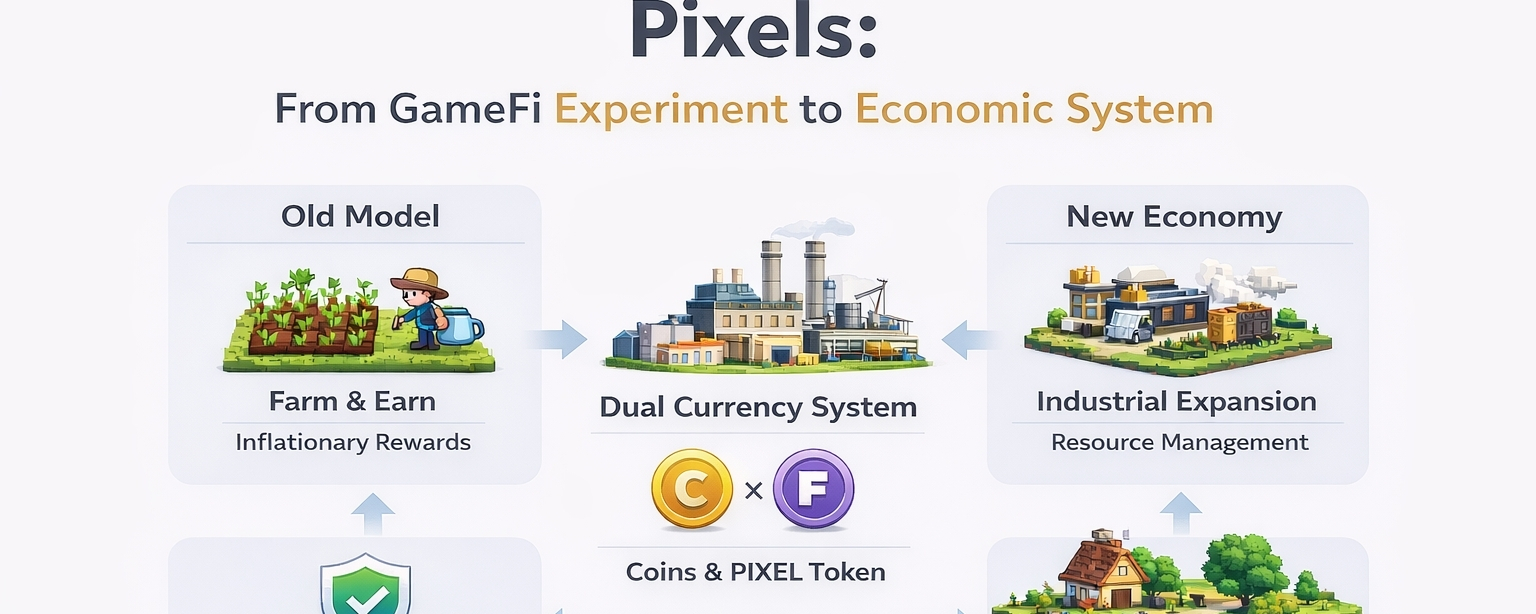

There was a time when Pixels looked like every other GameFi cycle trade. Fast onboarding, simple mechanics, and a reward loop designed more for attention than durability. It worked for growth, but not for credibility. What we’re seeing now in 2026 is something fundamentally different.
Pixels didn’t just iterate. It restructured its entire economic philosophy.
And that shift matters more than most people realize.
The Quiet Reset That Changed Everything
Early Pixels revolved around a soft in-game currency that inflated too easily. Rewards were accessible, but unsustainable. That model collapsed under its own weight, exactly like most GameFi economies do.
Instead of ignoring it, the team did something rare in this space. They admitted the flaw and redesigned the system.
The result is a dual-currency structure where PIXEL acts as a scarce premium asset while in-game Coins function as the transactional layer.
That distinction is not cosmetic. It’s structural.
It separates store of value from medium of exchange, which is the baseline requirement for any functioning economy, digital or physical. Most GameFi projects still fail to understand this.
Pixels does.
From Farming Game to Industrial Economy
The biggest shift came with the latest evolution often referred to as Chapter 3, or the Industrial Expansion.
Pixels is no longer about farming crops. It’s about managing production systems.
Players now coordinate supply chains, negotiate trade routes, and compete over resource control across different land types.
This introduces something GameFi has historically lacked: economic interdependence.
You can’t just grind solo anymore. Scale requires coordination. Efficiency requires specialization. And value is no longer extracted from the system. It is created within it.
That’s a completely different design philosophy.
Scarcity Is Finally Real
One of the strongest signals in the current Pixels model is land.
There are only around 5,000 plots available, and each one generates ongoing economic output based on activity and location dynamics.
This introduces three critical elements:
Fixed supply
Productive utility
Network-driven value
That combination is what turns digital assets into something closer to infrastructure rather than collectibles.
And it explains why land in Pixels is starting to behave less like an NFT and more like yield-generating digital property.
Tokenomics Are Maturing
For a long time, PIXEL carried the typical GameFi risk profile. High FDV, low circulating supply, and constant unlock pressure.
That phase is ending.
As of 2026, roughly 66 percent of the total supply is already in circulation, significantly reducing dilution risk.
This changes how the market interacts with the token.
Price is now increasingly influenced by actual in-game demand and ecosystem growth, rather than emissions and unlock schedules.
That’s a transition most tokens never successfully make.
Reputation Over Bots
Another underrated addition is the Trust Score system.
It introduces an on-chain reputation layer that rewards real user behavior and penalizes automation.
This is critical because GameFi has always struggled with one core problem: fake activity.
When rewards are tied to measurable human engagement instead of raw farming output, the economy becomes harder to exploit and easier to sustain.
It’s a subtle feature, but strategically important.
Market Reality Check
Despite all these improvements, PIXEL is not immune to volatility.
The token has shown aggressive price swings driven by trading volume spikes and sector rotations.
There are also ongoing unlock events, including a recent advisor allocation release, which can introduce short-term sell pressure.
This is where most narratives lose discipline.
Pixels is not a straight line up. It’s a system in transition.
And systems take time to stabilize.
The Bigger Picture Most People Miss
What Pixels is really building is not just a game.
It’s a time economy.
As digital environments absorb more human attention, the value shifts from speculation to participation. Pixels is positioning itself exactly at that intersection where time, ownership, and coordination meet.
That’s why the Industrial Expansion matters.
That’s why tokenomics restructuring matters.
And that’s why the project continues to stay relevant while others fade.
My Take
Pixels is one of the few GameFi projects that actually learned from its first cycle.
Not by adding features, but by redesigning incentives.
It moved from extraction to production
From inflation to scarcity
From solo farming to coordinated economies
That doesn’t guarantee success. But it dramatically improves the odds.
If the team continues to prioritize economic integrity over short-term growth, Pixels could evolve into something much bigger than a game.
It could become a blueprint.
And right now, that’s where the real value is forming.