Let me explain...When the importance of guilds in Pixels emerged, it did not happen amid some price rally or major release update. Rather, it developed quietly. Farming appeared to be the focal activity at first, but gradually it became evident that coordination was behind all the work being done.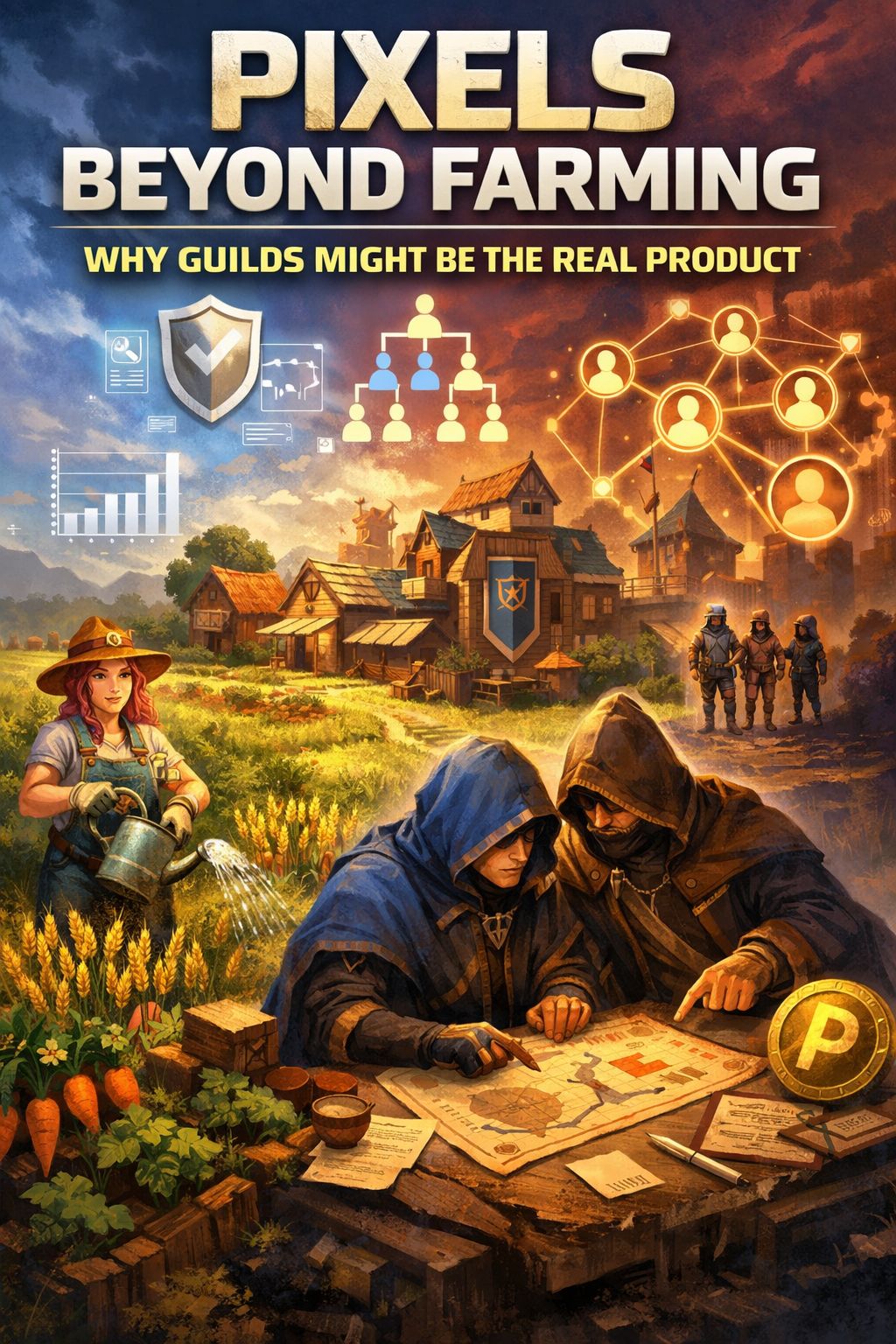
This makes all the difference.
What most crypto games monitor is what can be easily quantified. Fields harvested. Quests completed. Rewards distributed. User counts announced. However, such data loses significance over time. What becomes more relevant in the process is a different metric: which element of the system would players choose to rebuild in case the incentive layer were to fail? For Pixels, the answer seems to lie increasingly in guilds, not farming.
It is important to point out, however, that this statement could appear rather harsh since farming remains the key interface for player interaction with the game. After all, this is what users experience when interacting with Pixels and completing tasks. Guilds on the other hand, go beyond this interface and involve access control and management.
Hence, the key takeaway becomes clear. Farming is what players do. Guilds are what endures.
Value creation occurs through perseverance.
A variety of reward systems can create action from their incentives. Yet, action does not necessarily result in dependency. Players will always act as long as there are incentives for them to do so. However, the transformation takes place when player behavior goes beyond their own actions and involves cooperation.
Cooperation comes from having to depend on others for efficiency, security or progress.
Dependence, in turn, creates belonging, which is more difficult to duplicate than yield.
Incentives can always be replicated; so can game loops; so can tokens in general. What cannot be recreated as easily is a community that exists due to the role structures, regulations, collective memory, and coordinated effort that have accumulated.
Here, the Pixels experience starts to feel less like a farming game and more like an environment for the creation of micro societies.
The importance of this becomes more significant when incentives fade away.
Rather than disappear, however, the purely extractive activity softens. The only systems that survive are those that have reusable structure. That could mean anything from liquidity, to compliance histories, to layers of reputation. For Pixels, it might mean guild coordination. A player within a functional guild does not need to begin each day at square one. Value is preserved through shared history.
This is important. It is akin to social attestation, even if it is not explicitly categorized that way.
In this sense, Pixels might not be pricing action but rather, participation. And there is an important difference. A crowded map can be vibrant even if it is not deep. A coordinated map can be deeper, even if it is less loud, because the individual players themselves are no longer acting independently, but as part of a larger system.
Nevertheless, this is unproven for the time being. Guilds can be merely wrappers for the individual incentive structures; many crypto games talk about “community,” but do not extend much past convenient levels of coordination. Integration is not enough. The structure needs to continue to matter long after the novelty wears off.
However, the idea can't really be ignored. Pixels might be subtly turning individual player activities into organized and sustained groups. The first is simple to illustrate; the second is harder to quantify but much more significant to observe.
Stacked: Creating the Layer that Determines Winners
Aside from the social layer, there is a layer that is also forming Stacked. The key point about this layer is not just its purpose, but rather, who owns it.
The current Stacked platform is designed, built, and maintained solely by the Pixels company itself. All operations, ranging from behavior prediction using artificial intelligence, detecting frauds, distributing rewards, up to analytics, are handled by a single operator. This operator controls every single person involved in this system.
Such arrangement is common for nascent platforms. Both Stripe and Twilio follow the similar scheme.
But there is something unique about Stacked.
Pixels isn’t just an ecosystem operator. It’s also a player within that ecosystem. Its core game exists within the same world that it manages. This brings an inherent conflict.
In contrast to neutral platforms, changes in the system can now directly affect the success of the operator’s game. Changing reward structures, fraud parameters or access to functionality can affect every studio including Pixels.
This isn’t an issue of motivation. This is an issue of structure.
Structure sets up incentives.
Other markets have gone through this before. Ecosystem operators operating against their own players. Platforms being incentivized by their own needs. Even without bad guys, the temptation is there.
The answer doesn’t lie in distrust. It lies in governance.
A framework for decisions, clarity, and accountability can change this from risk to choice. Whether through advisory panels, public logic for parameters, or auditable systems, sharing control creates trust.
Ultimately, the game is bigger than one game.
The value of the PIXEL ecosystem is predicated on success for everyone involved. Should other studios fail, they would quit. When they quit, demand decreases. The ecosystem fails. Even if the game Pixels itself succeeds, the overall thesis collapses.
This is the alignment that needs watching.
Pixels is not merely testing gameplay. It is testing coordination both on the player level via guilds and on the ecosystem level via Stacked.
And both questions still have no easy answers.