
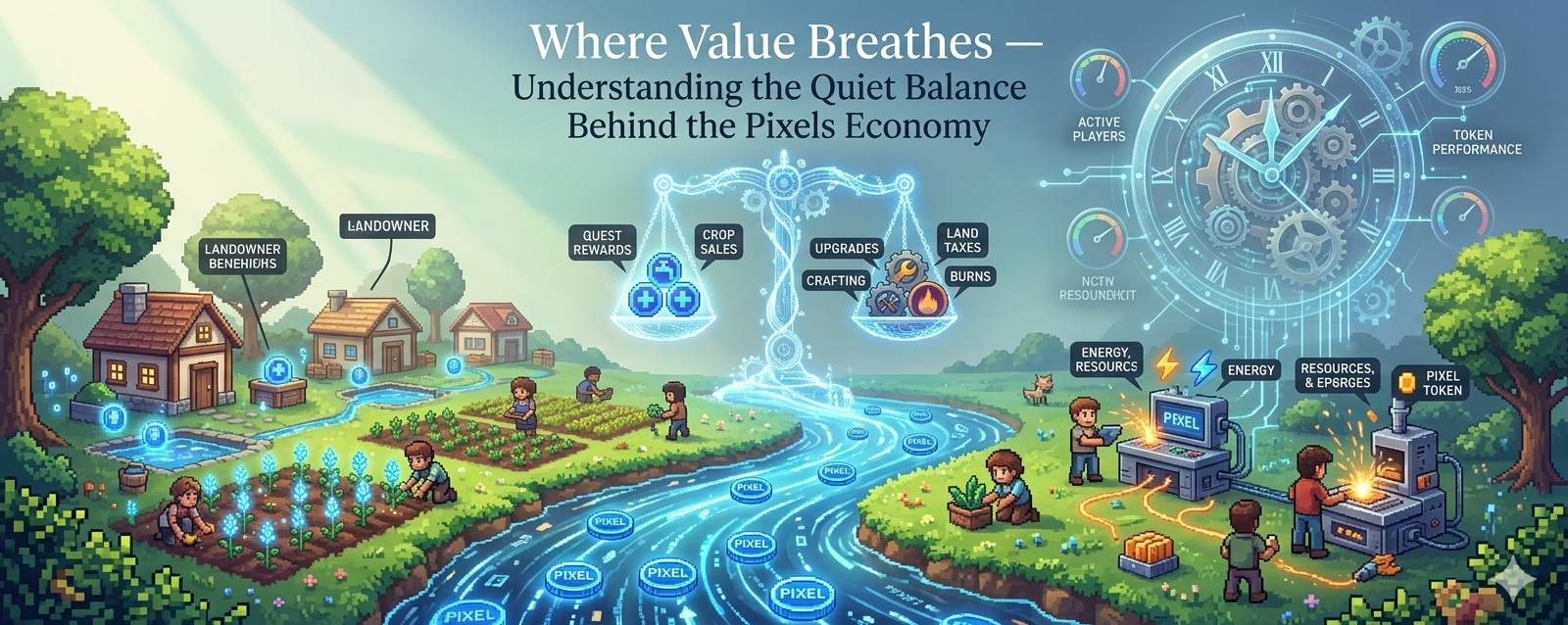
@Pixels There was a time when I used to think that describing a game economy in terms like “sinks and faucets” was just unnecessary jargon, something people used to make simple systems sound more complex than they really were. But the longer I’ve spent watching Web3 games rise and fall, the more I’ve realized that this idea isn’t overcomplicated at all it’s actually one of the clearest ways to understand why some ecosystems survive while others slowly drain themselves out. Every game has points where value enters the system: rewards from quests, crops that can be sold, incentives for participation. These are the faucets, constantly feeding the economy. And then there are the places where that value gets pulled back out: upgrades, crafting, taxes, burns those are the sinks. The tricky part is not just having both, but keeping them in balance. Too much flowing in, and everything starts to lose value. Too much being taken out, and players begin to feel like they’re working without reward. What makes this even more fragile is that this balance isn’t something you set once and forget. It shifts constantly depending on how many players are active, how they behave, and even how the token itself is performing.
What stands out to me about Pixels is that it doesn’t feel like it stumbled into this understanding it feels intentional. You can see how the PIXEL token moves through the system, entering through gameplay and leaving through meaningful mechanics like upgrades, crafting, and land-related interactions. It’s not just about giving players rewards; it’s about creating a loop where those rewards have somewhere to go. That alone puts it ahead of many projects that treated economy design as an afterthought, where rewards kept flowing endlessly and sinks were either weak or added too late to make a difference. In those cases, the damage was already done by the time adjustments were made. Pixels, at least from the outside, looks like it was built with the awareness that value needs circulation, not just distribution. Still, recognizing the problem and solving it perfectly are two very different things, and that’s where my confidence becomes more measured.
The real uncertainty begins when you consider how much the player base has changed over time. During the earlier phases, especially around the points campaign and token launch buildup, activity was high and the system had a large number of participants feeding both sides of the economy. That kind of scale naturally supports balance because there’s enough movement happening everywhere. But when that wave of attention settles and some players leave, the internal dynamics shift in ways that aren’t always obvious. Fewer players mean fewer rewards being generated, but also fewer resources being spent. The question isn’t just whether activity drops it’s whether both sides of the system shrink in proportion or if one side starts to outweigh the other. That’s the kind of detail you can’t fully judge from the outside, and it’s why I find myself cautious instead of overly optimistic. The structure is there, but the calibration is what really decides whether it holds up.
Then there’s the land system, which adds another layer that I find both fascinating and a bit uneasy at the same time. Ownership in Pixels isn’t just cosmetic it changes how you experience the economy. Landowners benefit from the activity of others, while players without land are effectively sharing a portion of what they earn. It creates a subtle divide, where two players can be doing similar work but walking away with very different outcomes. In a way, it mirrors real-world systems, where position can matter just as much as effort. That kind of design can add depth and long-term strategy, but it also risks creating a gap between players who feel like they’re progressing and those who feel like they’re just maintaining someone else’s advantage. It’s not inherently a flaw, but it’s definitely a tension that needs to be handled carefully if the game wants to keep its broader player base engaged.
What gives me some level of confidence is that Pixels doesn’t seem static. It feels like a system that is being adjusted rather than left to run on autopilot. Seasonal events, for example, act as temporary pressure points where resources get pulled out of circulation during periods of higher activity. When done right, that kind of design creates urgency without permanently distorting the economy. But it also comes with a risk if the game starts relying too heavily on these temporary fixes, it can signal that the core balance isn’t as stable as it needs to be. The same applies to bigger structural decisions like the move to the Ronin network. That wasn’t just a technical upgrade; it changed how easily players could interact with the economy, which directly affects how effective sinks actually are. A system can have all the right mechanics on paper, but if they’re not accessible or smooth to use, they don’t function the way they’re supposed to.
At its core, the challenge Pixels is facing isn’t unique it’s the same one that every play-to-earn ecosystem eventually runs into. Some players come in looking to extract value, and for them, the system needs to feel rewarding and generous. Others stay because they enjoy the experience, and for them, the economy needs friction, progression, and meaning behind what they earn. Those two perspectives pull the system in opposite directions, and balancing them isn’t just about numbers it’s about understanding behavior. No project has truly solved that tension yet. But what makes Pixels stand out, at least to me, is that it feels like it’s trying to deal with that reality instead of ignoring it. That doesn’t guarantee success, but it does make it more grounded than many of the systems that came before it, and sometimes that awareness is the difference between something that fades out and something that actually evolves.