
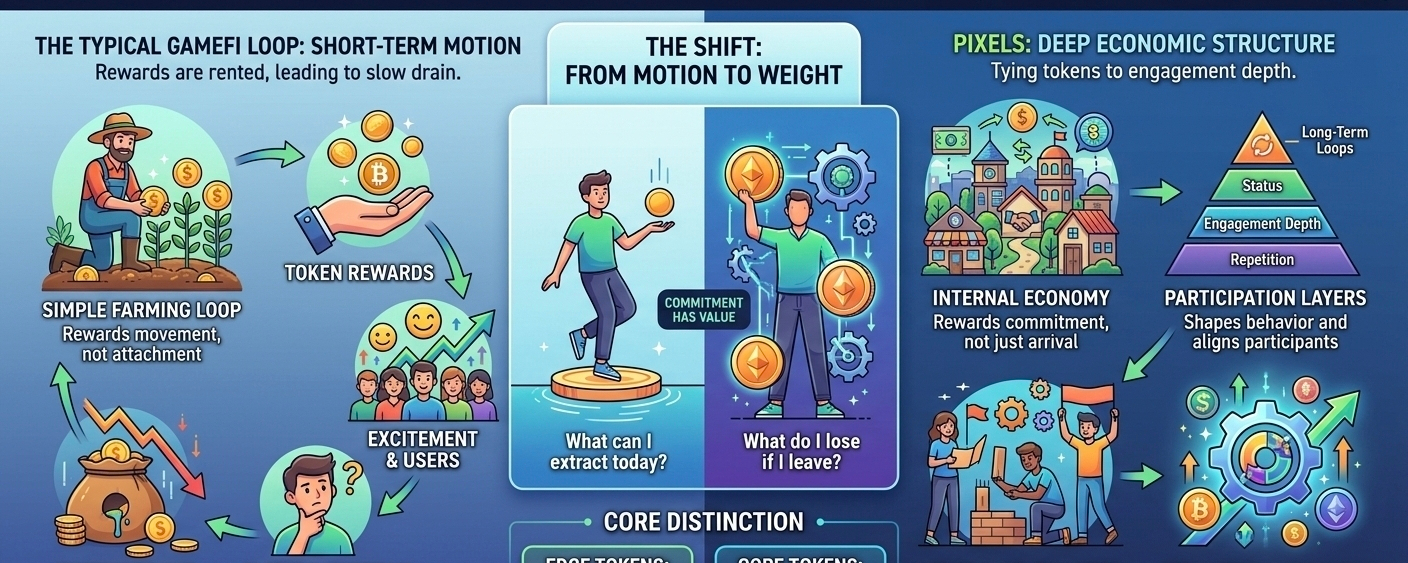
Pixels is the kind of project I would usually dismiss without much thought. I have seen this setup too many times. A simple game loop, a token layered on top, early excitement, a wave of users chasing rewards, and then the slow realization that most of the activity was never real to begin with. It was rented. Temporary. Built on incentives that were always going to be sold the moment they stopped making sense. So I came into Pixels with that exact mindset.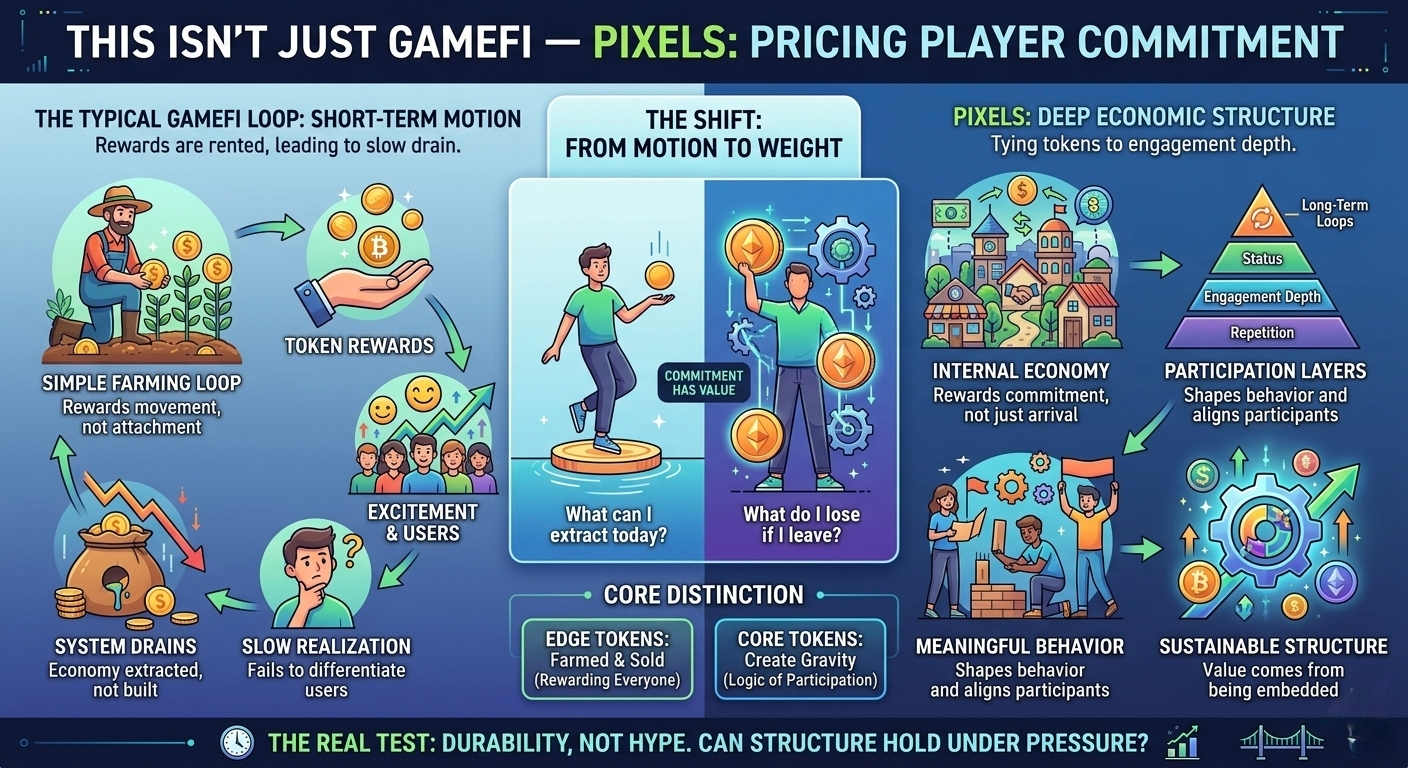
At first glance, it looks familiar enough to trigger that instinct. Farming loop. Resource cycles. Soft visuals. Token economy sitting in the middle. The kind of structure that has burned people repeatedly in this space. But the longer I spent paying attention to it, the harder it became to dismiss in the usual way. Not because it is perfect. Not because it is obviously winning. But because it feels like it is trying to solve a different problem than most projects in this category ever seriously attempt.
The core issue with almost every GameFi project is not onboarding. Crypto is extremely good at getting people in the door. If you attach enough financial incentive to anything, users will show up. That has never been the challenge. The real problem is what happens after they arrive. Most systems cannot distinguish between two very different types of users: the ones trying to build within the ecosystem and the ones trying to extract from it. And when a system fails to tell the difference, it ends up rewarding both the same way.
That is where everything starts to break. Rewards get distributed without context. Activity gets inflated without meaning. Metrics look strong on the surface, but underneath, the economy is slowly being drained by participants who were never aligned with it in the first place. I have watched this happen over and over again. The charts do not collapse immediately. They just start losing integrity. The system gets noisier. The incentives need to get louder to compensate. And eventually, the whole thing becomes unsustainable. Not because people left—but because the wrong people stayed.
What keeps pulling me back to Pixels is the sense that it is not just trying to increase activity—it is trying to shape it. That is a much harder thing to do. Instead of rewarding everything equally, the design seems to be slowly moving toward rewarding specific types of behavior. Not just showing up, but staying involved in a way that contributes to the internal economy. That shift sounds subtle, but it changes everything. Because once a system starts prioritizing how users participate—not just that they participate—you begin to see a different kind of structure emerge.
In that kind of system, progress becomes tied to engagement depth rather than simple repetition. Access starts to depend on your position within the system rather than just your wallet balance. Value begins to come from being embedded in the ecosystem rather than simply being present. This is where Pixels starts to feel less like a game with a token and more like an economy using a game as its interface. And that distinction matters more than people think.
Most tokenized systems reward motion. Do something, get paid, repeat. It is simple, it scales quickly, and it almost always fails over time because it never builds any real attachment between the user and the system. Pixels seems to be experimenting with something heavier. It is not just distributing rewards. It is gradually tying the token closer to progression, access, status, and long-term participation loops.
That creates a different kind of behavior. Instead of asking, “How much can I extract today?” users start asking, “What do I lose if I leave?” That is a powerful shift. Because once participation has weight—once it starts affecting how you exist inside the system—the decision to stay or leave becomes more complex than just checking the current payout.
This is where the idea of pricing commitment starts to make sense. Not in a direct or obvious way, but structurally. The system begins to reward users who are willing to spend more time, build deeper positions, and engage with more layers of the economy. And in doing so, it naturally filters out those who are only there for short-term extraction. At least, that is the direction it appears to be moving toward.
I am not blindly trusting this. If anything, I am more cautious because I have seen how easily this kind of approach can fail. There is a fine line between building a system that genuinely rewards meaningful participation and building a system that simply looks complex enough to hide the same old incentive leaks. Crypto projects are very good at adding layers—progression systems, badges, access tiers, internal terminology, nested mechanics. On the surface, it starts to feel like depth. But in reality, it is often just complexity sitting on top of a weak foundation.
If the underlying incentives are still pointing users toward extraction, no amount of structure will fix that. It will only delay the moment when it becomes obvious. So the real test for Pixels is not whether it can design a more intricate system. It is whether that system can hold behavioral alignment under pressure. Because pressure is where everything breaks.
I also think the market might be misreading Pixels right now. Most people are still looking at it through an outdated lens. They see a farming game, a token, and a familiar loop, and they categorize it quickly. That is understandable. Most projects in this space have trained people to think that way. But if Pixels is actually building an internal economy where user behavior is structured and ranked inside the system, then that quick classification might be missing the more important layer.
Because at that point, the token is no longer just a reward mechanism. It becomes part of the logic of participation. And tokens that sit at the center of participation behave very differently from tokens that sit on the edges. Edge tokens get farmed and sold. Core tokens create gravity. People do not hold them just for upside. They hold them because it changes how they interact with the system itself.
Markets are usually slow to price that distinction. Not because it is invisible, but because it does not fit neatly into the categories they are used to. It requires a shift in how people evaluate these systems, and that kind of shift rarely happens quickly.
At this point, I am not watching Pixels for hype. I am watching for durability. I want to see whether meaningful participation actually gets rewarded over time, whether the economy tightens instead of leaking value, whether users begin to behave like participants rather than extractors, and whether the system can maintain its direction without constantly increasing incentives.
Because that is the real test. Not whether it can grow fast, but whether it can hold its structure while it grows.
Pixels might fail. That would not surprise me. Most things in this space do. But I cannot look at it and dismiss it as just another disposable GameFi loop. There is a visible attempt here to answer a harder question—one that most projects avoid because it slows everything down. What kind of user behavior actually deserves to scale?
If Pixels gets that right, then the market may eventually realize it was never just looking at a simple farming game. It was looking at a system trying to turn participation into something with weight. And if it does not get that right, then it ends the same way as everything else—quietly, under the pressure of its own incentives.
Either way, that is where the real story is. Not in how loud it gets, but in whether it still means something when the noise disappears.
