

Pixels makes a straightforward promise: come into a shared world, build something that feels like yours, and keep growing it over time. That promise works because it feels intuitive. People understand the appeal of tending a place, improving it, and seeing it persist. But retention rarely depends on how intuitive something sounds. It depends on whether the system underneath can keep giving players a reason to return that feels proportional to the effort they put in.
What Pixels is really doing is not just building a world, but shaping how uncertainty is experienced inside that world. In any live game with an economy, especially one that involves trade and ownership, unpredictability is unavoidable. Players optimize, exploit gaps, and drift toward whatever produces the best return for the least effort. Left alone, that tends to flatten the experience into something mechanical. Pixels doesn’t try to eliminate that tendency so much as redirect it.
The way it does this is by narrowing the paths through which value moves. Instead of letting players extract value freely at any time, it introduces rhythm daily tasks, gated rewards, limits on how much can be earned or converted. On the surface, this looks like structure. Underneath, it is a form of control. It takes a wide, uncertain space and compresses it into repeatable loops. Players are not deciding what to do in an open field; they are following a pattern that has been pre-shaped to feel manageable.
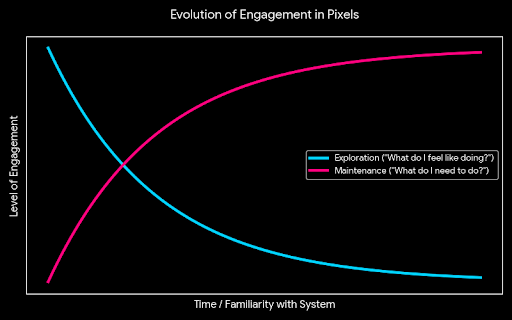
That has a psychological effect. When the path forward is clear, returning becomes easier. There is less friction in deciding to play because the next action is already defined. But clarity also changes the nature of engagement. It shifts from exploration to maintenance. The question quietly becomes not “what do I feel like doing?” but “what do I need to do to stay on track?” That difference is small at first, but over time it defines whether the experience feels like a world or a system.
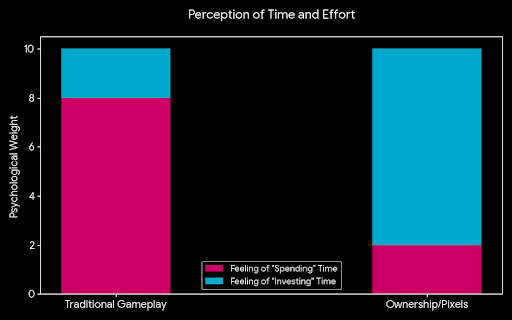
Ownership adds another layer to this. Pixels leans on the idea that what players build and acquire belongs to them. That idea is powerful because it changes how people relate to their time. Instead of feeling like they are spending time, they feel like they are investing it. But ownership inside a controlled system is not neutral. Its value depends on the rules that govern it how assets can be used, improved, or exchanged. As those rules shift, the meaning of ownership shifts with them. What looks like permanence is, in practice, conditional.
This is where the project reveals its real complexity. It is trying to make players feel anchored in a space that is still being actively adjusted. The economy, the reward flows, the constraints these are not fixed. They are tuned over time in response to behavior. That is necessary, because without adjustment the system would either be exploited or stagnate. But it also introduces a quiet instability. Players are not just responding to the game; they are responding to a moving version of it.
Social play helps stabilize this, but it also raises the stakes. When players are part of a shared environment, their engagement is reinforced by others. Returning is not just about personal progress; it is about staying connected. That can make the experience feel alive in a way that purely individual systems cannot. At the same time, it means that disengagement is more visible. If the underlying loops weaken, the social layer doesn’t mask that it amplifies it.
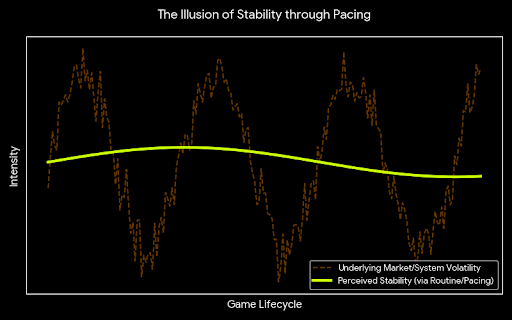
The result is a system that doesn’t remove uncertainty so much as reshape it into something that feels more orderly. Instead of large, unpredictable swings, players experience smaller, frequent decisions: complete the tasks, maintain the routine, keep the asset productive. This can feel stable, even reassuring. But the stability comes from pacing, not from eliminating the underlying volatility.
Whether that holds depends on how those routines feel over time. If they continue to translate effort into outcomes that feel meaningful, then the structure does its job. It gives players a sense of control without exposing them to the full unpredictability of the system. If that translation weakens if the routines start to feel like obligations without clear payoff then the same structure begins to reveal itself as constraint rather than support.
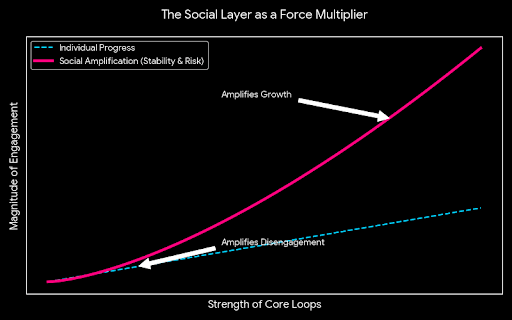
The project, then, is less about proving that players want ownership or social worlds. That part is already understood. It is about whether a carefully managed system can keep those ideas functioning under real conditions, where players optimize, drift, and eventually test the limits of what the design allows. If the balance holds, the world can feel steady even as it changes. If it doesn’t, the sense of control it offers may turn out to be more about presentation than resolution.