
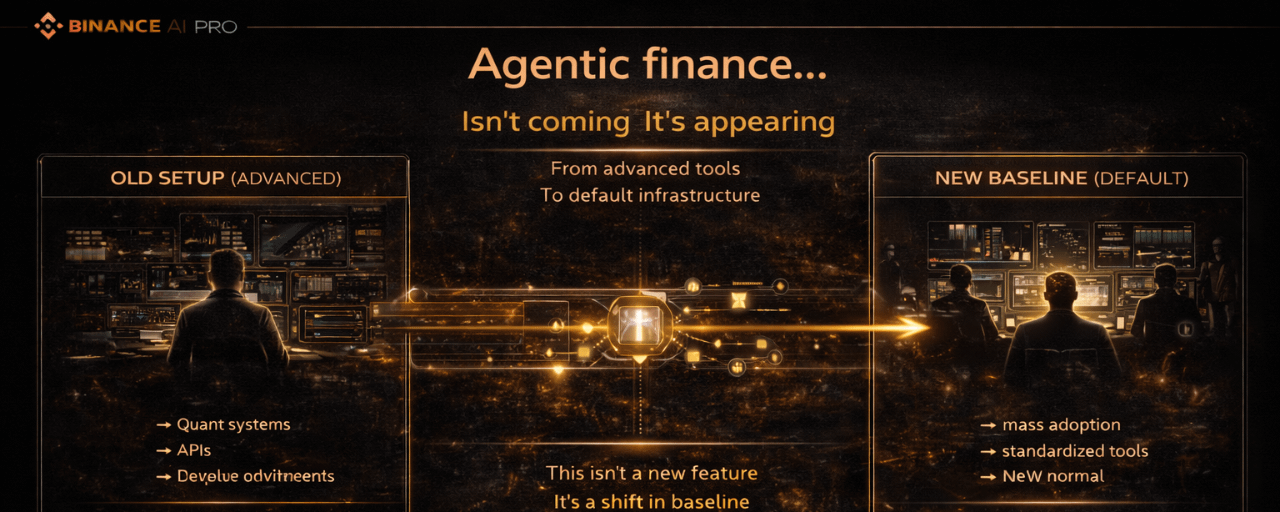
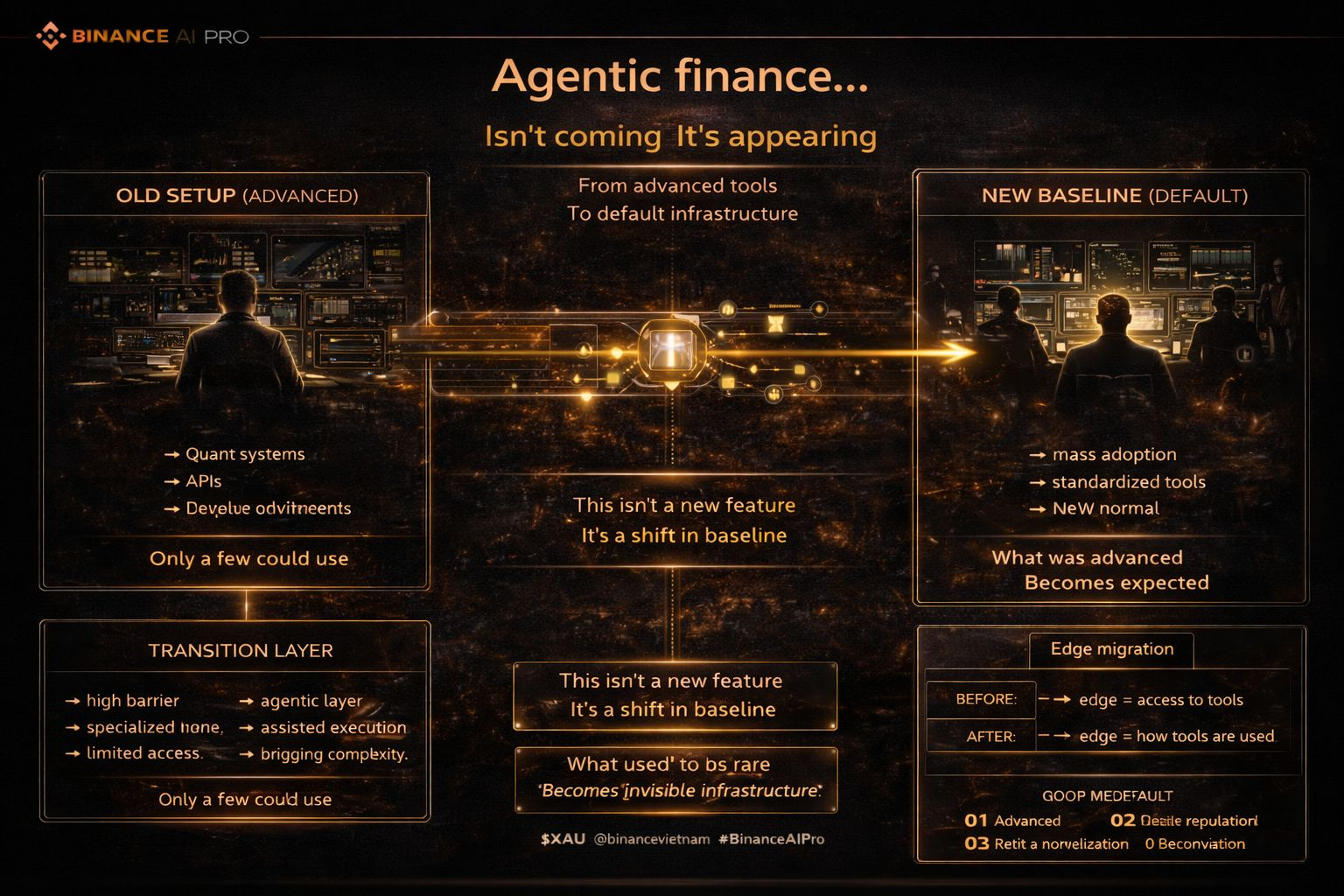
I didn’t expect to sit with this thought for this long after reading about Binance AI Pro. At first it just looked like another feature rollout inside Binance. Something iterative, not really something that changes how I think about the market.
But the more I let it sit, the more it felt like it showed up at a very specific timing.
People have been talking about this idea of “agentic finance” for a while now, though not always using that exact term. The shift from AI just helping you analyze… to AI actually acting within a defined setup. Not fully autonomous, but not just advisory either. Somewhere in between.
And I guess that shift has been building quietly.
Institutional desks have had versions of this for years. Different form, different scale, but the idea isn’t new. What’s new, or at least feels new to me, is where it’s being placed now. Not inside some closed infrastructure, but directly in front of a retail user base that’s… honestly massive.
That part changes the context.
Because when something like this sits inside a platform used by hundreds of millions of people, it stops being a niche tool. It starts to look more like infrastructure, even if it doesn’t feel that way at first glance.
And I keep going back to that point.
Not what it does feature by feature, but what it represents being available at this layer.
Things like multi-model reasoning, execution support, even basic forms of algorithmic behavior… these used to require a lot more setup. Not just money, but time, knowledge, sometimes even a team. Now it’s packaged into something that feels… almost casual to access.
That doesn’t automatically make it better, though.
If anything, it probably creates a different kind of problem.
Because access and usage are not the same thing. Just because more people can use something doesn’t mean they’ll use it well. If anything, tools becoming easier to use sometimes just means mistakes happen faster.
So I’m not fully convinced by the “democratization” angle in the way it’s usually framed. It’s real in terms of access, sure. But whether it leads to better outcomes… I’m not sure that part follows automatically.
Still, there’s something else here that feels more structural.
Most of the AI + crypto conversation lately has been around narratives. Tokens, themes, things that move because people believe in them. This feels different. Less about narrative, more about how people actually interact with the market on a day-to-day level.
Not AI as something you invest in.
More like AI as something you use while investing.
And that shift feels quieter, but maybe more persistent.
If tools like this become normal, then the baseline changes. The average way people approach trading changes a bit. Maybe decisions get slightly more structured, maybe execution gets a bit more consistent, or maybe people just end up relying on a new layer without fully understanding it.
Could go either way.
I also keep thinking about how this affects the market itself. If more participants start using AI-assisted execution, then certain edges probably compress. Things that used to be advantages for a small group become… just part of the environment.
That usually changes behavior over time, but not always in obvious ways.
I don’t think this is some kind of turning point yet.
But it does feel like a signal.
Not that everything is different now, but that the floor is moving. What used to be “advanced” is starting to look more like default. And once that baseline shifts, everything built after tends to assume it’s already there.
I’m still watching how it actually behaves in real conditions.
Because like everything else in this space, the gap between what something promises and how it performs under pressure… that’s where the real story usually is.
For now, it just feels like we’re a bit earlier in that transition than I expected.
@Binance Vietnam $XAU #BinanceAIPro $HIGH $RAVE
Trading always involves risk. AI-generated suggestions are not financial advice. Past performance does not guarantee future results. Please check product availability in your region.