
There was a point when I stopped thinking about rewards in Pixels as simple upside.
Not because they disappeared. Not because they became useless. But because after a while, I started noticing how little the question was about the reward itself and how much it was about what the system was teaching me to do next.
Log in now. Check the board. Finish one more loop. Come back before the timer ends. Stay just long enough to keep the chain unbroken.
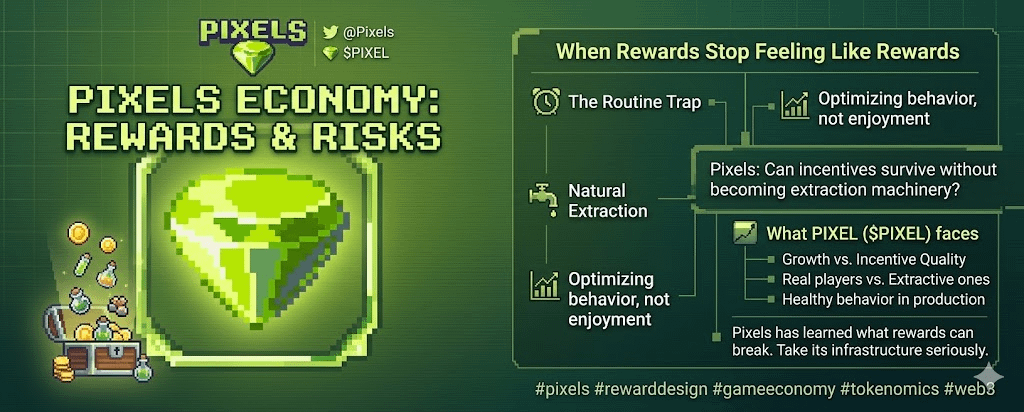
None of that feels unusual when you are inside a live game economy. In fact, that is exactly why it matters. The most effective systems rarely feel aggressive. They feel natural. They slide into routine so smoothly that you stop asking whether the behavior still belongs to you or whether it is being softly shaped around you.
That is part of why Pixels keeps holding my attention.
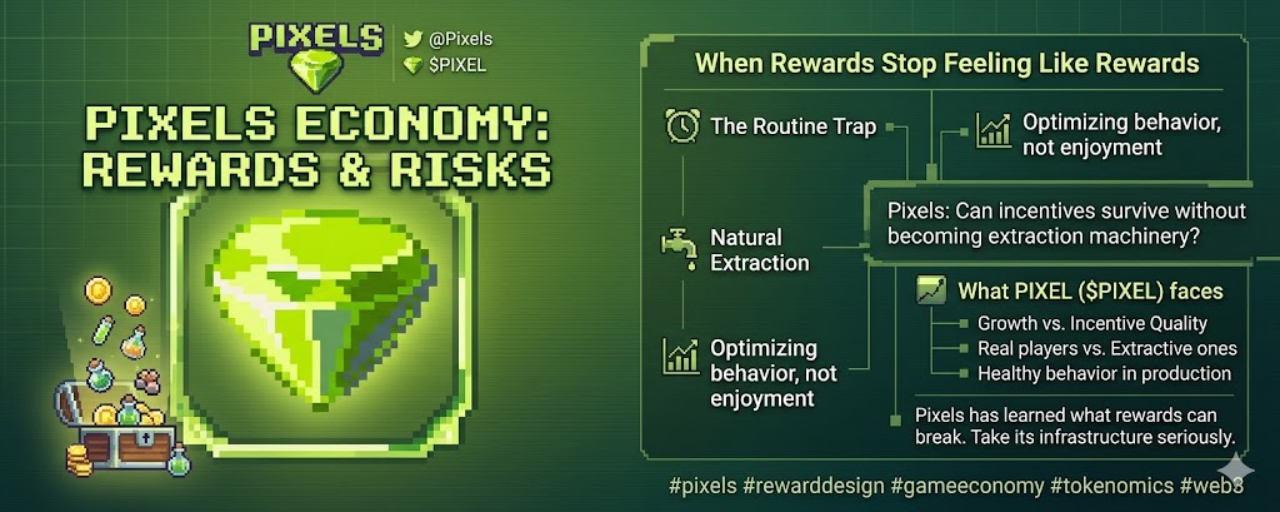
A lot of people describe the project through growth, rewards, infrastructure, or Stacked as a product. All of that matters. But the more interesting layer to me is the one underneath: Pixels seems to understand that the real challenge in game economies is not creating incentives. It is creating incentives that can survive repeated contact with human behavior without quietly turning into extraction machinery.
That is a much harder problem.
Any team can make a player move. A much smaller number of teams can look at that movement and ask whether it reflects enjoyment, habit, pressure, or some unstable blend of all three. And once a system starts optimizing around that distinction, the design conversation changes. It is no longer just about retention. It becomes a question of what kind of return the system is actually trying to pull out of the player.
That is where PIXEL becomes more interesting to me.
Not as a token floating by itself. Not even as a reward unit in the narrow sense. But as part of a broader economic design problem that Pixels has already been forced to confront in production. What happens when user growth arrives faster than incentive quality? What happens when the same loop attracts both real players and extractive ones? What happens when the system gets better and better at driving behavior without necessarily understanding whether that behavior is healthy?
Those are not theoretical questions anymore.
What makes Pixels worth watching is not that it has rewards. Almost every project has rewards. It is that the team has already had to learn what rewards can break when they are pointed at the wrong behavior.
And once a project has learned that lesson the hard way, I tend to take its infrastructure much more seriously.
