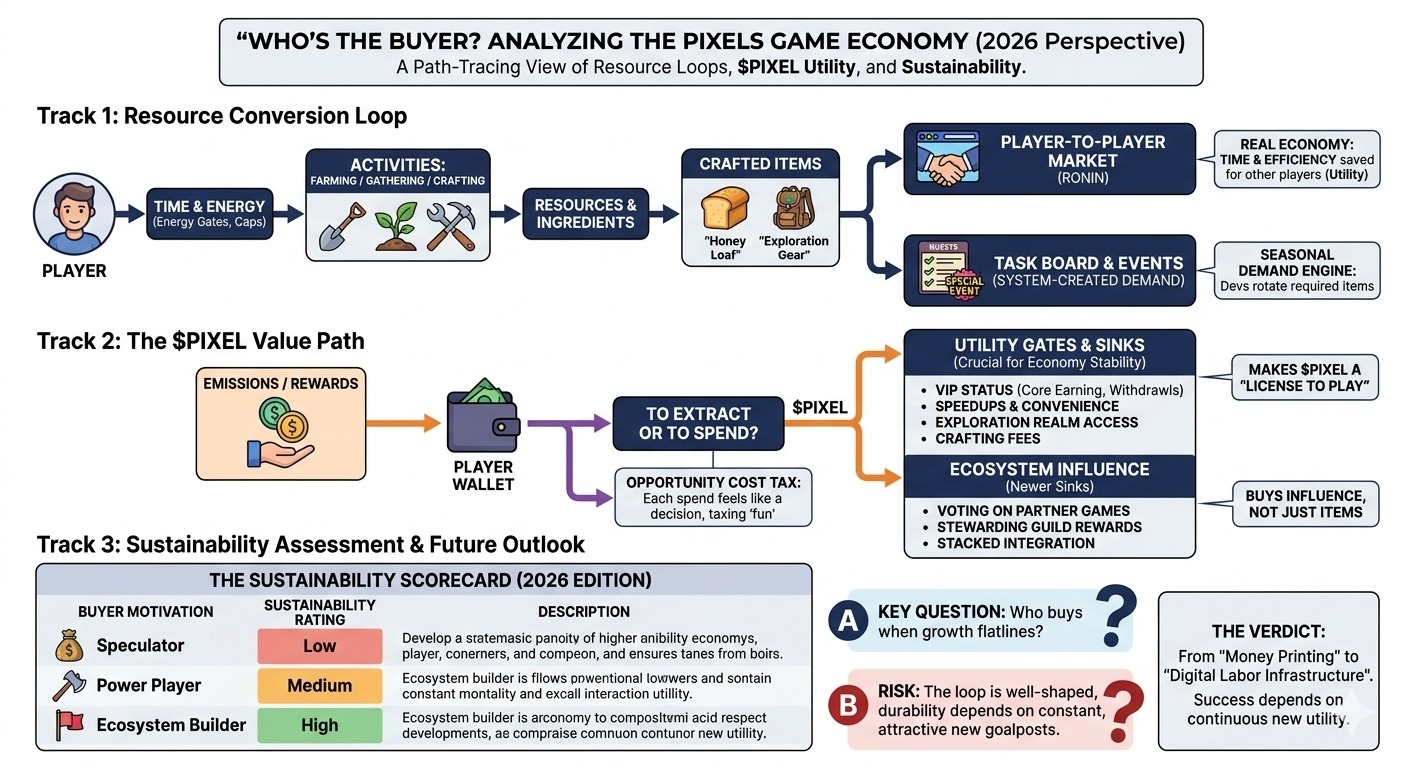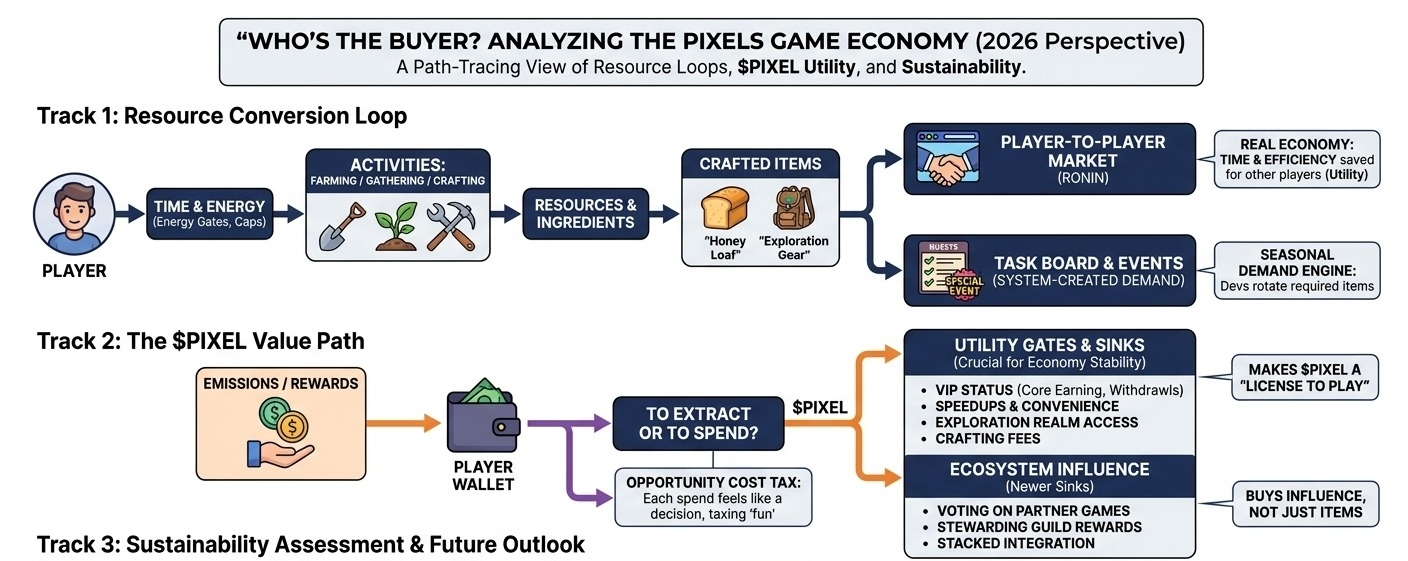
Most people talk about pixels like it’s basically stardew valley with a token, and if you stop there, it’s easy to nod along. plant crops, harvest, craft some stuff, sell it, earn $pixels, maybe pick up land or other assets. but once i started actually following the loops (and not just the vibes), it feels like the game is mostly an exchange machine: it converts player time into resources, resources into items, and items into either progression or liquidity.
resource generation is the obvious starting point. farming/gathering/crafting is the core, but what stands out is how much of it is designed around controlling throughput. there are a bunch of soft caps (energy/time, recipe unlocks, tool tiers, whatever your current bottleneck is) that basically decide how fast supply can hit the market. one simple loop i’ve been watching: farm a crop → turn it into an ingredient → craft a higher-value consumable → list it because other players need it for quests/crafting. that loop can be “real economy” if different players genuinely specialize and the items get consumed. but it can also be a temporary arbitrage loop where everyone copies the same chain until margins collapse and the devs have to rotate demand again. i’m not saying that’s bad, i’m just noting that the system seems to rely on constant tuning to keep the output mix from converging.
then there’s $pixels, which is where my confidence drops a bit. emissions give the economy momentum. if you’re rewarding activity, you can keep the market busy even when crafted goods don’t sell well. but emissions always imply inflation pressure; the only thing that matters is whether sinks are strong enough and “sticky” enough to offset it. and here’s the part i’m thinking about: sinks that feel optional (speedups, convenience, some access features, maybe certain crafting fees) tend to disappear when player sentiment shifts. in a normal game, you can’t really exit the currency system, so people spend almost by default. in pixels, you can always decide to stop spending and just treat rewards as something to extract. the token being liquid makes every spend feel like an opportunity cost, which is a weird tax on fun.
i’m also trying to separate player-to-player demand from system-created demand. if the main reason i’m buying crafted goods is because another player actually needs them for ongoing consumption (durability, repeatable uses, consistent progression), that’s healthier. if demand spikes mostly when an event or quest line tells everyone “this week you need item x,” then the game itself is kind of acting as the market’s demand engine. again, not automatically bad, but it means the economy might be more seasonal than it looks.
infrastructure-wise, the ronin integration feels less like a branding choice and more like a practical constraint solver. low fees and fast, predictable transactions make it viable to have a high-frequency marketplace without players thinking about gas every time they list a stack of items. wallets, asset transfers, and settlement are smoother, and that matters because pixels’ economy is basically a lot of small decisions repeated constantly. ronin also brings an existing ecosystem of economically literate players and liquidity rails, which helps markets form quickly. but it also means any imbalance gets optimized fast. if there’s a profitable crafting chain relative to $pixels emissions, people will find it and scale it until it stops working.
so sustainability… i’m still split. are players generating value, or are they mostly extracting emissions? i think pixels can look stable as long as (1) the game keeps item demand genuinely recurring, (2) sinks stay attractive even when $pixels is boring, and (3) the dev team can keep adjusting the valves without making the game feel like a chore. what depends on continuous user growth is liquidity and absorption: new players buy starter goods, create fresh demand, and keep the market clearing. if that slows, you find out if the economy is self-sustaining or just being carried.
no clean conclusion yet. it’s a well-shaped loop, but i can’t tell if it’s durable or just well-paced.
watching:
- retention when emission intensity drops (do people still play when it’s not “worth it”?)
- net sink behavior: how much $pixels gets removed/locked vs immediately recycled
- market clearance rates for crafted goods in non-event weeks
- frequency of economy tweaks (normal balancing vs constant leak-plugging)
if player growth flatlines, who’s left buying the output — other players for real utility, or nobody at all?