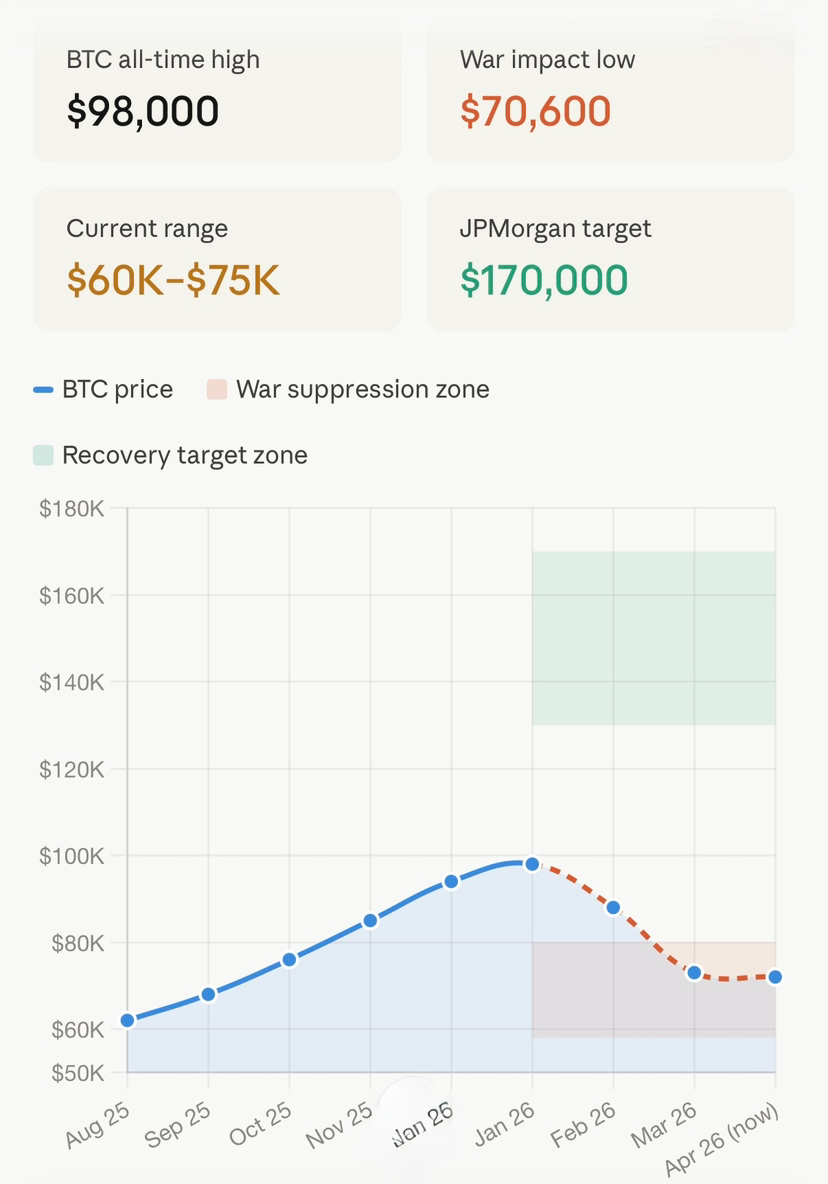
The crypto market is under renewed pressure in 2026 as war tensions involving Iran show no signs of easing, triggering energy shocks and reshuffling global monetary policy expectations — $BTC fell sharply from its previous peak of nearly $98,000 and is now fluctuating between $60K–$75K, reflecting the brutal weight of a changing macroeconomic landscape. NFT Evening The US-Iran conflict and the Strait of Hormuz blockade have sent Brent crude past $103/barrel, fueling inflation and forcing the Fed to delay rate cuts — and Bitcoin felt every bit of it, dropping to around $70,600, mirroring the oil shocks of past cycles. VALR But here's where it gets interesting: while institutional investors and algorithmic bots initially treat $BTC like a high-risk tech stock — triggering "risk-off" sell-offs in the first hours of any conflict — the secondary reaction has historically been a realization of crypto's true utility in a fragmented global economy. WEEX Every major conflict since 2020 has followed the same brutal pattern: crash, liquidation, then recovery — and once the initial shock is priced in, Bitcoin's core value proposition (decentralization, fixed supply, borderless transfers) becomes more obvious to the world, often pushing prices to new highs within months. WEEXAnalyst Nic Puckrin of Coin Bureau warns that even if the war ends today, its repercussions will dominate markets through 2026, with rate cuts unlikely before Q3–Q4 at the earliest — making BTC's current recovery "fragile." Coin-telegraph Yet the long-term structural case remains steel-strong: $BTC commands roughly 56% of total crypto market cap, and analysts at JPMorgan suggest that if BTC begins trading more consistently like gold, a $170,000 price target in 2026 is not off the table. WEEX The bottom line? War breaks markets. Bitcoin bends — but hasn't broken yet. 📊⚔️ The question isn't whether BTC survives the war cycle. History says it will. The question is: are you accumulating or watching from the sidelines?