
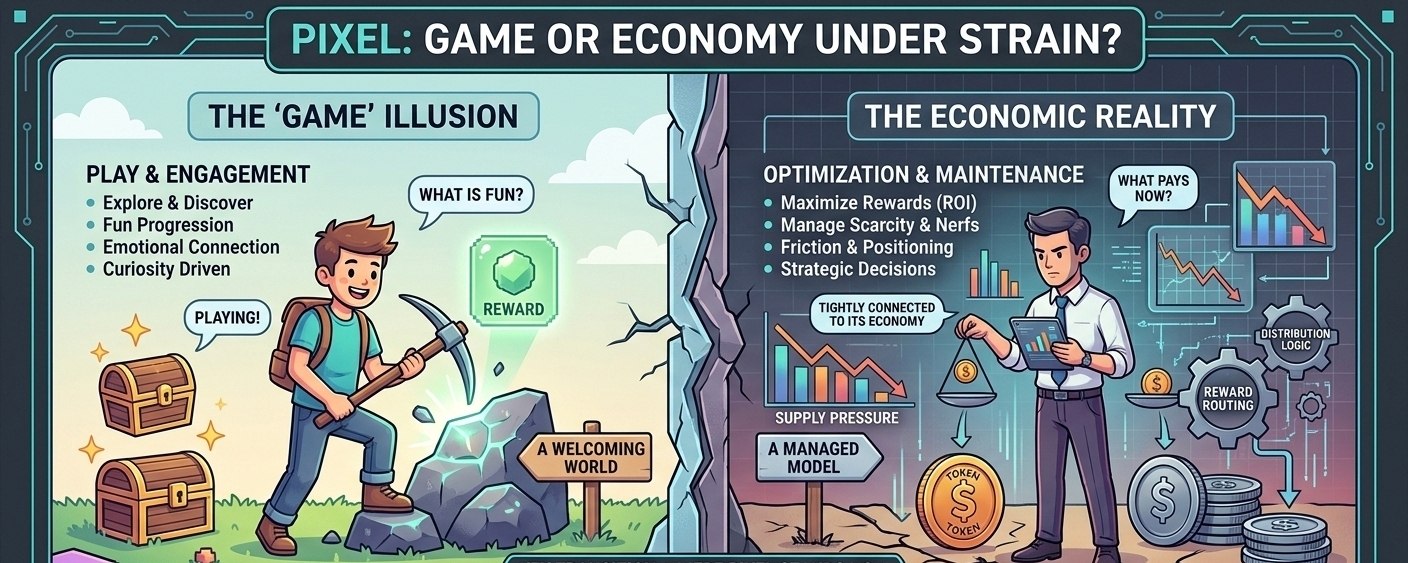
There’s a point in every crypto project where I stop listening to what it says and start watching how it behaves. That’s where PIXEL is for me now. Not in the early phase where everything feels open and full of possibility, and not in that stage where the language is clean and the vision sounds obvious. I’ve seen too many of those cycles play out the same way, with the same promises about ownership, the same confidence about community, and the same idea that this time the system is aligned. What matters to me comes later, when the excitement fades just enough to expose the pressure underneath, when users stop acting like believers and start acting like participants inside a system. That’s where things get real.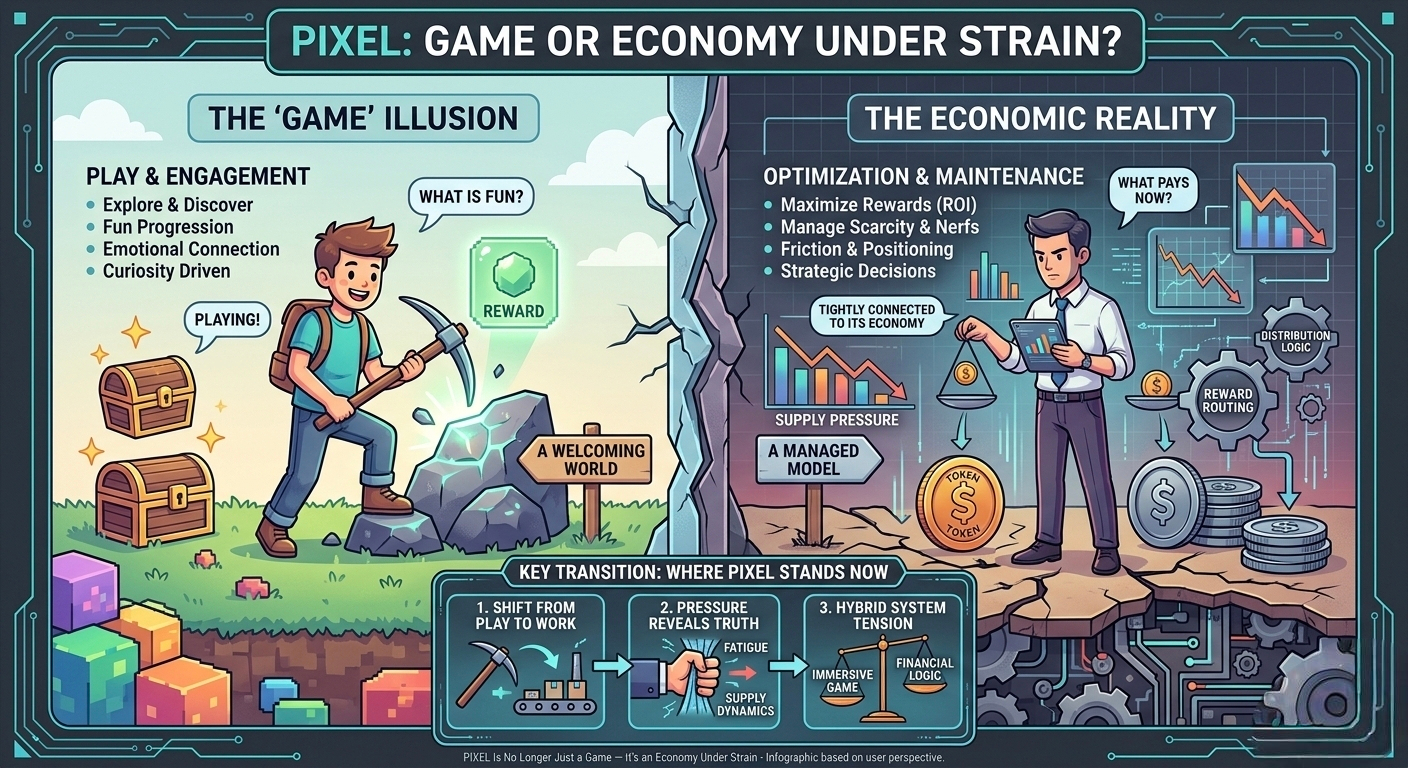
My experience with projects like PIXEL always shifts at this stage. At first, it’s easy to engage with it like a game. You explore, learn the loops, and get a feel for progression. There’s curiosity driving your time inside the system. But slowly, something changes. You start noticing that every action has a weight attached to it. Every decision feels less like play and more like positioning. You’re not just asking what you want to do, you’re asking what makes sense within the system as it exists right now. That subtle shift changes everything, because once a game introduces a token and layers in rewards, staking, access gates, and efficiency-driven progression, it stops being neutral. It becomes structured, and the more it evolves, the harder it becomes to separate playing the game from feeding the economy behind it.
What I’ve learned, mostly the hard way, is that the visible part of these ecosystems is rarely the most important one. On the surface, PIXEL still looks like a soft, accessible world, something familiar that invites you in like any casual game would. But underneath, it’s something else entirely. It’s distribution logic, reward routing, supply pressure trying to balance itself, and constant calibration of who earns, who progresses, and who falls behind. That’s the real system. And once you start seeing it, you can’t really unsee it. Ownership sounds powerful in theory, the idea that players can hold assets and benefit from their time inside the game feels like a correction to traditional gaming. But in practice, that ownership exists inside a controlled environment where the rules still belong to the system. Who gets rewarded efficiently, who faces dilution, who gains early access, and who ends up spending just to keep pace — that’s where the real economy lives.
One thing I’ve started paying closer attention to in PIXEL is how updates feel. Not just what they introduce on the surface, but what they do underneath. Because at this stage, updates are never just content. They’re adjustments. They introduce new filters on participation, new ways to manage scarcity, new ways to shape efficiency, and new ways to quietly redistribute opportunity across the player base. From the outside, it still looks like progression with new features and systems. From the inside, it starts to feel more like tuning. That’s not necessarily a flaw, it’s what happens when a system moves from growth to maintenance, when it has to sustain itself instead of just attracting attention. But it also introduces friction, and players can feel it.
There’s a very specific moment I’ve experienced in systems like this, when I stop asking what’s fun and start asking what pays right now, what’s getting nerfed next, where efficiency is shifting, and how to stay ahead without overcommitting. That’s the turning point, when play turns into optimization. Once that happens, your relationship with the game changes whether you want it to or not. You’re no longer just inside a world, you’re navigating a model. PIXEL, to me, feels like it’s already somewhere in that transition. Not fully there, but far enough that the tension is noticeable.
A lot of people still frame the risk around projects like PIXEL in simple terms, pointing at the token, volatility, or sustainability. But I don’t think the real risk sits there anymore. The deeper risk is structural. It’s what happens when the game becomes so tightly connected to its economy that every part of the experience starts reflecting that pressure. When players stop seeing a world and start seeing systems designed to manage them. Once the system becomes too visible, the illusion breaks. Players stop engaging emotionally and start engaging strategically, and that creates a completely different kind of product.
To be fair, I actually find PIXEL more interesting now than I would have earlier, not because it’s perfect but because it’s under pressure. And pressure tells the truth. A strong market can hide weaknesses, and early hype can cover structural flaws, but fatigue, sustained usage, and ongoing supply dynamics force a system to reveal itself. That’s where PIXEL is now, not selling a dream but trying to hold together a working model. And that’s a much harder job.
I don’t think PIXEL has fully figured itself out yet. It feels like a system caught between two identities, a game that wants to feel natural and immersive, and an economy that needs to be maintained, balanced, and constantly adjusted. Those forces don’t always move in the same direction, and the friction between them is where the real story sits.
If I’m being honest, PIXEL doesn’t feel like an outlier. It feels like a preview. This might be where a lot of Web3 gaming ends up, not purely games and not purely markets, but hybrid systems where play, labor, and financial logic blend together. Where users aren’t just players, but participants in a structure that is always trying to stabilize itself. And the real question becomes how much weight that structure can carry before the experience starts feeling like work.
I keep coming back to the same feeling when I look at PIXEL. It doesn’t feel broken, and it doesn’t feel finished either. It feels like something still being tested in real time, a system trying to prove it can be engaging and sustainable at the same time without collapsing into pure optimization or extraction. Maybe it finds that balance, or maybe the economy eventually becomes too visible to ignore. Either way, this is the phase that matters, because this is where you stop watching what a project promises and start seeing what it actually is.
