
The narrative of Web3 gaming has long been haunted by the "one-hit wonder" cycle: a fever dream of speculative hype followed by an inevitable collapse when token emissions outpace player utility. By April 2026, the landscape has shifted definitively. We have moved past the era of unsustainable "Play-to-Earn" (P2E) models toward a new paradigm: Digital Sovereignty and Sustainable Economic Engineering.
Standing at the forefront of this transition on the Ronin Network is Pixels ($PIXEL). Having evolved from a charming farming simulator into a foundational multi-game platform, Pixels represents more than a digital asset—it is a case study in how to scale a decentralized economy without succumbing to the inflationary traps that decimated the sector in previous market cycles.
# I. The Structural Bull Case: From Speculation to Maturity
In the early days of Web3 gaming, market participants were focused on "Low Float, High FDV" (Fully Diluted Valuation) projects—a trap that fueled massive sell-side pressure. As of mid-April 2026, Pixels has achieved a critical state of supply maturity, with approximately 66% of its total token supply now in circulation.
This is not merely a technical statistic; it is a fundamental shift in the risk profile of the asset. The "venture capital overhang" that previously dominated the narrative has been significantly neutralized. Price action for PIXEL is now increasingly tethered to actual network participation, game updates, and ecosystem milestones rather than the anxiety of impending, massive token unlocks. This maturity is the bedrock upon which institutional-grade long-term confidence is built.
# II. The RORS Revolution: Economic Engineering 2.0
The most "uncommon" aspect of the current Pixels model is the adoption of RORS (Return on Reward Spend).
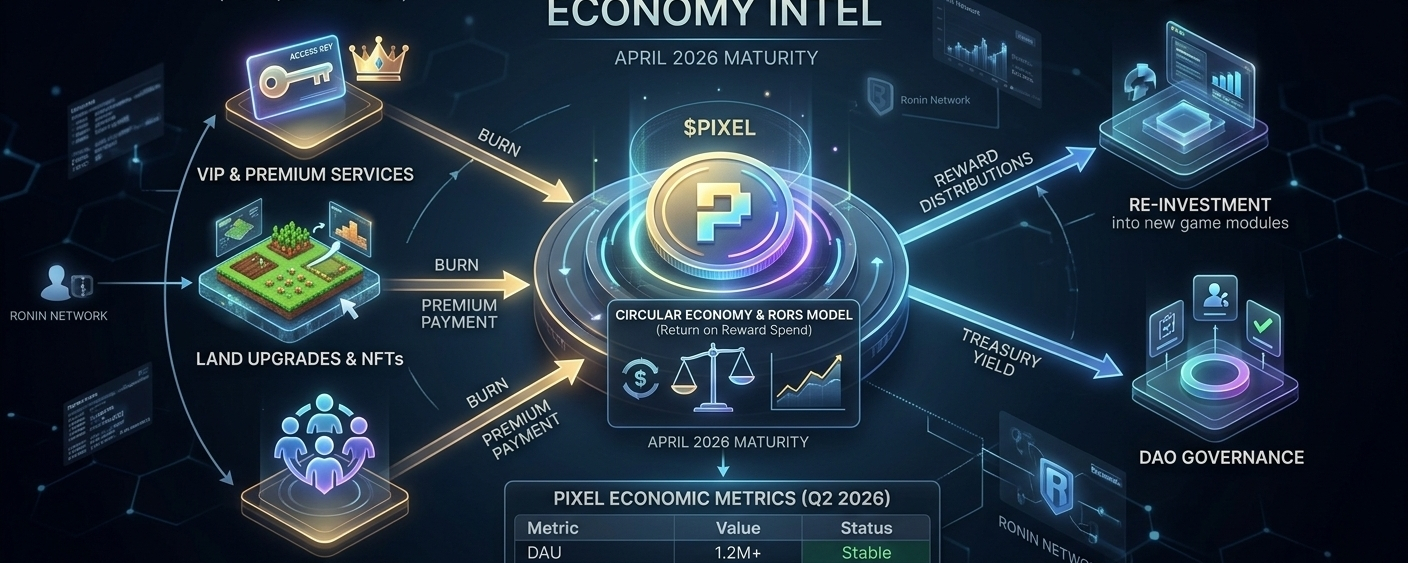
Legacy P2E games failed because they treated tokens as a "gift" to be earned. Pixels has inverted this: PIXEL is the premium currency required for access, efficiency, and status. The protocol now balances its economy by asking: How much value is generated for the treasury for every token distributed?
By integrating the "Stacked" AI-powered reward infrastructure, Pixels has decoupled its internal reward system from direct PIXEL sell pressure, favoring USDC payouts for certain activities. This creates a dual-layer economy:
1. USDC for Liquidity: Stability for casual participants.
2. PIXEL for Sovereignty: A scarcity-driven asset required for NFT land upgrades, VIP tiers, and community governance.
This mechanism ensures that the PIXEL token remains a "store of value" for the most dedicated stakeholders, while shielding the broader ecosystem from the inflationary pressures that forced older models into a death spiral.
# III. Ronin Network: The Infrastructure Moat
Pixels' choice to leverage the Ronin Network was a masterstroke of architectural foresight. In 2026, the battle for Web3 gaming dominance is being won by those who can provide the best "User Experience (UX)."
Ronin provides a frictionless, high-throughput environment that mimics the efficiency of traditional Web2 platforms like "Steam" or "Epic Games," while retaining the benefits of decentralized ownership. For institutional observers, the "Ronin Moat" is twofold:
*Scalability:** The ability to support millions of concurrent users without the gas-fee volatility that crippled Ethereum-based gaming attempts.
*Composability:** Pixels is becoming a "Financial Lego" hub. By sitting on the same network as other major gaming assets, the potential for cross-game liquidity—where a $PIXEL-denominated item in one game could hold value in another—is rapidly becoming a reality.
# IV. Social-Fi and the Rise of Digital Sovereignty
The most profound shift in 2026 is the movement toward Digital Sovereignty. Pixels has transitioned from a game to an ecosystem where Guilds function as Micro-DAOs.
Players are no longer just "farmers" or "participants"; they are stakeholders. The transition of the Pixels DAO from a theoretical concept to an active governance body—where PIXEL holders influence protocol-level decisions—is the ultimate proof that the project is maturing. This creates a "sticky" user base. When users own the infrastructure they operate on, their loyalty is not driven by the token price, but by the value of their digital sovereignty.
# V. Strategic Outlook: The "Steam of Web3"
Looking forward, the roadmap for Pixels is clear: becoming the foundational layer for decentralized gaming. The "Stacked" engine allows the team to apply the lessons learned from scaling Pixels to an entire fleet of new titles. This is the "Steam of the decentralized world" strategy—a multi-game ecosystem where PIXEL acts as the reserve currency, the unit of account, and the governance token for a vast, interconnected metaverse.
# Conclusion: Measuring the Future
As we evaluate the remainder of 2026, the metrics that matter are no longer just "active wallets." Instead, focus on:
*Burn Rate vs. Emission Rate:** As long as PIXEL continues to be consumed for premium ecosystem services, the deflationary pressure remains the engine of value.
*Guild Activity:** The volume and sophistication of Micro-DAO governance.
*RORS:** The efficiency of the "Stacked" reward distribution.
Pixels has successfully navigated the "death valley" of Web3 gaming by focusing on precision, infrastructure, and genuine economic utility. For those seeking an institutional-grade exposure to the future of decentralized gaming, the focus should remain on projects that treat their tokenomics with the same rigor as a traditional central bank. Pixels is, in 2026, the benchmark for that evolution.
