
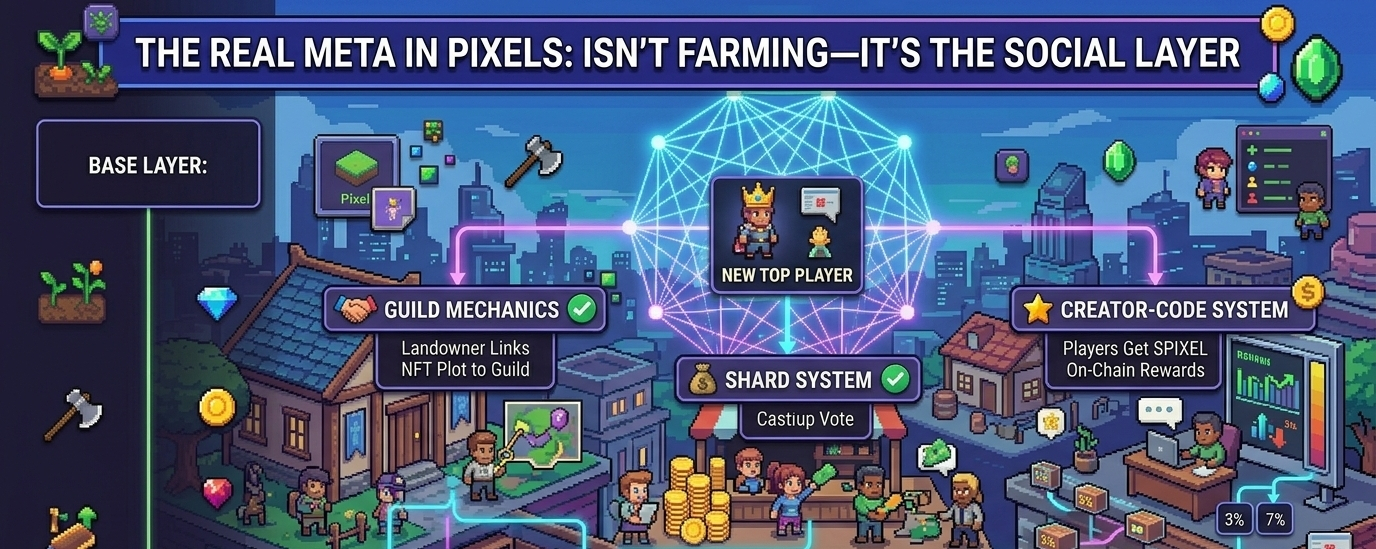
 Beaucoup d'entre nous regardent encore le côté social des jeux Web3 comme s'il s'agissait simplement d'une petite touche supplémentaire—peut-être un serveur Discord, un chat de guilde pour de bonnes vibrations, et quelques badges pour que tout le monde se sente partie de quelque chose. C'est agréable, c'est sûr, mais cela ne semble jamais être l'événement principal.
Plus je passe de temps dans Pixels, plus je réalise que toute cette mentalité est complètement à l'envers. Le côté social n'est plus une décoration. Il s'est discrètement transformé en le véritable jeu de haut niveau qui se trouve au-dessus de toute la culture, de l'artisanat et du travail quotidien. C'est ici que les relations, qui vous connaissez, la réputation, l'accès et simplement l'énergie de groupe commencent à décider où se déplace la véritable valeur.
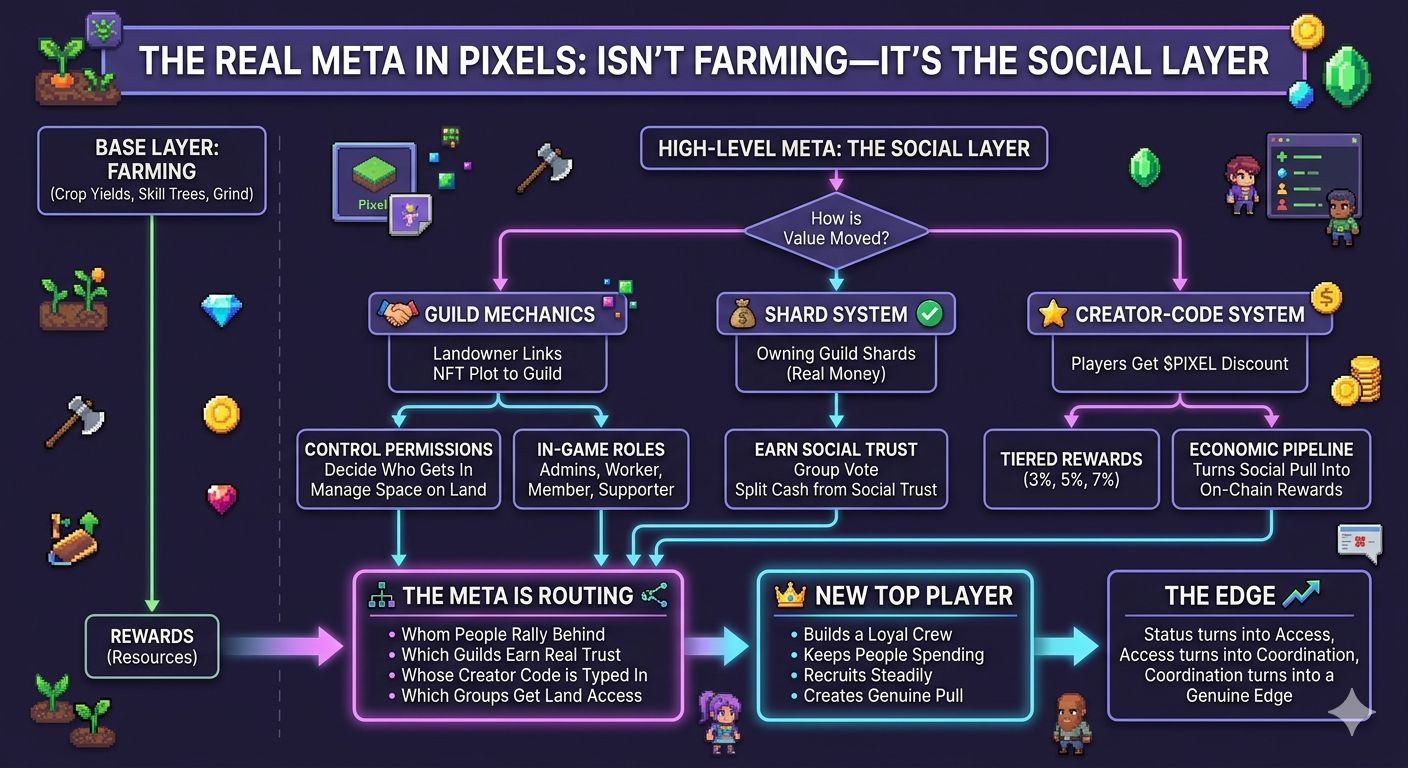
Si tu ne regardes que tes rendements agricoles et tes arbres de compétences, tu passes à côté de l'essentiel. Mais dès que tu commences à prêter attention aux permissions et à la propriété dans le monde, ça te frappe. Les guildes dans Pixels ne sont pas juste de jolis salons de chat avec du style. Un propriétaire de terrain peut littéralement lier son NFT à une guilde et décider exactement qui peut entrer. Une fois à l'intérieur, il y a de vrais rôles—Supporter, Membre, Travailleur, Admin—et les admins contrôlent réellement les choses depuis un tableau de bord en jeu. L'ensemble du graphe social vit là, dans le jeu, au lieu de vivre à l'extérieur sur un Discord aléatoire. Qui obtient de l'espace sur le terrain, qui peut réellement travailler et contribuer, qui prend les décisions… tout cela est désormais intégré dans les mécaniques.
C'est à ce moment-là que le social cesse de ressembler à des choses de communauté douces et commence à agir comme une véritable infrastructure opérationnelle.
Le système de shard va encore plus loin. Posséder un shard de guilde signifie que tu as de l'argent en jeu, mais ça ne te donne pas automatiquement une place à l'intérieur. Tu peux financer tout ça et devoir quand même gagner la confiance du groupe à travers un vote. Cette séparation nette entre l'argent et la véritable confiance sociale semble étonnamment mature pour un jeu blockchain.
Ensuite, tu as le système de code créateur. En surface, ça ressemble à une promo d'influenceur classique—les joueurs obtiennent une petite remise quand ils achètent $PIXEL et une partie revient au créateur ou au trésor de la guilde. Mais Pixels a ajouté ce système par niveaux où les créateurs peuvent débloquer 3 %, 5 %, ou même 7 % selon leur statut. Ce n'est pas juste du marketing creux. C'est un pipeline économique direct qui transforme un réel attrait social en récompenses mesurables on-chain dans le jeu.
Et une fois que ça existe, la définition d'un « joueur d'élite » change complètement. Ce n'est plus seulement la personne avec la ferme la plus efficace ou le matériel le plus rare. Ça peut tout aussi bien être celui qui construit une équipe loyale, garde les gens en dépensant, recrute régulièrement, ou crée suffisamment d'attrait pour que tout le monde canalise naturellement son activité à travers lui. L'agriculture reste la couche de base, ne te méprends pas. Mais le jeu de niveau supérieur ? Ça se passe dans l'attention, le sentiment d'appartenance et la coordination.
J'ai observé l'équipe resserrer cette boucle à chaque mise à jour—codes créateurs pour les guildes, meilleures annonces en jeu, corrections du tableau de bord, tableaux de tâches qui montrent maintenant clairement la propriété et les affaires de groupe. Aucun de ces changements ne semble tape-à-l'œil individuellement, mais mis ensemble, ils continuent de renforcer l'identité, la visibilité et les récompenses dans l'expérience.
Quand je dis que la couche sociale dans Pixels ne concerne pas vraiment l'expression personnelle, je veux dire qu'il s'agit de routage. Qui les gens soutiennent-ils réellement ? Quelles guildes gagnent une véritable confiance ? Quel code créateur les joueurs continuent-ils à taper ? Quels groupes obtiennent un véritable accès au terrain et des rôles appropriés au lieu de juste traîner en tant que supporters ? Ça peut sembler des questions sociales douces en surface, mais en dessous, ce sont des questions économiques directes. Elles décident où l'argent du trésor circule, comment le travail est organisé, et où l'attention de tout le monde se concentre réellement.
Il y a quelque chose d'un peu plus froid et intentionnel à ce sujet, et je ne dis pas cela comme une mauvaise chose. Alors que la plupart des projets Web3 traitent encore la communauté comme de la magie—lancer un token, créer un Discord, et prier pour que ça fonctionne—Pixels semble avoir réellement conçu les systèmes pour façonner, contrôler, monétiser et réinjecter le comportement social dans la progression. Même le processus de vérification des guildes montre la même mentalité honnête : ils donneront un statut officiel à certaines guildes, mais ils sont clairs que c'est un effort de bonne foi et que tu devrais quand même faire tes propres recherches. La confiance est encouragée, jamais supposée aveuglément.
Bien sûr, il y a un revers. Plus de valeur réelle circule à travers ces structures sociales, plus il devient facile pour elles de se transformer en arènes de capture. Une guilde peut passer d'un lieu de détente à un tunnel hyper-optimisé. Un code créateur peut commencer à ressembler à une taxe silencieuse sur l'attention. Les rôles peuvent rassembler les gens… ou les enfermer discrètement à différents niveaux.
Mais honnêtement, cette tension pourrait être exactement pourquoi Pixels semble si vivant. Ses systèmes sociaux ont cessé d'être des fonctionnalités secondaires et sont devenus l'endroit où le statut se transforme en accès, l'accès en coordination, et la coordination en un véritable avantage.
Ce n'est plus juste un accompagnement. C'est le meta.
Et j'ai le sentiment qu'un bon nombre de jeux Web3 se dirigent déjà discrètement dans la même direction—Pixels se trouve juste être l'un des exemples les plus clairs montrant exactement où tout cela va.#pixel @Pixels $PIXEL
