
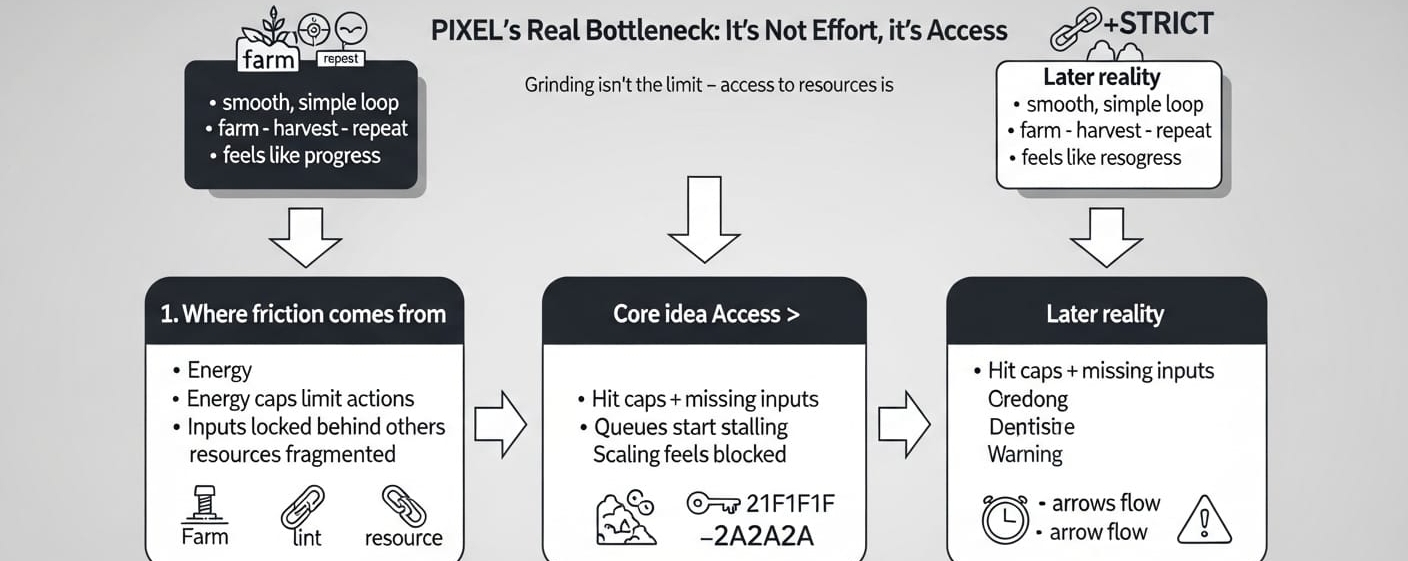
in Pixels, the thing that breaks people isn’t the farming grind. it’s the moment you realize you can’t scale just by trying harder. early on, everything feels smooth and friendly: click, plant, harvest, repeat. the onboarding is clean on purpose, and it gives you that small dopamine drip that makes you think you’re progressing. but that early phase is basically a low-yield sandbox. you can stay busy for hours and still not touch real throughput.
then the friction starts leaking in.
you hit energy caps. you run into missing inputs. your crafting queue stalls because one tiny component you need sits behind someone else’s land tier. and that’s when the system reveals what it’s really doing. it’s not starving you of rewards. it’s starving you of access. and access in Pixels is priced like an asset.
a lot of players treat renting a plot as the “upgrade.” better output, more space, less friction. but renting is also a soft tax. you produce more, but part of that production leaks out as rent. it’s yield bleed by design. you’re basically routing your time through another player’s position, paying them in perpetuity, while telling yourself you’re climbing. it feels like progress, but it’s progress with a leak.
owning land flips the role in a much deeper way. it doesn’t just give “more rewards.” it changes who controls throughput. once you own the constraint, you stop being throughput and start managing it. you decide who gets access, who produces, and how much of the output you capture. at that point it’s less “gameplay” and more allocation. it’s like a sharecropping structure: labor logs hours, capital skims flow.
and that’s why looking only at $PIXEL emissions misses the real layer. people debate inflation curves, sinks vs sources, like it’s a normal play-to-earn faucet. but the real faucet isn’t the token. it’s resource generation. the real sink isn’t a burn mechanic. it’s time trapped in inefficient loops.
resources aren’t evenly distributed in this system. they’re gated and fragmented and intentionally inconvenient. high-tier inputs sit behind ownership, progression trees, or logistical headaches that force coordination. you don’t just farm them freely. you negotiate for them, coordinate around them, or you pay. that’s not “bad balancing.” that’s market structure.
once resources become the choke point, everything reorganizes. crafting becomes a latency problem: can you keep inputs flowing without stalling? movement becomes routing: can you get what you need without wasting half your session? players specialize not because they love it, but because the system punishes generalists with dead time and broken loops.
dead time is the hidden tax most players don’t model. waiting, traveling, compensating for missing inputs. it doesn’t vanish. it gets absorbed by whoever sits closest to the resource layer—usually landowners. landowners don’t grind more. they remove friction. they internalize supply chains. they compress the loop into something that scales.
in that framing, $PIXEL isn’t carrying the economy. it’s settling it. the token sits downstream of access and scarcity. as long as access stays priced and scarcity stays real, $PIXEL has somewhere to flow. flatten that access and the whole thing becomes another liquidity event with a farming minigame attached.
the uncomfortable part is where this leads. it’s not trending toward “fun.” it’s trending toward efficiency: players optimizing routes, operators optimizing people, capital optimizing both. and the real competitive edge becomes simple. you don’t win by playing better. you win by owning the constraint everyone else has to route around.