


It didn’t begin with a feature or a headline. It began with a pause.
I was looking at Pixels, and what caught my attention wasn’t what the game was asking me to do, but what it seemed to be learning while I was doing it. A small delay here, a familiar pattern there, and I found myself wondering whether the visible layer of the project was only a fraction of what was actually happening.
Maybe that’s the more interesting way to look at it......not as a game first, but as a system of observation.
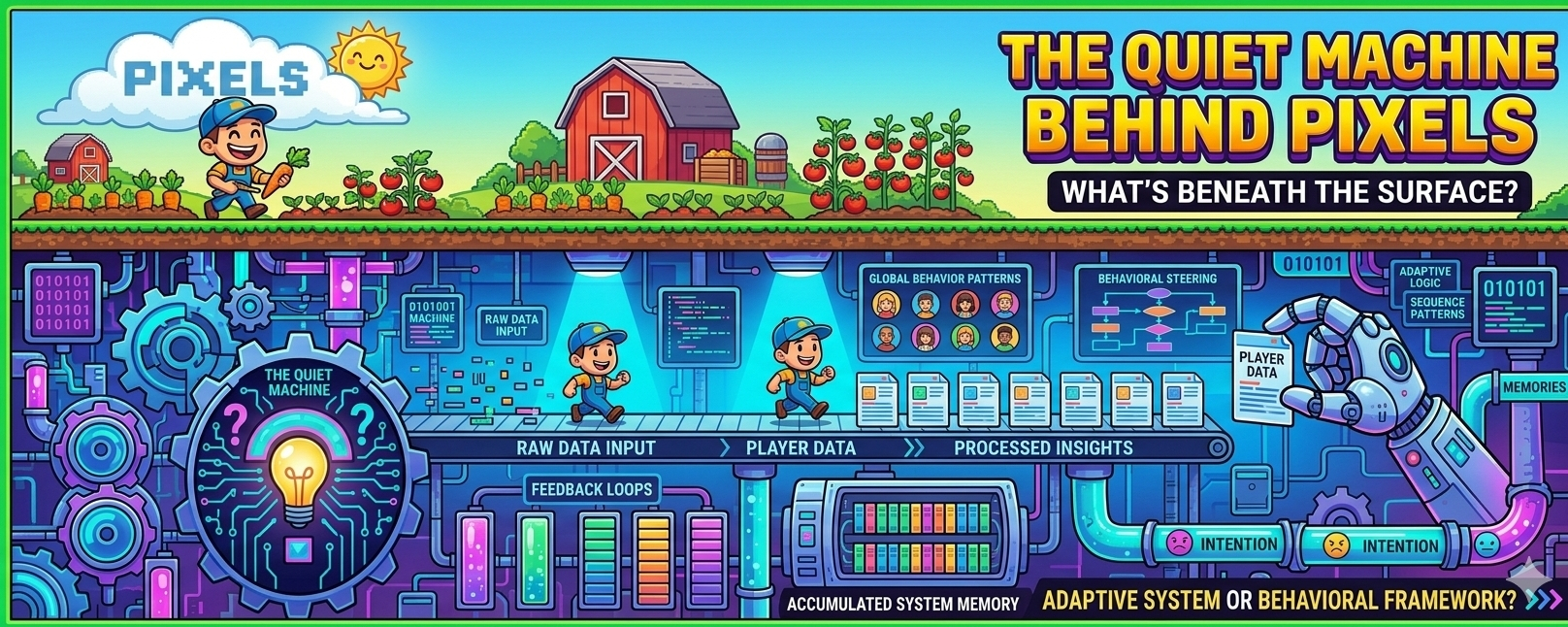
The surface is easy enough to describe. There is a world, a loop of actions, familiar mechanics, and a structure that feels intentionally simple. But simplicity on the surface often hides complexity underneath, and that’s where Pixels begins to feel different. The visible experience seems less like the core product and more like an interface for something deeper: a behavioral architecture that quietly records, interprets, and adjusts.
I keep coming back to that thought.
It feels as if every ordinary action—where I spend time, what I repeat, what I ignore—becomes part of a larger memory. Not memory in the human sense, but a system memory. Historical behavior is not just stored; it seems to become part of the logic that shapes what comes next. The project appears to rely heavily on accumulated data, almost as if it is building a long-term understanding of its own users through repetition and variance.
That, to me, changes the angle completely.
Instead of asking, “What does this game offer?” I start asking, “What is this system trying to learn?”
And perhaps that is why it exists.
Earlier Web3 projects often felt obsessed with visible outputs—tokens, mechanics, loops that were almost too easy to decode. Once players understood the system, they optimized around it, and the structure became fragile. Pixels seems to be addressing that same weakness, but from a quieter direction. Rather than exposing all the rules, it appears to move some of the logic into the background.
The result is something less linear.
Player behavior doesn’t seem to be treated as isolated moments. It feels more like sequences are being read over time, almost as if the system is trying to understand intention from repetition. Maybe it notices when someone slows down, loses interest, or changes habits. Maybe it adjusts pathways in response. I can’t say with certainty, and perhaps that uncertainty is part of what makes it interesting.
Still, something here feels slightly unresolved.
The more adaptive a system becomes, the more it stops being neutral. If it can learn from behavior, it can also begin to shape behavior. Not in an obvious or manipulative way, but through subtle reinforcement—timing, pacing, friction, visibility.
That’s the part I keep thinking about.
Where does intelligent design end and behavioral steering begin?
I don’t mean that as criticism. If anything, it’s what makes the architecture feel more thoughtful than it first appears. But it also introduces fragility. A system that constantly recalibrates itself risks becoming too dependent on its own assumptions. If the data it learns from is distorted, then the system may begin reinforcing the wrong patterns without realizing it.
Something here doesn’t fully settle for me.
Maybe that’s because Pixels feels less like a finished project and more like a living mechanism—something still evolving in real time through the people who use it.
And perhaps that is the more honest way to see it.
Not as a static product, but as a quiet machine learning what people do, and in the process, slowly becoming shaped by them in return.
I’m still not entirely sure whether I’m looking at a game, an economy, or a behavioral framework disguised as one.
Maybe it’s all three.
Or maybe it’s something that only becomes visible once you stop looking at the surface.