
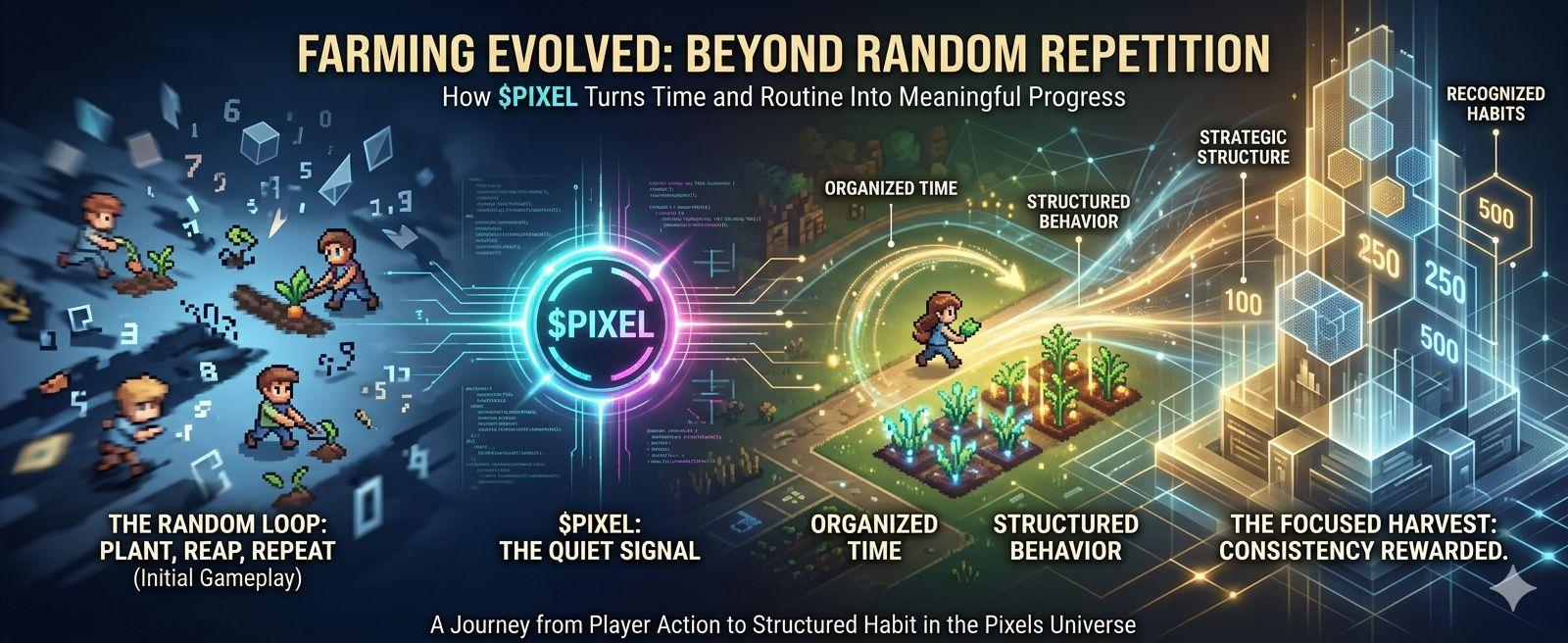
@Pixels I did not notice it right away. At first, Pixels felt exactly like what it looks like on the surface — another familiar loop of logging in, planting, collecting, repeating, and coming back again. The kind of system that feels easy to understand because you have seen versions of it before. But after spending enough time inside it, I started sensing that not every player was moving through it in the same way. Two people could spend similar hours doing similar things, yet somehow the results would not line up the same. It did not feel like a skill gap, and it did not feel like pure luck either. It felt quieter than that, like the system was paying attention to something deeper than just activity.
That is what made me start looking at time differently. We usually think of time in games as equal and simple. One hour is one hour. If outcomes differ, we blame strategy, timing, or optimization. But in Pixels, time does not seem to behave like a flat unit. It feels more selective, almost as if the system is reading not just how much time is being spent, but how that time is being arranged. Some patterns seem to settle in faster than others. Some routines begin to flow, while others stay messy no matter how much effort you put in. The difference is subtle, but once you notice it, it becomes hard to ignore.
What surprised me most was how slowly that change happens. There is no sudden reveal, no dramatic moment where everything becomes obvious. Instead, the experience starts to shift little by little. A routine that once felt random begins to feel steady. Progress stops feeling choppy and starts feeling smoother. Rewards do not necessarily explode, but they become more consistent. It is the kind of change most people would probably describe as getting better at the game, but it feels like something more structural than that. Like the system is not just rewarding effort, but recognizing a particular style of behavior and giving it more weight.
That is where $PIXEL starts to feel more interesting than a normal reward token. It is easy to think of it as just the thing that pays out for action, but over time it begins to feel like part of the logic that decides which activity matters more. It is not acting like a loud mechanic. It is not shouting for attention. It is working quietly in the background, translating certain patterns into progress in a way that feels almost invisible unless you are paying close attention.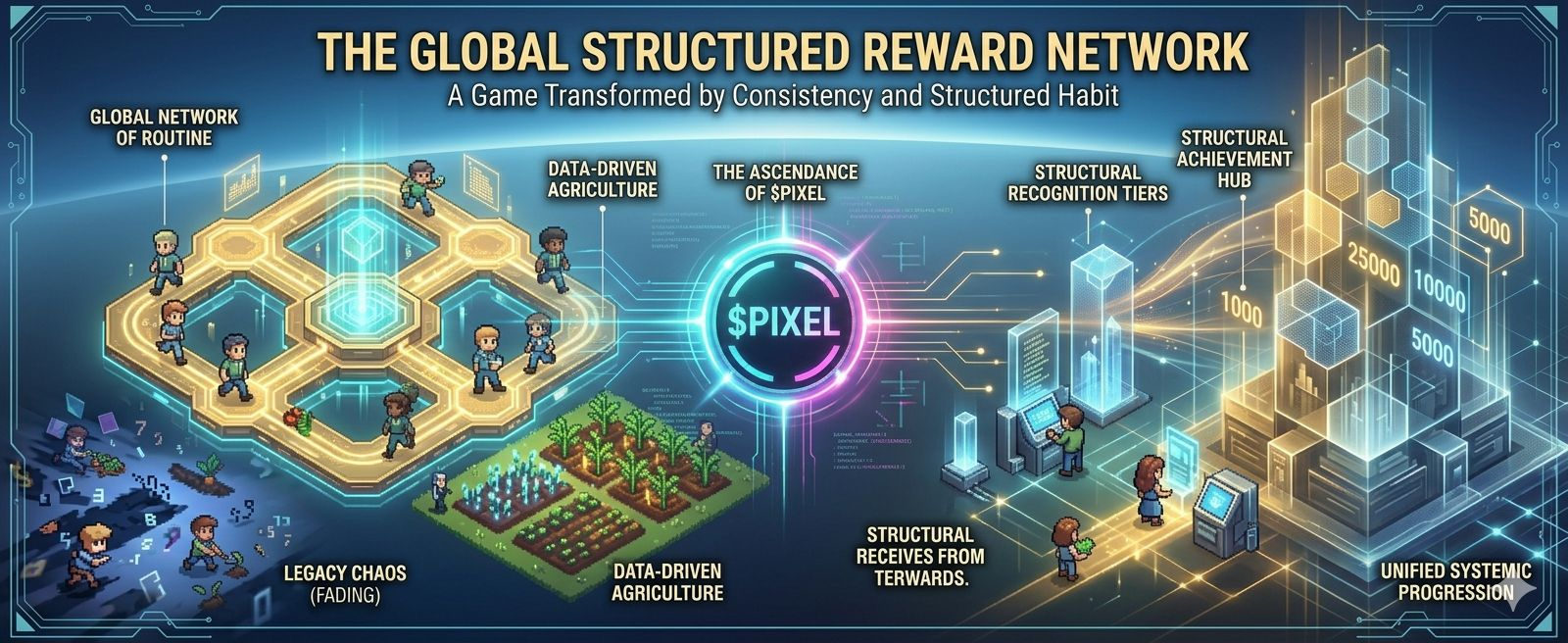
I kept thinking about how this reminds me of other platforms outside of crypto and gaming. A lot of systems start by rewarding volume, but over time they begin favoring consistency. The person who shows up the same way every day often gets more traction than the person who appears in bursts, even if both are equally active. Reliability becomes more valuable than raw effort. Pixels gives off a similar feeling. It does not punish exploration, but it seems to reward structured behavior more efficiently. The more predictable your actions become, the more usable they seem to the system.
That creates an unusual kind of tension. Because once players notice what works, they naturally begin to lean toward it. At first it happens without much thought. Then it becomes intentional. You stop playing just to explore and start playing to align with what the system appears to favor. That is efficient, but it also changes the experience. The range of behavior narrows. Repetition becomes safer than experimentation. And slowly, the game starts shaping not just what players do, but how they think about time itself.
That is the part I keep coming back to. It does not feel like Pixels is only rewarding time. It feels like it is organizing time. Sorting it. Turning some actions into meaningful patterns and letting others fade into the background. The token sits in the middle of that process, not just as a payout but as a signal that helps translate behavior into something the system can recognize and reuse. In that sense, $PIXEL is not simply tied to activity. It is tied to structure.
Maybe that is why the whole thing feels different from a standard farming game. Standard loops are usually easy to read. You do work, you get something back, and the relationship stays obvious. But here, the relationship feels more layered. Time itself starts to feel like a kind of asset, not because it is being stored directly, but because the system seems to care which version of time you are producing. Consistent time, repeatable time, structured time — that is what starts to matter.
I would not say the pattern is fully proven or fully intentional. Some of it could just be the natural result of players adapting to the same environment over and over again. Systems often look smarter than they really are once enough people begin to interact with them. But even if that is part of what is happening, the effect still matters. Because once a system starts rewarding certain forms of behavior more reliably than others, it stops being just a game loop and starts becoming a filter.
And that is what makes Pixels interesting to me now. It no longer looks like a simple farming routine. It looks like a system that is quietly deciding which habits are worth carrying forward. The result is not just tokens, and not just progress, but a shaped version of time — one that has been organized, recognized, and turned into something more useful than repetition alone.
