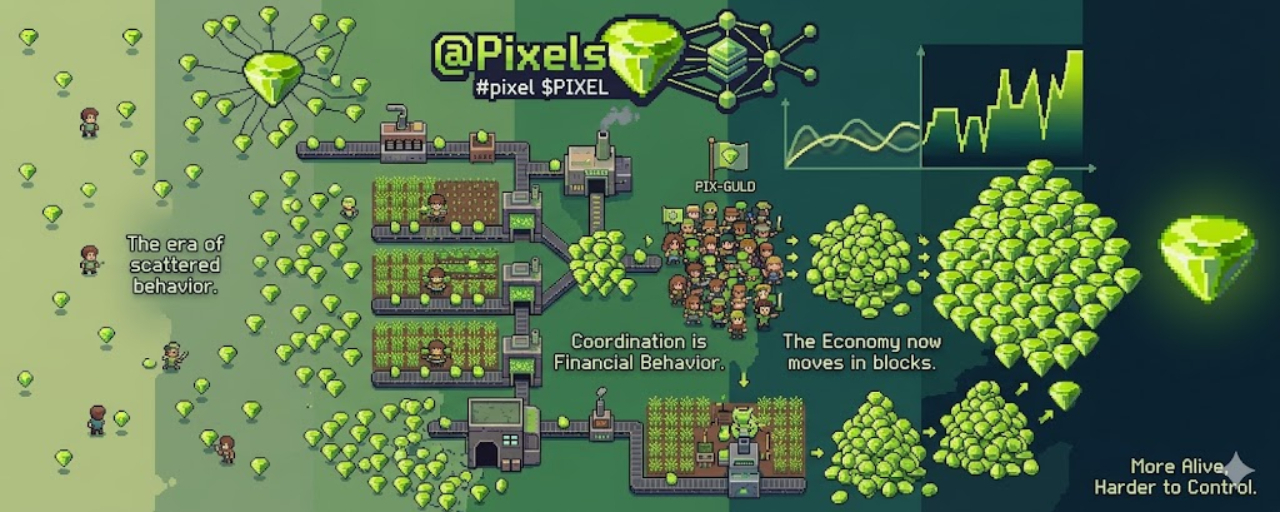
The first time I read about Pixels pushing harder into coordinated play, I did not read it as just another social upgrade.
I read it as a change in economic behavior.
That is a very different thing.
In most game updates, community features are easy to romanticize. Team up. Share progress. Build together. Strengthen retention. It all sounds healthy because socially it usually is. More connection tends to make a world feel less transactional and more worth returning to.
But in a tokenized game, coordination is never only social.
It is financial behavior happening in groups.
And once players start acting in groups, the economy stops moving with the rhythm of isolated decisions. It starts moving in blocks. More concentrated. More intentional. Sometimes more efficient than the system was originally designed to absorb.
That is the part I keep staring at.
Pixels has spent a long time trying to make game activity more meaningful, more durable, more connected to real participation instead of shallow extraction. That only works when incentives can still distinguish between healthy engagement and optimized behavior that drains value faster than it creates it.
Guild-like coordination complicates that line.
Because a coordinated group does not behave like ten separate players. It behaves like a small economic machine. It can divide labor. It can optimize routes. It can respond faster to reward opportunities. It can identify the highest-yield loop and push members into it with a level of discipline that solo players usually never reach.
That makes the world richer.
It also makes the reward layer more fragile if the system is still calibrated around individuals.
A lot of token economies look stable when behavior is scattered. Players farm at different times. Sell at different times. Stake with different levels of conviction. The noise creates softness. It spreads pressure across time.
Coordination removes some of that softness.
Now the same economy can experience synchronized farming, synchronized claiming, synchronized staking, synchronized exits. The metric on the dashboard may still look familiar. But the underlying behavior is no longer the same. And that difference matters more than people like to admit.
Because a healthy-looking number can hide a structural shift.
That is what makes Pixels interesting to me right now. Not just whether social systems improve retention. They probably will. The more important question is whether the economic model evolves at the same speed as the coordination layer.
If social depth grows faster than economic recalibration, the game becomes more engaging at the exact moment the token system becomes harder to read.
And Web3 has a habit of noticing those problems late.
Still, I do not read this as a negative.
A world where players form real groups, build strategies together, and care about shared outcomes is usually a stronger world than one built entirely around isolated optimization. That is part of what makes a game feel like a living place instead of a reward interface wearing a game skin.
Pixels is right to move in that direction.
I just think every step toward collective play is also a step toward collective economic power.
And collective economic power changes everything faster than the social framing suggests.
@Pixels #pixel $PIXEL $RAVE $PIEVERSE