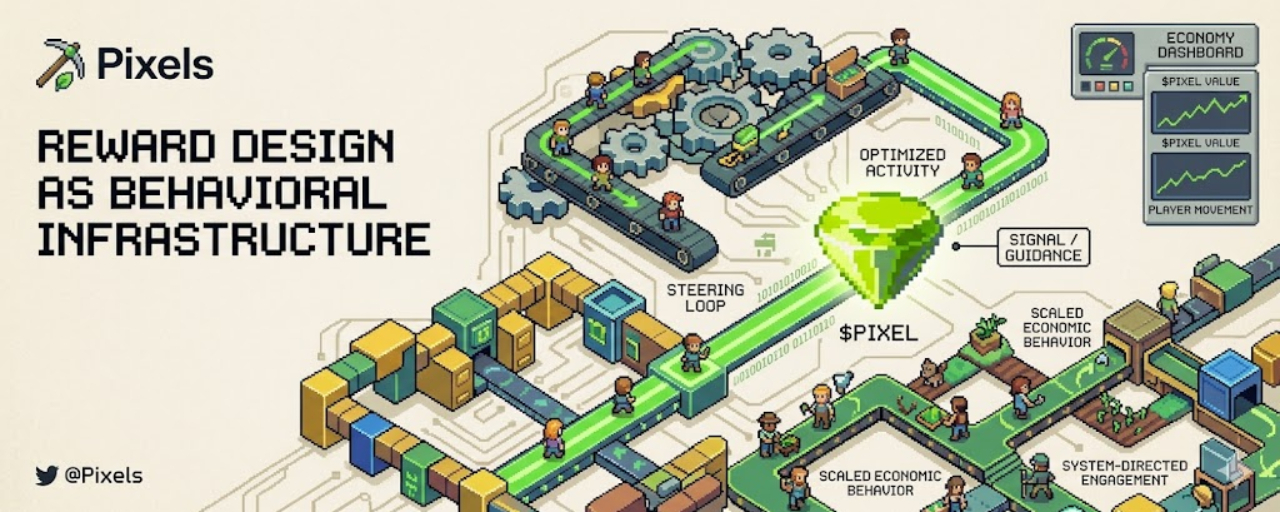
There was a point when I stopped reading reward design in Pixels as just a retention tool.
I started reading it as behavioral infrastructure.
And once I saw it that way, a lot of things stopped looking innocent.
In most games, rewards are framed as generosity. Play more, get more. Stay active, unlock benefits. The system gives players reasons to return, and that logic feels normal because it has existed in gaming for so long that people rarely question the structure underneath it.
But in Pixels, the reward layer feels like it is doing more than rewarding activity.
It is shaping activity.
That difference matters.
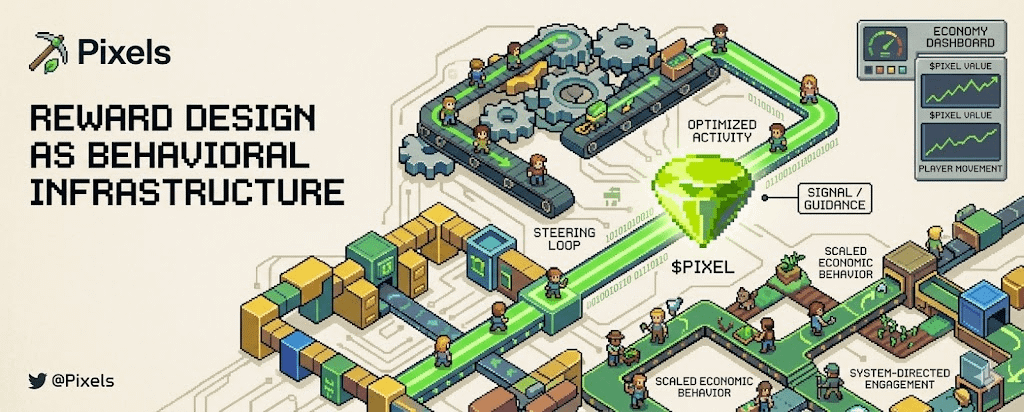
A reward is something you receive after behavior. Behavioral infrastructure is something that quietly organizes behavior before you even realize a decision is being made. It changes what feels worth doing. It changes what feels inefficient to ignore. Over time, it can narrow the gap between what players want and what the system wants until the player starts mistaking guidance for preference.
That is the part I keep thinking about.
Because the more sophisticated the reward logic becomes, the less it behaves like a bonus layer and the more it behaves like a steering mechanism. Certain actions become more visible. Certain loops become more attractive. Certain habits start feeling natural not because they were naturally fun, but because the incentive design kept pushing attention back toward them.
And in a tokenized environment, that pressure carries financial weight.
This is where Pixels becomes interesting in a way that most Web3 games are not. The system is no longer just asking whether rewards are large enough to attract users. It is asking whether reward architecture can influence player movement precisely enough to create durable economic behavior.
That is a much more serious design problem.
Because once rewards become behavioral steering, the economy is no longer shaped only by player intention. It is shaped by how effectively the system can guide intention at scale. That creates efficiency. It can also create dependence.
A player may feel active, but the more important question is whether that activity is self-directed or system-directed.
That line gets blurry fast.
Still, I do not think this is automatically bad. Games have always guided players. Good design always does. The real issue is not whether Pixels is influencing behavior. Of course it is. The issue is whether the reward structure is producing engagement that remains meaningful when the incentives become less visible.
Because if the system becomes too good at directing action, then the economy may start looking healthy for reasons that are less organic than they appear.
And economies built on guided behavior can look strong right until the guidance weakens.
That is why I keep coming back to PIXEL.
Not as a reward token.
As a signal inside a system that may be learning how to shape human attention more effectively than most people realize.
@Pixels #pixel $PIXEL $RAVE $PIEVERSE