
To be honest, there’s one thought I can’t seem to shake…
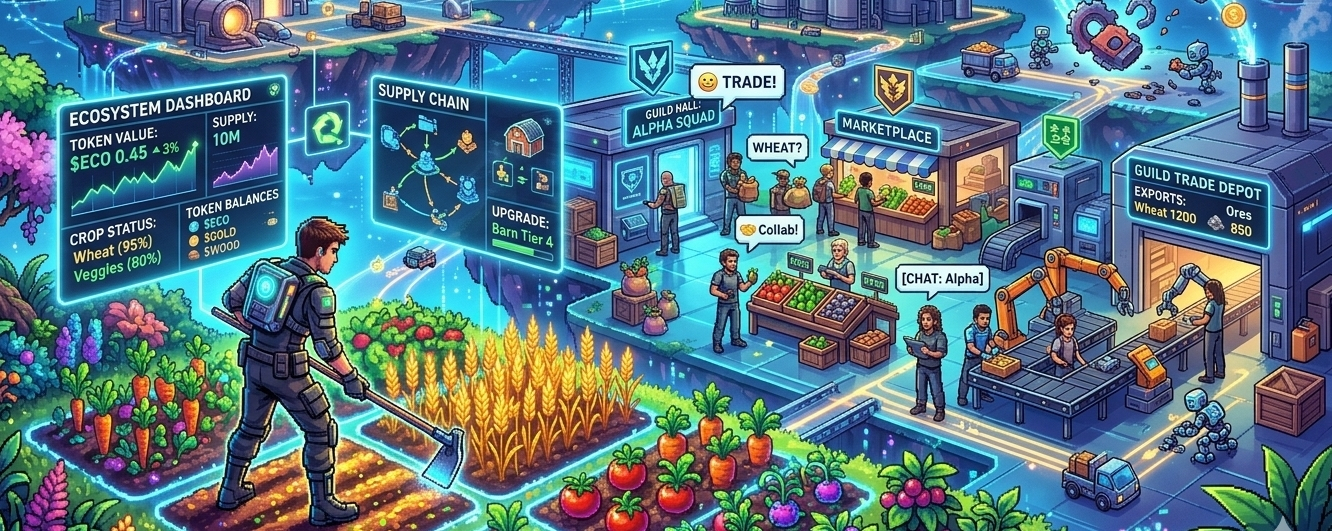
Is Pixels really just a game, or is it slowly evolving into something much bigger — almost like a digital economy of its own?
At first glance, everything feels familiar. Farming, crafting, earning tokens, collecting rewards — it all looks like a standard gameplay loop. But once you actually spend time inside, the experience starts to shift. It stops feeling like simple gameplay and begins to feel more like participation in a system that’s constantly trying to balance itself.
After going through the Pixels whitepaper, one thing becomes quite clear. The core challenge was never just about making the game engaging — it was about keeping the economy stable.
From early on, two major issues stood out. One was inflation, where tokens kept entering the system without enough meaningful ways to spend them. The other was the endgame gap, where players had reasons to begin but not enough motivation to stay long-term. When both of these problems exist together, the result is an economy that grows on the surface but feels empty underneath.
What Pixels is doing now feels like a direct response to that imbalance.
Take the Speck Upgrade system. It may sound simple at first, just expanding your land, but it introduces controlled growth. Expansion is possible, but it comes at increasing cost. Growth is no longer free, and that changes how players think about progression.
Then there’s crafting durability. Earlier, items felt almost permanent, but now they degrade with use. That one change alone reshapes demand, because items need to be recreated and resources need to circulate again.
Inventory caps follow the same logic. By limiting how much players can hold, the system reduces hoarding and keeps movement within the economy active.
All of this points toward a clear intention — turning a closed loop into a continuous cycle where activity never truly stops.
The real shift becomes more visible with Chapter 3.
With Bountyfall and the introduction of partner game criteria, Pixels begins to move beyond individual gameplay. It starts leaning into coordinated interaction. Players are no longer just farming for themselves; they’re becoming part of larger groups, managing supply chains, and controlling resources together.
Exploration realms bring procedurally generated islands into the picture, adding a sense of discovery rather than just repetition. Voyage Contracts, which require spending $PIXEL, tie access to content directly into the economic system.
LiveOps events like Fishing Frenzy and Harvest Rush feel less like casual additions and more like structured ways to keep players engaged and the system active.
At the same time, the social layer becomes more visible. Features like proximity chat, emotes, referral rewards, and share-to-earn mechanics are clearly designed to reduce the feeling of isolation that often exists in Web3 games. The experience is slowly shifting from something solitary to something network-driven.
Pixels Pals introduces another interesting direction. On the surface, it looks like a simple two-player pet experience, but underneath, it captures behavioral data that feeds into a smarter reward system.
Even the onboarding process reflects this shift. A wallet-free experience for the first seven days lowers friction for new users, while vPIXEL microtransactions quietly introduce a functioning micro-economy right from the start.
By 2026, the system feels far more structured.
Bountyfall brings faction-based competition into focus, where groups like Wildgroves, Seedwrights, and Reapers compete, and rewards are tied to collective performance rather than individual effort.
The addition of USDC rewards signals another major step. With a significant portion of the $PIXEL supply already released, the system appears to be stabilizing while also expanding beyond a single-token economy.
Then there’s the stacked system, an AI-driven reward engine that adjusts earnings based on player behavior. Not everyone progresses the same way anymore, and rewards are becoming more dynamic and personalized.
When you combine that with staking mechanics, where holding $PIXEL increases in-game productivity, it becomes clear that everything is interconnected.
At this point, Pixels doesn’t feel like just a game anymore. It feels like a layered system where economy, social interaction, and reward design are all working together.
And yet, the biggest question still remains.
No matter how well-designed the system is, everything ultimately depends on player motivation. If participation starts to feel forced or overly engineered, long-term engagement could become a challenge.
Still, one thing is undeniable. Pixels is no longer chasing hype — it’s trying to build structure.
It may not be perfect, but it’s clearly evolving.
And maybe the real question is no longer whether it will work.
Maybe it’s this — how naturally people will adapt to becoming part of a system like this, without even realizing it.