
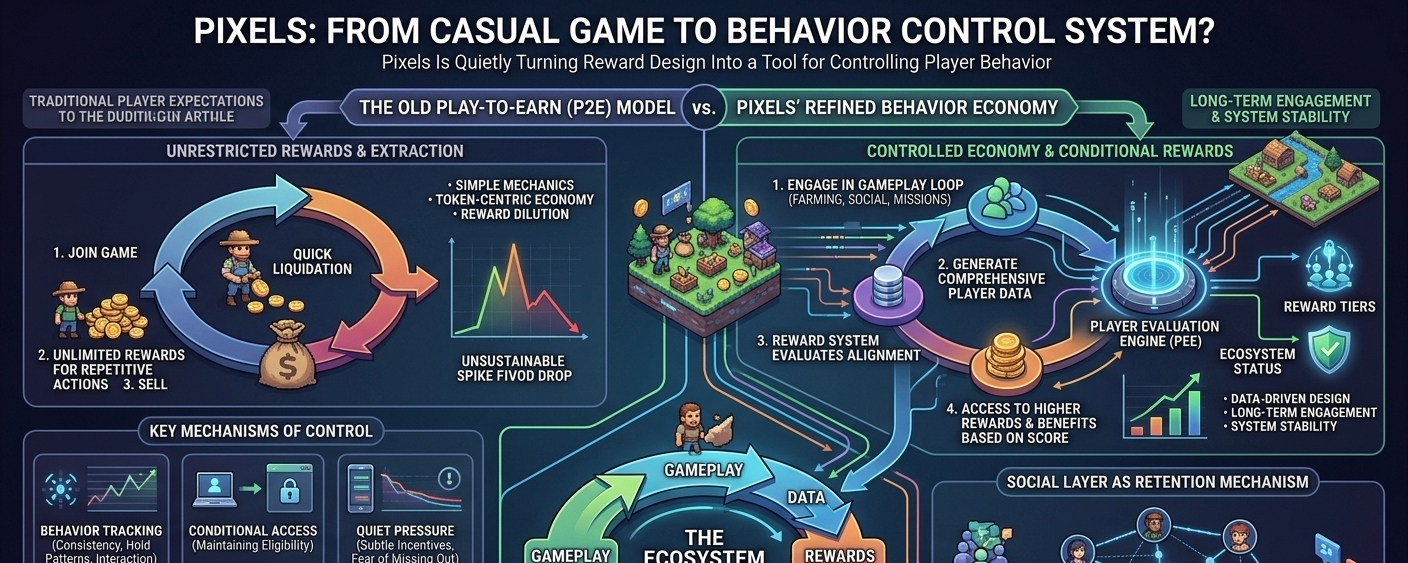
Pixels has reached the point where I’ve stopped looking at it like a game I casually check in on, and started looking at it like a system I’m being evaluated inside of. That shift didn’t happen all at once. At first, everything feels familiar. You log in, you follow the farming loop, you engage with the world, and it all carries that same surface-level simplicity most GameFi projects rely on. It’s comfortable by design. But the longer I stayed active, the more I started noticing that the real structure of Pixels isn’t built around gameplay alone—it’s built around behavior. And that’s where things start to feel different.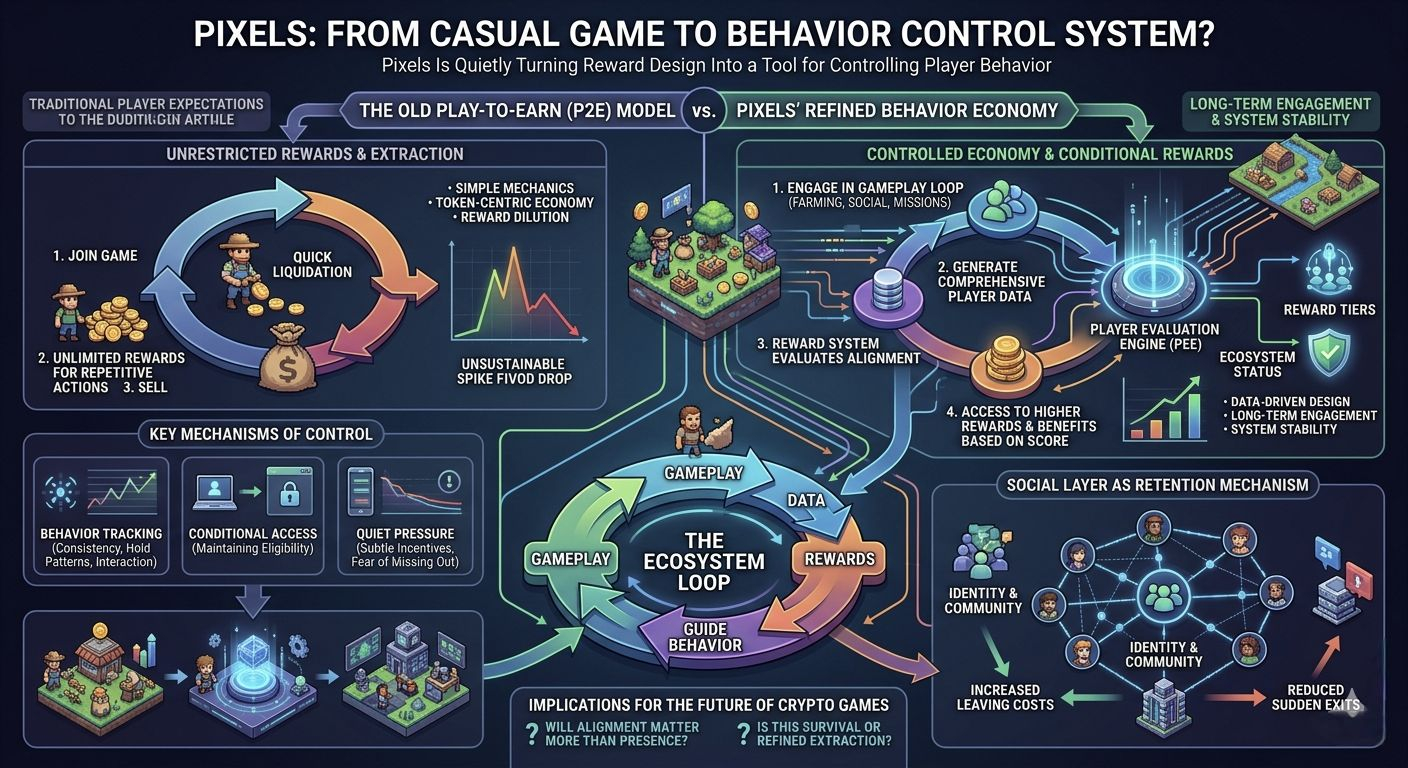
I’ve spent enough time in crypto games to recognize the usual cycle. Rewards get distributed broadly, users show up to farm them, tokens get sold, and what gets labeled as “activity” is really just extraction. I’ve seen projects call that growth, and I’ve seen how quickly it collapses once the incentives stop making sense. Pixels doesn’t feel unaware of that history. If anything, it feels like it was designed in response to it. What stands out to me now is that earning doesn’t feel automatic anymore—it feels conditional. The system seems to be constantly asking whether you are the kind of user it wants to keep rewarding, and that question quietly shapes how you move inside it.
The biggest shift I’ve noticed is how controlled the economy feels compared to older play-to-earn models. In the past, reward systems felt loose. If you understood the loop, you could optimize it, extract value, and move on. The system didn’t really care who you were—it just kept emitting rewards. Pixels feels tighter. Rewards don’t feel like something you can rely on indefinitely. They feel like something you need to maintain access to. I’ve caught myself thinking less about how much I can earn and more about whether I am still aligned with what the system wants. That alone changes the entire experience.
At some point, I stopped seeing the gameplay loop as the core product. The farming, progression, and social interaction are all real, but they also feel like tools—tools that allow the system to track behavior, evaluate participation, and guide outcomes. Gameplay generates data, data informs rewards, and rewards shape behavior. When you look at it this way, the structure becomes clearer. The game is not just there to entertain—it is there to organize how value moves through the ecosystem. And while I understand why that design exists, it still changes how the whole thing feels from the inside.
One of the more subtle things I’ve experienced is a kind of quiet pressure to behave “correctly.” Nothing forces you to act a certain way, but over time you start noticing patterns. Staying active feels safer than disappearing. Consistency feels more valuable than bursts of activity. Holding or reinvesting seems to align better than extracting quickly. You begin adjusting without being told to, and that’s what makes the system effective. It doesn’t need to control you directly if it can shape your incentives well enough.
The social layer plays a bigger role in this than it might seem at first. It looks like community building on the surface, but it also acts as a retention mechanism. When you build identity, connections, and routines inside the system, leaving becomes harder. The experience starts to feel less temporary. From an economic perspective, this keeps value circulating and reduces sudden exits. But it also reinforces the sense that everything is being designed not just for engagement, but for stability and control.
There comes a point where the experience stops feeling purely like a game. For me, that moment came when I realized I was thinking more about the system than the gameplay itself. I wasn’t just asking whether something was enjoyable—I was asking what it meant for my position inside the economy. That shift makes the experience deeper, but also less open. When a system prioritizes survival, it naturally becomes more selective. It starts rewarding behavior that supports it and filtering out what doesn’t.
This is where I find myself uncertain. On one hand, Pixels feels like progress. It is more aware, more controlled, and clearly trying to solve problems that broke earlier crypto games. On the other hand, it might just be a more refined version of the same loop—one where extraction still exists but is better managed, slower, and less visible. From the inside, it is not easy to tell which one is true.
What I do know is that Pixels is not just testing gameplay. It is testing whether reward design can guide behavior without making that control feel obvious. And from my experience, it is already working to some extent. The real question is what happens if this approach becomes standard. Because if it does, crypto games may stop being about simple participation and start becoming systems where alignment matters more than presence.
Maybe that is what survival looks like now. Or maybe it is just a more polished version of the same old model. Either way, it is hard not to feel that something fundamental is shifting—and I am still figuring out whether that shift is worth it.
