Look, I’ve seen this movie before.
A simple game shows up. Friendly graphics. Low barrier to entry. Then, quietly, it starts layering in ownership, tokens, markets. Before long, people aren’t just playing anymore. They’re calculating. That’s where Pixels sits right now, whether its fans want to admit it or not.
On the surface, it’s harmless. You plant crops. You gather resources. You walk around a pixel world and chat with other players. It feels like something you’d play to unwind. That’s the hook. That’s always the hook.
But let’s be honest. That’s not the real product.
The real product is the economy underneath.
The Core Problem They Claim to Fix
The pitch sounds reasonable. Traditional games lock players in. You spend time, maybe money, and you get nothing you truly own. Your items sit inside a company’s database. If the servers shut down, it’s gone. If the developer changes the rules, you deal with it.
So the argument goes: give players ownership. Let them trade assets freely. Let their time mean something outside the game.
It sounds tidy. On paper, at least.
And yes, that problem is real. Players have been creating value inside closed systems for decades while publishers capture most of it. No argument there.
But here’s where I start to lean back in my chair.
Because fixing that problem isn’t just about ownership. It’s about building a stable economy around that ownership. And that’s where things usually fall apart.
The “Solution” Is Just More Moving Parts
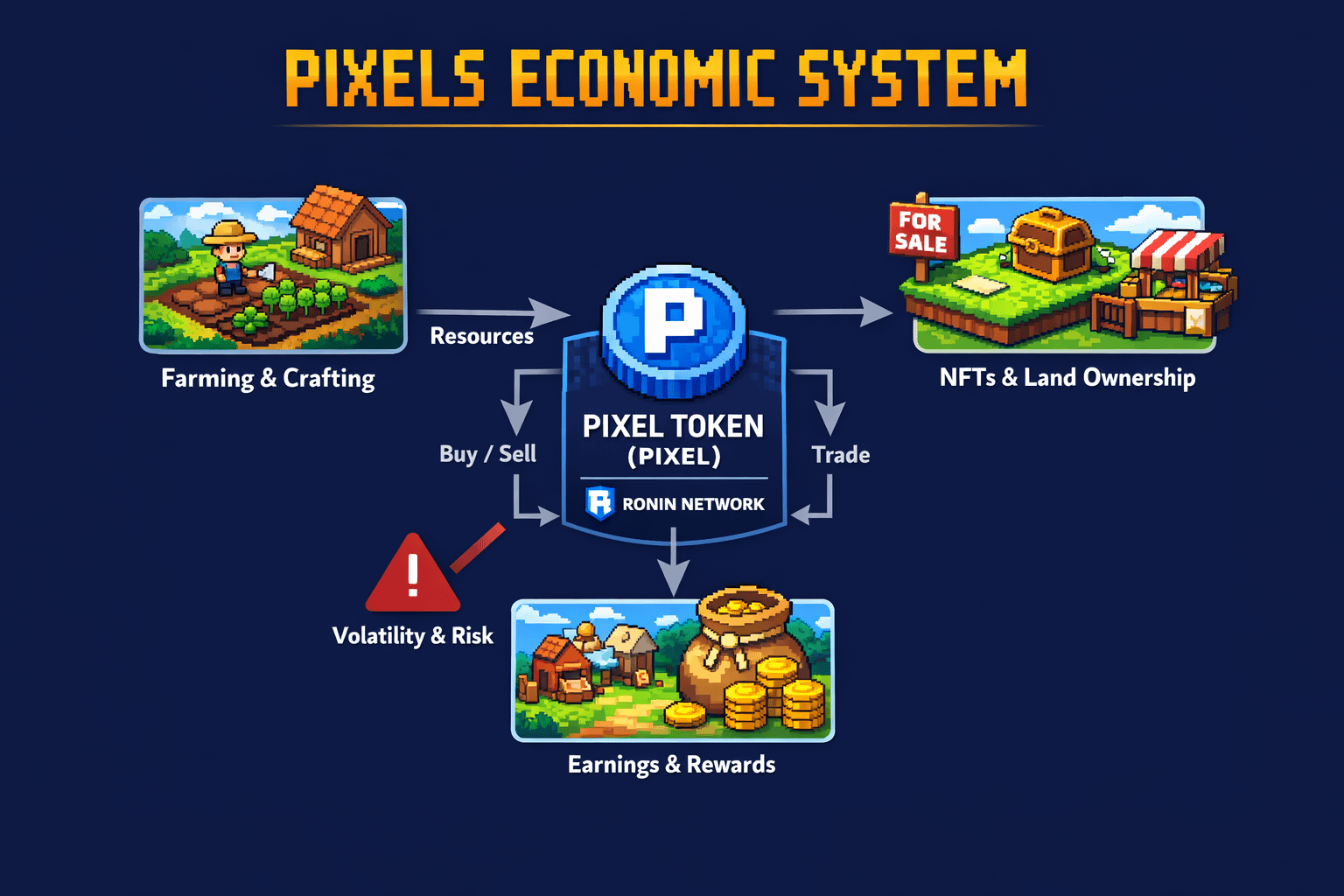
Pixels runs on the Ronin Network, which means your in-game assets are technically yours. You can trade them. Sell them. Move them around.
Sounds empowering.
But now you’ve added an entirely new layer of infrastructure between the player and the game. Wallets. Tokens. Network fees, even if they’re hidden. Security assumptions. Market liquidity.
That’s a lot of machinery for what used to be… planting virtual carrots.
I’ve seen this pattern across crypto projects. Take something simple. Add ownership. Add a token. Add a marketplace. Suddenly you’re not just playing—you’re participating in a small, fragile financial system.
And fragile is the key word.
Because every extra layer introduces new failure points. If the token drops, the incentives collapse. If liquidity dries up, your “owned” assets become souvenirs. If the network hiccups, the whole experience degrades.
The original problem was centralization. The solution replaces it with complexity.
And complexity tends to break in ways users don’t expect.
Follow the Money
Now let’s talk incentives. This is where things get uncomfortable.
Whenever a game introduces a token, you have to ask a basic question: who benefits the most?
Early participants. Always.
They accumulate assets when they’re cheap or easy to earn. As new players arrive, demand increases, and those early assets appreciate. It looks like organic growth. Sometimes it is. But often, it’s just a transfer of value from latecomers to early adopters.
I’ve watched this play out with earlier play-to-earn titles. The names change. The mechanics get tweaked. The underlying pattern doesn’t.
Pixels tries to soften this by focusing more on gameplay and less on pure extraction. Fair enough. It’s a smarter design choice.
But the economic gravity is still there. Tokens are issued. Assets are scarce. Players are incentivized to optimize for returns, not fun.
That shift matters more than people think.
Because once players start treating a game like work, the entire dynamic changes. You’re no longer asking, “Is this enjoyable?” You’re asking, “Is this worth my time financially?”
That’s a much harsher question.
The Centralization Nobody Mentions
Here’s another thing that gets glossed over.
Yes, assets are on-chain. Yes, you “own” them.
But the game itself? Still controlled by the developers.
They decide reward rates. They adjust mechanics. They introduce or remove sinks for the token. They can rebalance the entire economy with a patch.
So what exactly do you own?
You own pieces of a system you don’t control.
That’s not the same as decentralization. That’s more like holding stock in a company that doesn’t answer to you, except there are fewer safeguards and a lot more volatility.
And if the developer makes a bad call—which happens all the time in gaming—you feel it directly in your wallet, not just your gameplay experience.
The Catch Nobody Leads With
Here’s the part the marketing doesn’t emphasize.
For the system to work, it needs ongoing participation. Not just players, but engaged players who are willing to spend, trade, and hold assets.
If that slows down, everything tightens.
Token value comes under pressure. Trading activity drops. Assets become harder to sell. The “ownership” starts to feel theoretical rather than practical.
At that point, you’re left with a simple question.
Would you still play this game if there were no financial upside?
If the answer is no—or even “probably not”—then the entire structure is more dependent on economic incentives than it admits.
And those incentives are notoriously unstable.
I’ve seen entire ecosystems unravel because a single variable shifted. A reward tweak. A drop in new users. A broader market downturn. It doesn’t take much.
Pixels might be better designed than the last wave. It probably is. The interface is cleaner. The onboarding is smoother. The gameplay loop is at least trying to stand on its own.
But underneath, it’s still balancing the same equation that has tripped up dozens of projects before it.
And that equation doesn’t get easier just because the graphics are friendlier.
So when people talk about digital ownership and player-driven economies, I nod. The idea makes sense. It always has.
Then I look at the mechanics. The incentives. The reliance on constant engagement.
And I think: I’ve seen how this ends.