
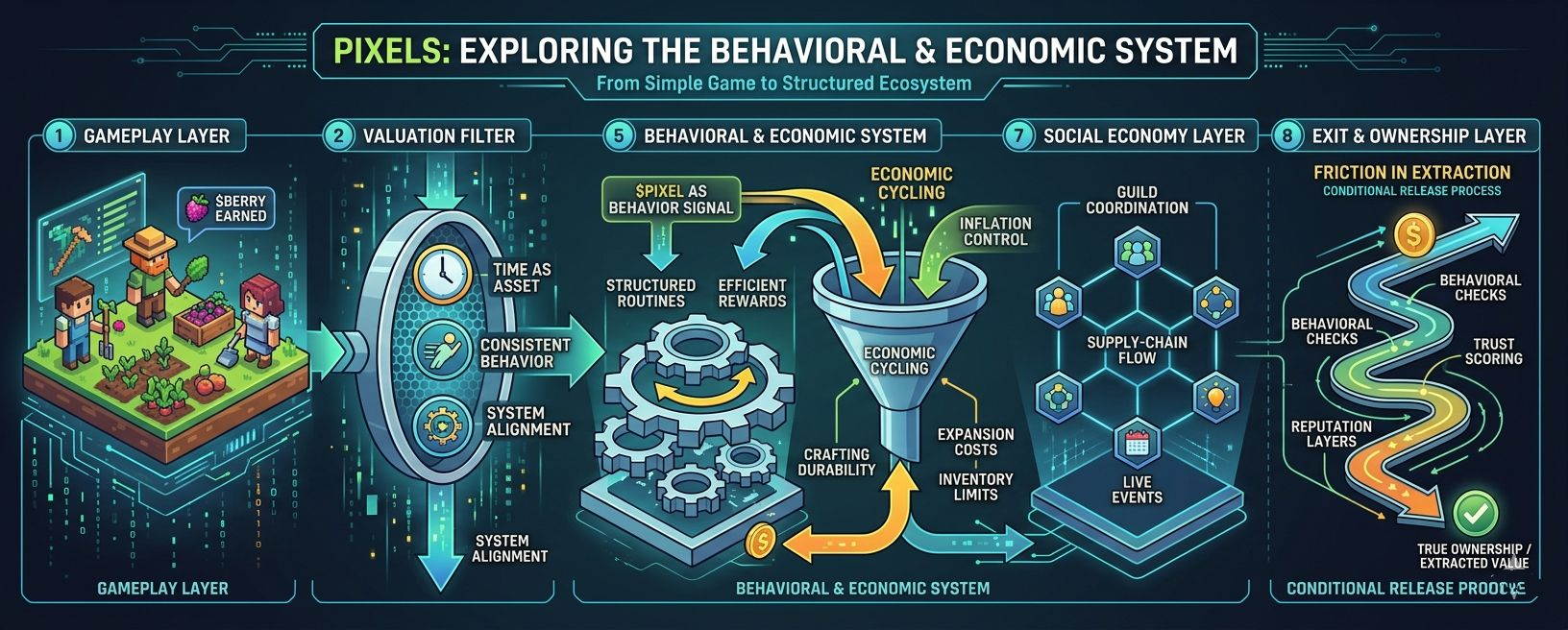

At first glance, @Pixels looks like a simple Web3 farming game. You log in, complete tasks, craft items, earn rewards, and slowly upgrade your farm. Everything feels familiar, almost like traditional farming simulators mixed with blockchain rewards.
But the deeper you observe it, the more it stops looking like just a game and starts looking like a structured digital economy built around behavior, time, and controlled value flow.
The real question is no longer “what is Pixels?”
It becomes: what is it actually trying to optimize? gameplay, or the system behind gameplay?
1. The Core Pressure: Inflation, Retention, and System Balance
Like many token-based ecosystems, Pixels faces two fundamental challenges.
First is inflation control. Tokens continuously enter the system through gameplay, but without strong sinks, value can dilute over time.
Second is the retention problem. Early engagement is usually strong, but long-term motivation becomes difficult when progression becomes predictable or repetitive.
Instead of solving this with simple reward scaling, Pixels seems to be building structural controls inside the economy itself.
This is where its design starts becoming more complex than standard GameFi systems.
2. Controlled Progression Instead of Free Growth
Recent system design choices suggest a shift from open-ended farming to controlled economic circulation:
Expansion systems allow growth but introduce increasing costs
Crafting durability reduces permanence, forcing repeated demand
Inventory limits discourage hoarding and keep assets circulating
These are not just gameplay tweaks. They function as economic pressure tools.
The result is a loop that looks less like accumulation and more like continuous regeneration:
create → consume → upgrade → repeat
Instead of letting value settle permanently, the system keeps it moving.
3. From Farming Game to Social Economy
As Pixels evolves, it moves away from isolated gameplay toward structured social coordination.
New layers include:
Guild-based systems and faction competition
Supply-chain style coordination between players
Exploration-based content that reduces repetitive grinding
Live events designed to constantly refresh engagement
Social mechanics like proximity interaction and referrals
This transforms Pixels from a solo farming experience into a network-driven economy where progress depends on collective activity.
Players are no longer just farming they are participating in a shared system of production and coordination.
4. The Hidden Layer: Exit, Ownership, and Friction
One of the most important shifts appears not inside gameplay but at the boundary between in-game value and external ownership.
Inside the game, earning feels smooth. Tasks complete, rewards appear, and progression feels immediate.
But when value tries to exit the system, friction appears:
behavioral checks and trust-like systems
delayed settlement for certain users
inconsistent exit speed between similar earnings
reputation or activity-based evaluation layers
This creates a separation between:
earning value vs. successfully extracting value
Which leads to a deeper structural question:
If value cannot freely exit at the moment it is earned, then when is it truly owned?
In this system, ownership seems less like instant possession and more like a conditional release process controlled by system logic.
5. Time as a Measurable Asset
Beyond tokens and rewards, Pixels appears to treat player time as something more structured than simple engagement.
Not all activity produces equal results. Instead, the system seems to respond differently to:
consistent behavior vs. random play
structured routines vs. chaotic interaction
predictable patterns vs. experimental actions
Over time, this creates a system where time is not just spent it is categorized and evaluated.
This means player behavior becomes something like a dataset.
And when behavior becomes structured, it becomes usable.
6. $PIXEL and the Shift From Reward to Behavior Signal
In this context, $PIXEL is not just a reward token.
It becomes a medium that reflects how well a player’s behavior aligns with the system’s preferred patterns.
This creates an indirect feedback loop:
structured behavior feels more efficient
efficiency leads to smoother rewards
smoother rewards reinforce similar behavior
Over time, players naturally adjust without being explicitly forced.
The system does not need to control behavior directly it simply rewards patterns that fit its internal logic.
7. Social Systems, Engagement Loops, and Economic Cycling
To maintain long-term stability, Pixels introduces continuous engagement mechanisms:
Live events that reset activity cycles
Exploration zones that prevent repetitive stagnation
Group-based reward distribution
Activity-driven economic sinks
These systems ensure that value does not remain static. Instead, it keeps circulating through different layers of gameplay and social interaction.
This creates a self-reinforcing structure where:
activity generates value → value drives behavior → behavior sustains activity
8. The Real Transformation: From Game to System
When all layers are combined, Pixels no longer looks like a traditional game economy.
It resembles a multi-layered behavioral and economic system:
Gameplay layer → generates activity
Economic layer → regulates value flow
Social layer → structures coordination
Exit layer → controls value extraction
Behavioral layer → influences player patterns
Each layer is connected, and each one reinforces the others.
The result is not just gameplay it is a managed digital ecosystem where behavior, economy, and reward are tightly linked.
Conclusion: What Pixels Is Really Testing
Pixels is not just testing game mechanics or token utility.
It is experimenting with a deeper question:
How can a digital system maintain long-term stability by controlling:
how value is created
how behavior is shaped
how time is structured
and how easily value is allowed to leave
The most important shift is subtle but powerful:
It is no longer just about earning rewards.
It is about how those rewards are formed, filtered, and finally allowed to become real outside the system.
In that sense, Pixels is less a game and more an evolving experiment in structured digital economies built on human behavior loops.