
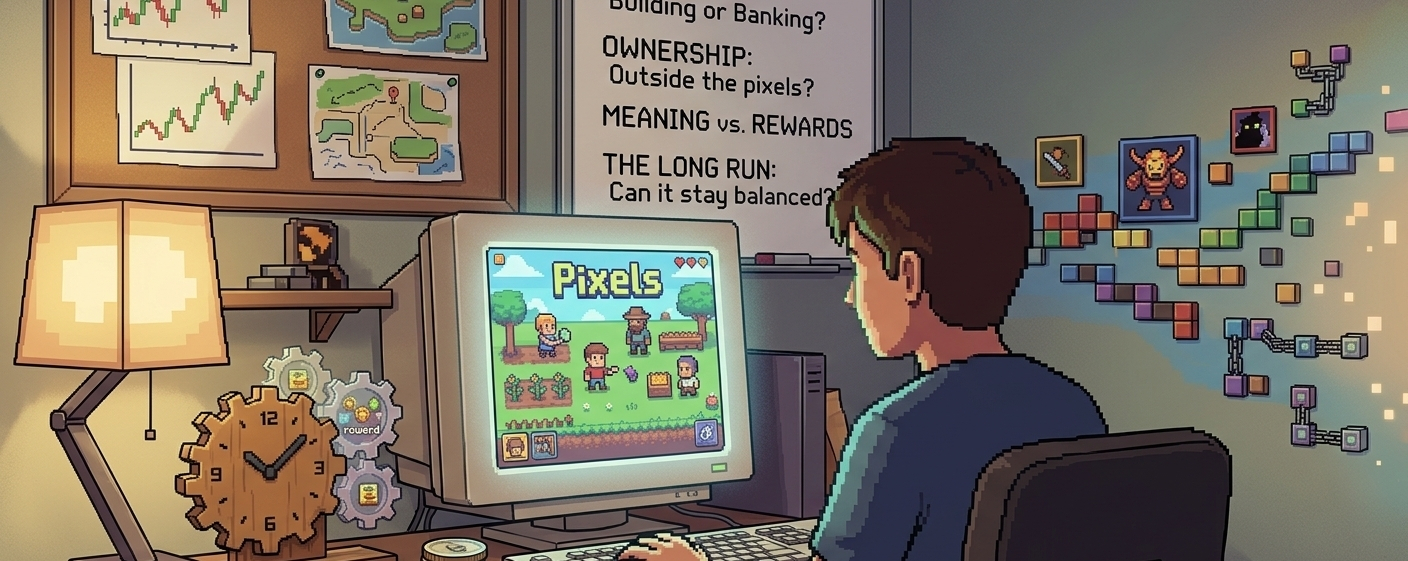
I’ve been thinking about something that sounds simple, but gets complicated the more I sit with it: what exactly happens to the time I spend in games?
When I play, it doesn’t feel like I’m wasting time. I’m building something, working toward progress, interacting with systems that respond to what I do. It feels active. Sometimes even productive in its own way. But at the same time, I know that everything I create stays locked inside that game world. If the game changes, shuts down, or I stop playing, all of it just disappears from my control.
That’s always been normal in gaming. I just didn’t question it much before.
Then the idea of “ownership in games” started showing up more seriously through blockchain-based systems. The promise was straightforward: if I spend time building something, I should be able to own it outside the game too. Not just as a memory, but as something persistent and transferable.
At first, that sounded like a real shift. Like games might finally start recognizing player time as something more than just entertainment.
But what I noticed in practice was more complicated. A lot of those early systems quickly became focused on rewards. Instead of just playing, I found myself watching incentives, tracking value, and thinking in terms of output. The game part sometimes felt secondary.
And when those incentives slowed down, many of those systems didn’t hold up well. It showed me something important: ownership alone doesn’t automatically make a game meaningful. If the underlying experience isn’t strong, the economic layer can’t carry it for long.
Pixels sits in that same space, but in a more restrained way.
When I first look at it, it doesn’t feel like a complicated system. It feels familiar. Farming, gathering, crafting, trading—basic game loops that are easy to understand without needing to think about anything technical.
That simplicity matters. It means I can actually just play without constantly thinking about economics or systems in the background.
But there is another layer underneath that I can’t ignore. Some parts of what I earn or collect aren’t just stuck inside the game. They exist in a way that connects to a wider system of ownership beyond the immediate gameplay.
What stands out to me is that this layer isn’t forced into every moment. I can engage with it if I want, or I can mostly just play normally. It doesn’t interrupt the basic experience in the same way earlier systems sometimes did.
There’s also a social structure running through it. I don’t really progress in isolation. Trading, cooperation, and interaction with other players actually matter. The world feels shaped by how people move through it together, not just by individual effort.
But even with that, I still notice some tension. Not everyone experiences the game the same way. Some players naturally progress faster because they understand the system earlier or invest more time and attention into it. Others stay more casual, and the gap between those experiences can slowly become visible.
There’s also the question of how stable this kind of design can be over time. Any system that depends on player behavior and internal economies has to constantly adjust. If it doesn’t, things can drift—either toward over-optimization or toward stagnation.
So when I look at Pixels, I don’t really see a finished answer. I see a work in progress trying to balance two different ideas: playing for enjoyment, and playing in a system where what I do might carry value beyond the game itself.
And I keep wondering if those two ideas can actually stay balanced in the long run.
Because once my time in a game starts to have value outside of it, does that make the experience feel more meaningful—or does it quietly change what “playing” even means in the first place?
