
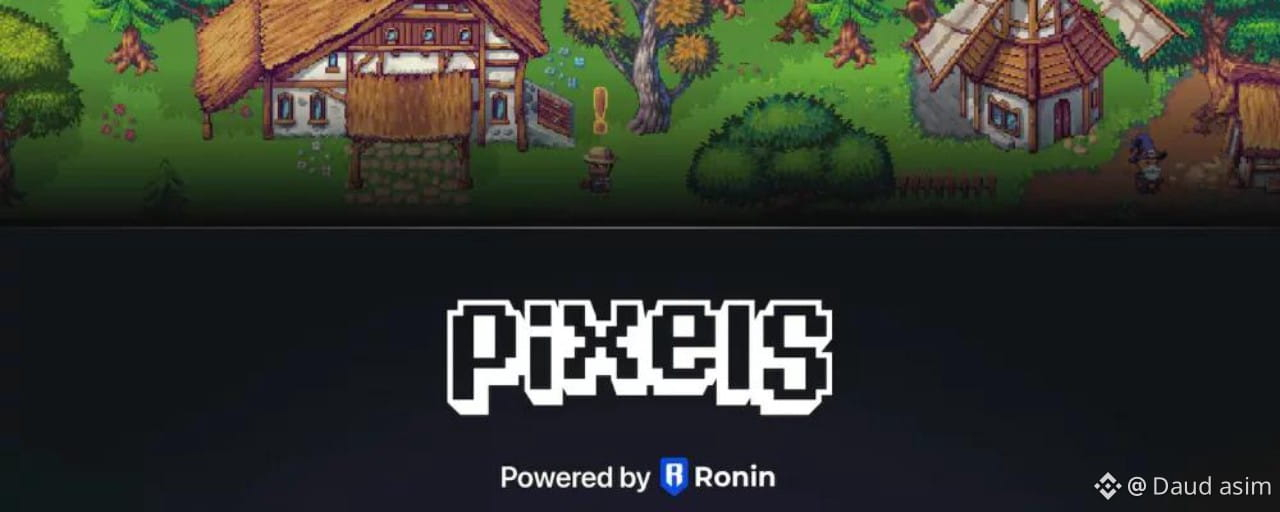
$PIXEL (@Pixels ) is a Web3 gaming project that sits at the intersection of blockchain technology, NFTs, and social gaming. Unlike many cryptocurrencies that rely heavily on speculation or abstract utility, Pixels is anchored to a live, playable game ecosystem. This alone sets it apart in a crowded crypto market where many projects promise utility but fail to deliver a functioning product.
At its core, Pixels is a browser-based farming and social simulation game, often compared to traditional titles like Stardew Valley, but with a blockchain-based economy layered on top. The PIXEL token powers this economy, enabling transactions, rewards, governance, and premium features.
What makes Pixels interesting from a fundamental perspective is not just its token, but the entire digital economy being built around user participation. The more players engage with the game, the more demand is theoretically created for PIXEL. This creates a feedback loop that is very different from typical cryptocurrencies.
⚙️ Core Fundamentals
🎮 Product and Utility
The strongest pillar of Pixels is its real utility inside a functioning ecosystem. PIXEL is not just a store of value; it is actively used within the game.
Key utilities include:
Purchasing in-game items and NFTs
Unlocking premium features and VIP access
Participating in social and guild-based activities
Acting as a core reward currency for gameplay
This makes PIXEL a utility token first, speculative asset second. From a fundamental standpoint, this is a positive signal because utility creates organic demand.
The game itself revolves around farming, exploration, crafting, and trading. Players can own digital land, grow crops, interact with other players, and build their own economic strategies. This player-driven system gives PIXEL a role similar to a currency inside a digital nation.
🌐 Ecosystem and Network (Ronin Integration)
Pixels operates on the Ronin Network, a blockchain specifically designed for gaming. This is a critical strategic decision.
Ronin gained popularity through Axie Infinity, one of the first major GameFi successes. By building on Ronin, Pixels benefits from:
Low transaction fees
Fast transaction speeds
Existing gaming-focused infrastructure
Access to a Web3-native gaming audience
This reduces friction for players, which is essential for mass adoption. High gas fees on Ethereum have historically limited GameFi growth, so this move positions Pixels for scalability.
🧑💻 Team and Development Approach
Pixels is led by Luke Barwikowski and a team with a mix of gaming and blockchain experience. One notable aspect of the team is their product-first mindset.
Instead of focusing purely on token hype or marketing, the team prioritized:
Building a playable game early
Iterating based on user feedback
Expanding gameplay before pushing token economics
This approach is relatively rare in the crypto space, where many projects launch tokens before having a working product.
The development style appears to follow a live-service model, similar to traditional gaming companies. This means continuous updates, feature additions, and player engagement strategies rather than a one-time product launch.
📊 Tokenomics Analysis
PIXEL has a maximum supply of around 5 billion tokens. This is relatively high compared to many cryptocurrencies, which introduces potential inflation concerns.
However, tokenomics must be evaluated in context.
🔑 Key Considerations:
A large supply is often necessary for in-game economies
Tokens are distributed through rewards, incentives, and ecosystem growth
Demand is tied to player activity rather than speculation alone
If the player base grows, token circulation increases alongside utility demand. This creates a balancing mechanism.
However, if growth stagnates, inflation can become a serious issue, as more tokens enter the market without sufficient demand.
From a fundamental standpoint, PIXEL’s tokenomics are high-risk, high-reward:
Success scenario → strong utility demand offsets inflation
Failure scenario → token dilution reduces value
🚀 Development Progress
One of Pixels’ strongest indicators is its execution track record.
✔️ What They’ve Already Achieved:
Launched a fully playable browser-based game
Built an active player community
Migrated to Ronin for scalability
Integrated NFTs and token-based rewards
Achieved listings on major crypto exchanges
This is significant because many GameFi projects never move beyond whitepapers or early demos.
Pixels, on the other hand, has demonstrated:
Real user engagement
Continuous updates
A functioning economy
This reduces execution risk, which is one of the biggest risks in early-stage crypto projects.
🗺️ Roadmap and Future Vision
Pixels’ roadmap is less about fixed deadlines and more about progressive ecosystem expansion.
🔮 Short-Term Goals
Expanding gameplay features (quests, crafting systems)
Improving onboarding for non-crypto users
Enhancing user interface and accessibility
The focus here is clearly on user growth and retention.
🌐 Mid-Term Vision
Introduction of guild systems
Expansion of social and cooperative gameplay
Deeper NFT integration and player ownership
This phase aims to transform Pixels from a simple game into a social economy platform.
🏛️ Long-Term Vision
Transition toward decentralized governance (DAO)
Full player-driven economy
Potential expansion into a broader metaverse
If executed successfully, Pixels could evolve into a self-sustaining digital world, where players control both the economy and governance.
⚖️ Strengths and Competitive Advantages
✅ 1. Real Product
Unlike many crypto projects, Pixels already has a working, playable game. This significantly reduces speculation risk.
✅ 2. Strong User-Centric Model
The economy is driven by player activity, not just investor sentiment. This aligns long-term success with user engagement.
✅ 3. Strategic Blockchain Choice
Building on Ronin gives Pixels a major advantage in terms of scalability and cost efficiency.
✅ 4. Continuous Development
The team is actively improving the game, which is critical for retaining players in a competitive market.
⚠️ Risks and Challenges
❗ 1. Dependence on Game Popularity
PIXEL’s value is directly tied to the success of the game. If user interest declines, demand for the token will drop.
❗ 2. GameFi Volatility
The GameFi sector is known for hype cycles. Projects often see rapid growth followed by sharp declines.
❗ 3. Token Inflation
A large supply can create downward pressure on price if demand does not keep up.
❗ 4. Competition
Pixels competes with both:
Traditional games (which often have better gameplay)
Other blockchain games (fighting for the same audience)
🧠 Final Fundamental Perspective
Pixels (PIXEL) represents a new generation of crypto projects where value is tied to actual usage rather than speculation alone.
From a fundamental standpoint, it sits in a unique position:
More credible than meme coins
More risky than established Layer 1 or infrastructure projects
Highly dependent on execution and user growth
The project’s biggest strength is its live ecosystem and active development, while its biggest risk is long-term player retention.
If Pixels succeeds in building a large and engaged player base, PIXEL could become a core currency within a thriving digital economy.
If it fails to maintain interest, the token may struggle due to inflation and reduced demand.
$PIXEL #pixel #StrategyBTCPurchase #KelpDAOFacesAttack #AltcoinRecoverySignals? #RheaFinanceReleasesAttackInvestigation