

I Will Be Honest
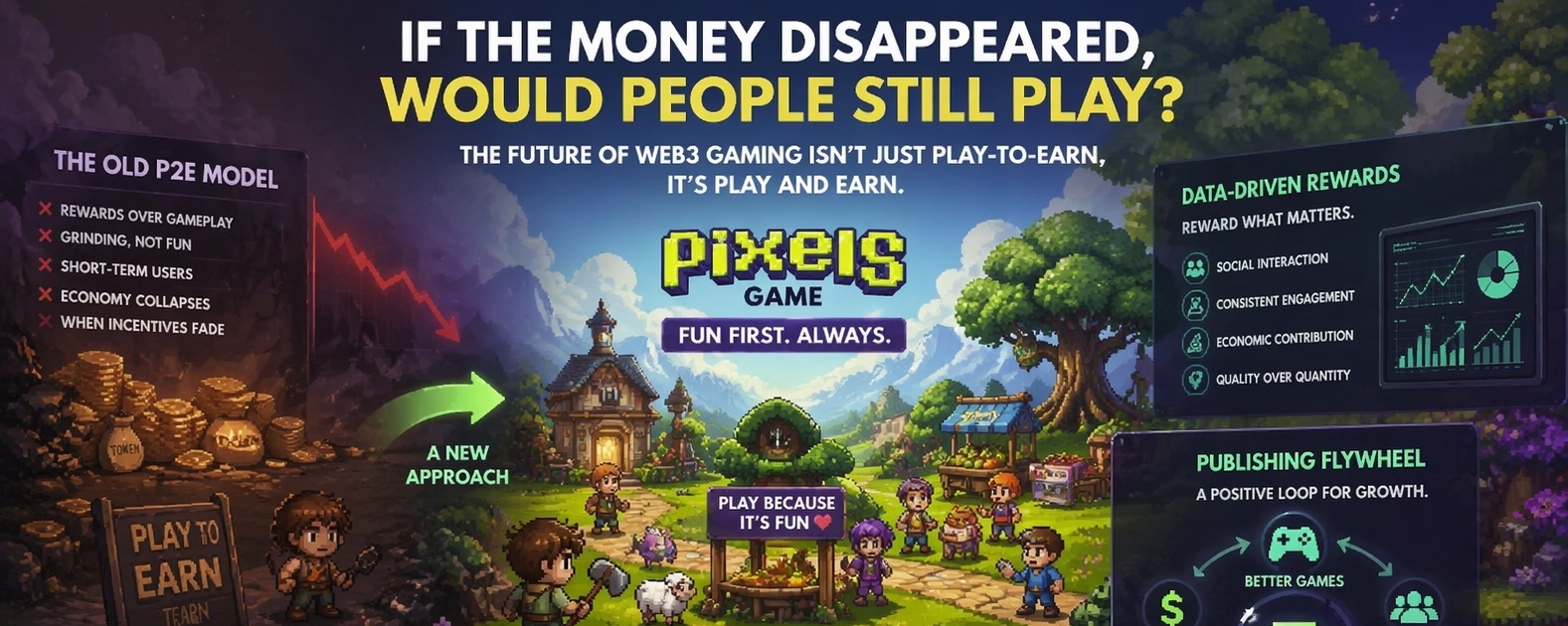
That Question sounds Uncomfortable, but it cuts yeah Straight to the core of the play-To-earn (P2E) model. Over the past few years, I’ve seen countless blockchain games explode in popularity, only to fade just as quickly. The pattern is familiar early users rush in for Rewards, token prices rise, and then everything slows down when incentives weaken. It makes me wonder if the industry has been solving the wrong problem all along.
The Biggest issue With traditional P2E is not technology. It’s human behavior.
Most systems Reward activity, not value. Players are encouraged to grind, Farm, and extract as much as possible in the shortest time. In my experience, This creates a fragile economy. New users are needed to sustain rewards, and once growth slows, The system struggles. It becomes less like a Game and more like a temporary income source. And when that income drops, so does user interest.
What makes this more complex is that many people underestimate how important “Fun” actually is. In traditional gaming, fun is the product. In Web3 gaming, Rewards often became the product. That shift changes everything. When financial incentives become the main driver, gameplay becomes secondary. And once gameplay loses depth, Retention becomes nearly impossible.
I’ve looked at different attempts to fix this, and most solutions focus on tweaking Tokenomics Burn mechanisms, staking models, Or limited supply. But these are often surface-level adjustments. They don’t address the core issue: Why should someone stay if they are not genuinely enjoying the experience?
This is where I started looking deeper into Pixels Game, not as a fan, But as a researcher trying to understand whether a different approach is actually possible.
What caught my Attention is that the idea doesn’t begin with earnings. it begins with enjoyment. That sounds obvious, but in the context of Web3, it’s surprisingly rare. The “fun first” approach shifts the priority back to something traditional gaming has always understood well: if players enjoy the game, they stay. If they stay, Everything else becomes easier to build.
But Pixels doesn’t stop there. What I find more interesting is how they approach rewards. Instead of distributing tokens broadly and hoping for organic growth, the system tries to be selective. They use data to understand which player behaviors actually contribute to the ecosystem. In simple terms, Not all activity is treated equally.
I see this as a Subtle But important shift. Rather than rewarding pure grinding, the idea is to reward meaningful participation. This could include social interaction, consistent engagement, or actions that improve the in-Game economy. If done correctly, this reduces wasteful emissions and aligns incentives more closely with long-term growth.
Another concept I find worth discussing is what they describe as a kind of publishing flywheel. The logic is straightforward: better games attract better players, which generates better data. That data then helps improve targeting and reduces user acquisition costs. Lower costs attract more developers, and the cycle continues.
From my perspective, this is less about gaming and more about building an ecosystem. It reminds me of how modern digital platforms evolve Not through one product, But through interconnected systems that reinforce each other over time.
Now, the real question is whether this model can actually work at scale.
If Pixels succeeds in aligning fun, data, and incentives, it could change how we think about Web3 gaming. Instead of short-lived economic spikes, We might see more stable and sustainable environments. Players wouldn’t just come for rewards. they would stay because the experience itself is valuable.
But I also see Challenges. Data-driven reward systems sound powerful, But they depend heavily on execution. If the system misjudges value or becomes too Complex, it could confuse users or create unintended imbalances. There’s also the risk that over-optimization removes the organic feel that makes games enjoyable in the first place.
Still, I think the direction is worth paying attention to. For the first time in a while, I see an approach that doesn’t try to “force” sustainability through token design alone. Instead, it tries to rebuild the foundation. Starting with player experience and then layering incentives on top.
If this idea spreads, we could see a broader shift in the industry. Developers might start focusing less on short-term token performance and more on long-term engagement. Players might begin to value time spent in-game not just for earnings, but for entertainment and community.
And that brings me back to my original question.
If the money disappeared, would people still play?
Because if the answer becomes “yes,” then play-to-earn might finally evolve into something more sustainable something closer to “play and earn,” where earning is a bonus, not the reason.
I’ve been thinking about this a lot, and I’m curious how others see it.
Do you think fun-first design is enough to fix P2E?
Can data-driven rewards really create fair and sustainable systems?
Or are we still too early to solve the core issues of Web3 gaming?
From what I’ve seen and studied, the future of this space won’t be decided by who offers the highest rewards. But by who builds experiences people genuinely don’t want to leave.@Pixels #pixel $PIXEL