
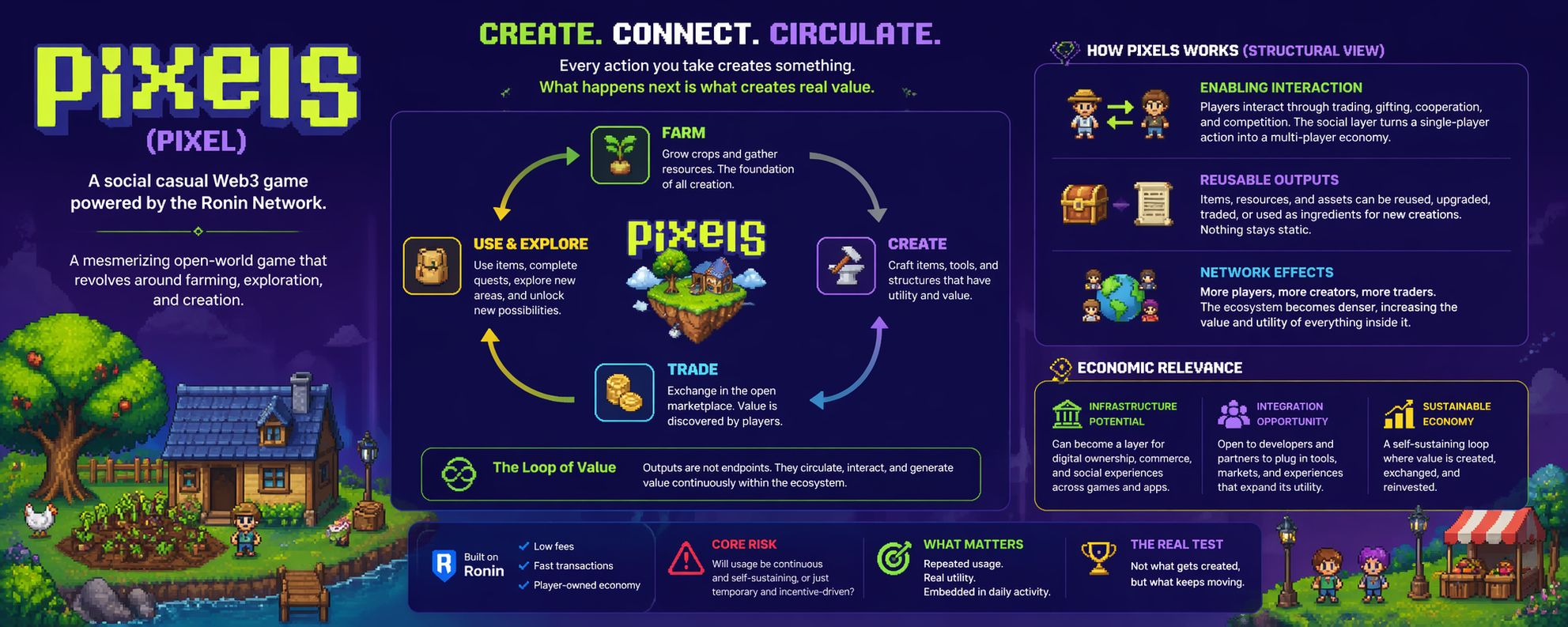

I used to think games like Pixels were just another layer of abstraction dressed up as innovation. Oh a token here, a virtual farm there a promise of “ownership” it all felt like a surface narrative I had seen too many times before. I assumed the value stopped at creation: you plant you earn you trade and that’s the loop. Clean simple… and honestly a bit naive.
But that view started to crack when I stopped asking what the system offers and started asking what actually happens after something is created. Okay, you grow crops craft items build assets then what? Do those outputs just sit in a wallet like digital trophies or do they continue to move, interact, and generate value within a living system?
That’s where my perspective shifted. I realized most systems don’t fail because they lack features they fail because nothing meaningful happens after the initial action. It’s like building a factory that produces goods no one uses. Creation without circulation is just decoration.
Pixels, at least structurally tries to push beyond that. The farming exploration and crafting aren’t isolated mechanics they’re designed to feed into each other. One player’s output becomes another player’s input. It reminds me of a small-town economy: a farmer grows crops a merchant trades them a builder uses the proceeds to expand infrastructure. If that loop actually sustains itself, then you don’t just have a game you have a functioning micro-economy.
The key question is whether these interactions are real or just temporarily stimulated. Because yeah incentives can make anything look alive for a while. The real test is whether players need each other over time or if they’re just farming rewards in parallel.
What I find more interesting is how outputs can be reused and referenced. If something I create today still has relevance tomorrow if it feeds into another system another player another layer of activity then it’s not static anymore. It’s part of a flow. That’s where network effects begin to form not from user count alone but from the density of interactions between users.
Still, I’m cautious. There’s a difference between potential and proven behavior. Pixels is positioned well it sits at the intersection of gaming and economic participation which is a powerful narrative. But maturity isn’t about positioning it’s about consistency. Are people engaging daily because the system makes sense, or because rewards are temporarily attractive? Is activity spreading across participants or is it concentrated among a small, optimized group?
Because here’s the uncomfortable truth: most Web3 systems look alive during incentive phases and hollow out once those incentives fade. The real risk isn’t failure at launch it’s decay over time.
So I keep coming back to the same filter. Are players developers and even external participants finding reasons to stay without being pushed? Are the outputs of this system integrating into something broader or are they trapped within the game’s boundaries?
For me confidence would increase if I see repeated organic usage not spikes but steady rhythms. If assets and actions inside the system start to feel necessary rather than optional. If new participants enter not because of hype but because there’s clear utility in joining the flow.
On the other hand, I’d get cautious if activity feels event-driven if value creation doesn’t translate into continued usage or if the system needs constant incentives to maintain engagement. That’s usually a sign the engine isn’t self-sustaining.
Yeah I’ve stopped being impressed by what systems can create. That part is easy. What matters what really separates signal from noise is what happens next. The systems that matter aren’t the ones producing assets; they’re the ones where those assets keep moving, keep being used and quietly embed themselves into everyday activity without needing constant attention.