
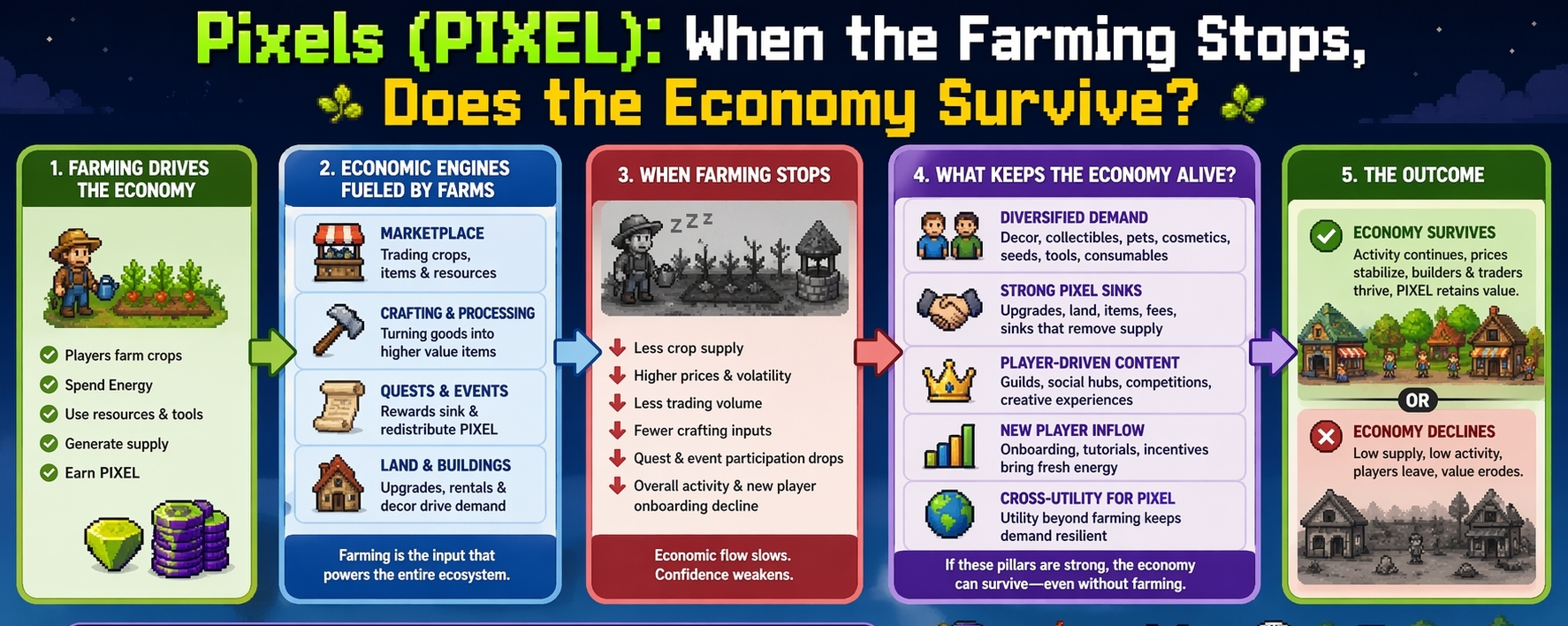

I keep catching myself checking PIXEL late at night—not because it screams “buy,” but because it feels like a familiar pattern I’ve watched play out before. Web3 games trying to turn player activity into something that actually lasts.
On the surface, Pixels makes sense. It’s simple, almost intentionally so. Farming, social interaction, light MMO elements—all built on Ronin. It doesn’t try to overwhelm you. I can see the strategy: pull people in with something familiar, then slowly layer in the token economy. That part feels well thought out.
But I don’t stay for the gameplay—I drift to the numbers.
At ~$0.007–$0.008 with a market cap around $25–28M, what really stands out to me is the volume. Sometimes it’s unusually high compared to the market cap. That kind of activity doesn’t immediately signal real demand to me—it often points to incentives, rotations, short-term positioning. It’s movement, but not necessarily conviction.
Then there’s supply. Around 67% is already circulating, which sounds reassuring at first. But unlocks are still happening in the background, quietly adding pressure. And when I look at the 39% allocated to community incentives, I can’t ignore what that really means—user activity is being subsidized.
And that’s where my main question keeps coming back:
What happens when the incentives slow down?
Because technically, Pixels is doing something right. It’s not forcing everything on-chain. Gameplay stays fast and off-chain, while ownership and assets settle on-chain. It’s practical. It avoids the mistakes older projects made trying to do too much on-chain. I respect that approach.
But good design doesn’t automatically lead to a sustainable economy.
I’ve seen the patterns before—volume spikes around events, rewards, listings. Wallets wake up, activity surges, everything looks alive. But I’ve learned not to trust those moments at face value. The real signal is what happens after. Do people stay when there’s nothing extra to gain?
The reported 150K daily players sounds strong, but I don’t take that number at face value either. I care more about why they’re there. Are they enjoying the game enough to stick around, or just extracting value while it’s available?
Because if it’s the second, the outcome is usually slow and predictable. Not a sudden crash—but a fade. Less activity, thinner liquidity, more volatility. Eventually, the narrative disappears.
And honestly, PIXEL’s price history already tells part of that story—down over 99% from its peak. That’s not just market noise. That’s a full cycle.
Still, I’m not writing it off.
What keeps me interested is Ronin. Pixels isn’t alone—it’s plugged into an ecosystem that already understands gaming liquidity and distribution. That gives it an edge most projects never get. A second chance, in a way.
So I keep coming back to the same thought:
Is this actually a game people want to play… or just a system people want to farm?
Right now, it feels like it’s still balancing between the two—maybe leaning slightly toward the latter.
What would change my mind isn’t hype or updates. It’s behavior. I want to see players spending without being pushed. Activity that holds steady without rewards. Real reasons to use the token beyond earning it.
Until then, I see PIXEL for what it is—an interesting experiment. Not broken, not proven. Just… unfinished.
And in this space, that usually means everything depends on what happens when the easy incentives disappear.
