
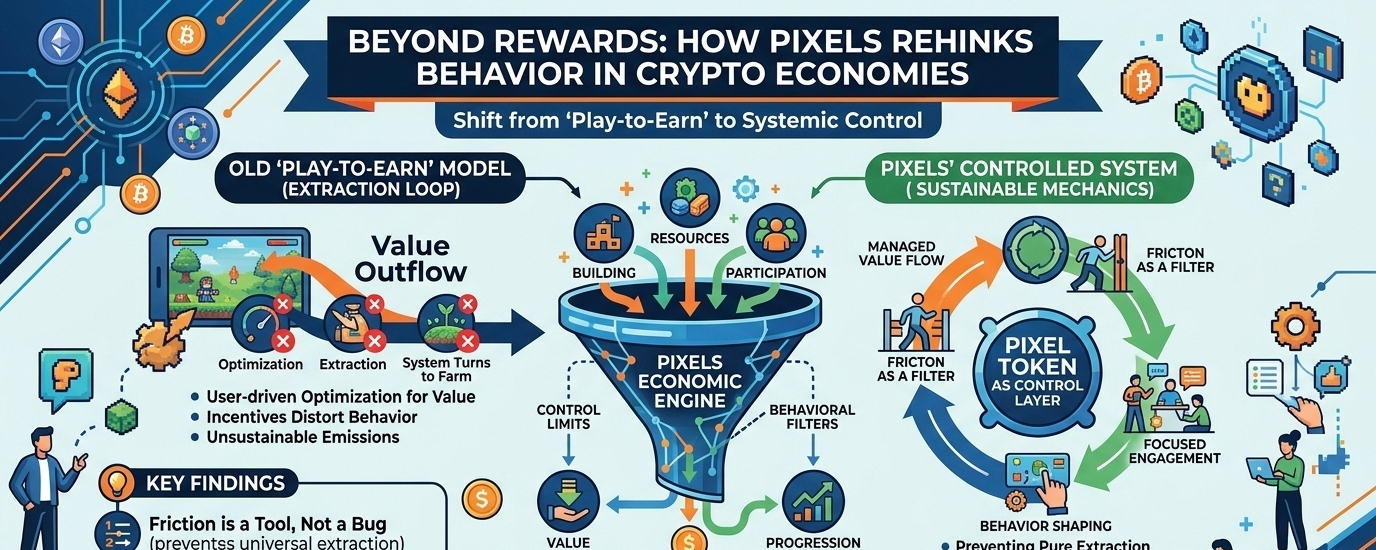
There is a point in every crypto cycle where I stop listening to what a project says and start watching what it actually does under pressure. Most systems look clean when they are growing, but they only reveal their real design when users begin to optimize, extract, and push against the edges. That is exactly where Pixels started to make more sense to me.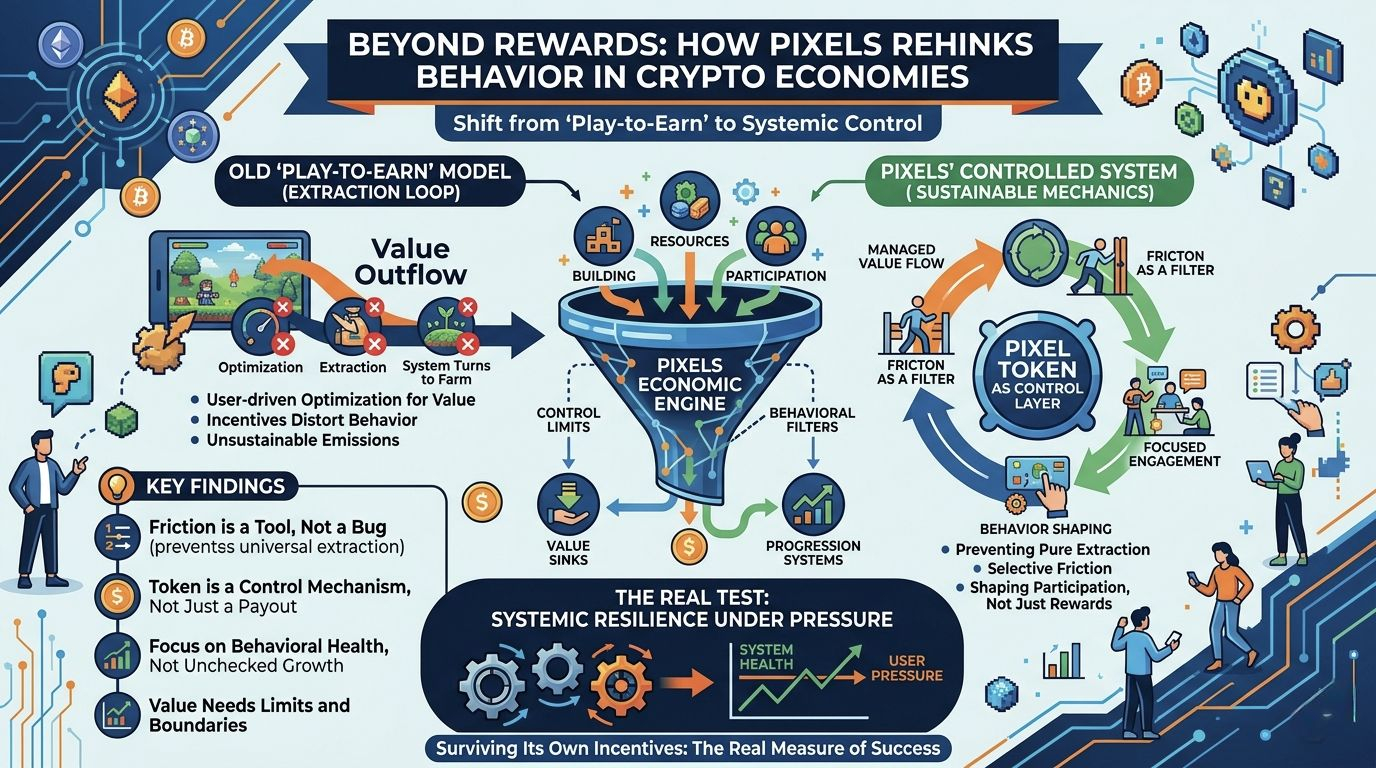
I have seen this pattern too many times before. A project launches with a simple loop, adds a token, and frames it as a reward for participation. At first, everything feels alive. Users are active, numbers are rising, and the system looks like it is working. But the moment that token gains real value, behavior changes. Participation becomes optimization, and optimization becomes extraction. New users fund old users, emissions increase to keep people engaged, and value starts leaking faster than it is created. Eventually, the system turns into a farm, and the story quietly falls apart.
Pixels does not feel built on that assumption. When I look at it, I do not see a system designed to reward users in the traditional sense. If anything, it feels like it was designed to limit how rewards behave. Instead of asking how to give users value for showing up, it seems to be asking how to prevent participation from turning into pure extraction. That is a much colder question, but also a more realistic one.
Over time, the token itself started to look different to me. PIXEL does not behave like a simple payout mechanism. It feels more like a control layer inside the economy. Value is not just distributed freely; it is managed. Sometimes it flows, sometimes it slows down, and sometimes it gets redirected into sinks, requirements, or progression systems. From the outside, that can feel restrictive, but from a system perspective, it is necessary.
One of the biggest mindset shifts for me was realizing that friction is not something Pixels is trying to remove. It is something it is actively using. Most projects treat friction as a problem. If earning feels too slow or too difficult, users leave, so everything gets smoothed out. But that is exactly why those systems collapse. Without friction, everyone qualifies, everything gets rewarded, and nothing gets filtered. Pixels seems to be doing the opposite by introducing selective friction, where not all activity is equally valuable and not all users are treated the same.
The real problem in most crypto economies is not low rewards, but behavioral decay. You can feel it when it starts. Players stop engaging with the system itself and start focusing only on the output. Instead of asking what they can build or contribute, they start asking how fast they can extract value. That is when participation turns into routine, and the system begins to feel like work. Once that shift happens, it is almost impossible to reverse.
Pixels, at least from what I have observed, seems to understand that danger. It does not feel like a project that wants to spray value everywhere and hope it works out. There is a sense that participation needs to be shaped, filtered, and controlled. Value needs boundaries. Incentives need limits. That kind of thinking is usually missing in projects that rely too heavily on growth and momentum.
That said, this is not something I see as a guaranteed success. Designing a tighter system is one thing, but maintaining interest within it is another. The real test has not happened yet. It will come when growth slows, when attention shifts elsewhere, and when users start pushing harder against the system’s limits. That is when we find out whether the structure actually holds or slips into the same patterns we have seen before.
From my own experience watching this space, what keeps my attention is not that Pixels looks exciting, but that it looks aware. Too many projects act like incentives are harmless, like you can just distribute value and trust the system to balance itself. That never works. Incentives always distort behavior. The only real question is whether a system can survive those distortions without collapsing into pure extraction.
What Pixels seems to be doing is stepping away from the old play-to-earn mindset. That model relied on the idea that users would keep calling something a reward even when it clearly depended on constant outflow. Eventually, that illusion breaks. Pixels feels like it is moving toward something more grounded, where the token is not the end goal but part of the system’s internal mechanics.
When I look at it now, I do not see a project trying to reward everyone equally. I see a project trying to decide what kind of behavior it wants to sustain. That is a much harder problem to solve, but also a more honest one. It means not all participation is valuable and not all rewards are guaranteed, but it also gives the system a chance to avoid collapsing under its own incentives.
At this point, I am not watching the price as much as I am watching the pressure. I want to see whether the economy holds when users push against it, whether incentives remain controlled or start leaking, and whether participation stays meaningful or turns into routine extraction. That is where the real answer will show up.
Because in the end, the success of a system like this does not depend on how attractive it looks at the start. It depends on whether it can survive its own incentives. And that is the part Pixels is now being tested on.
