
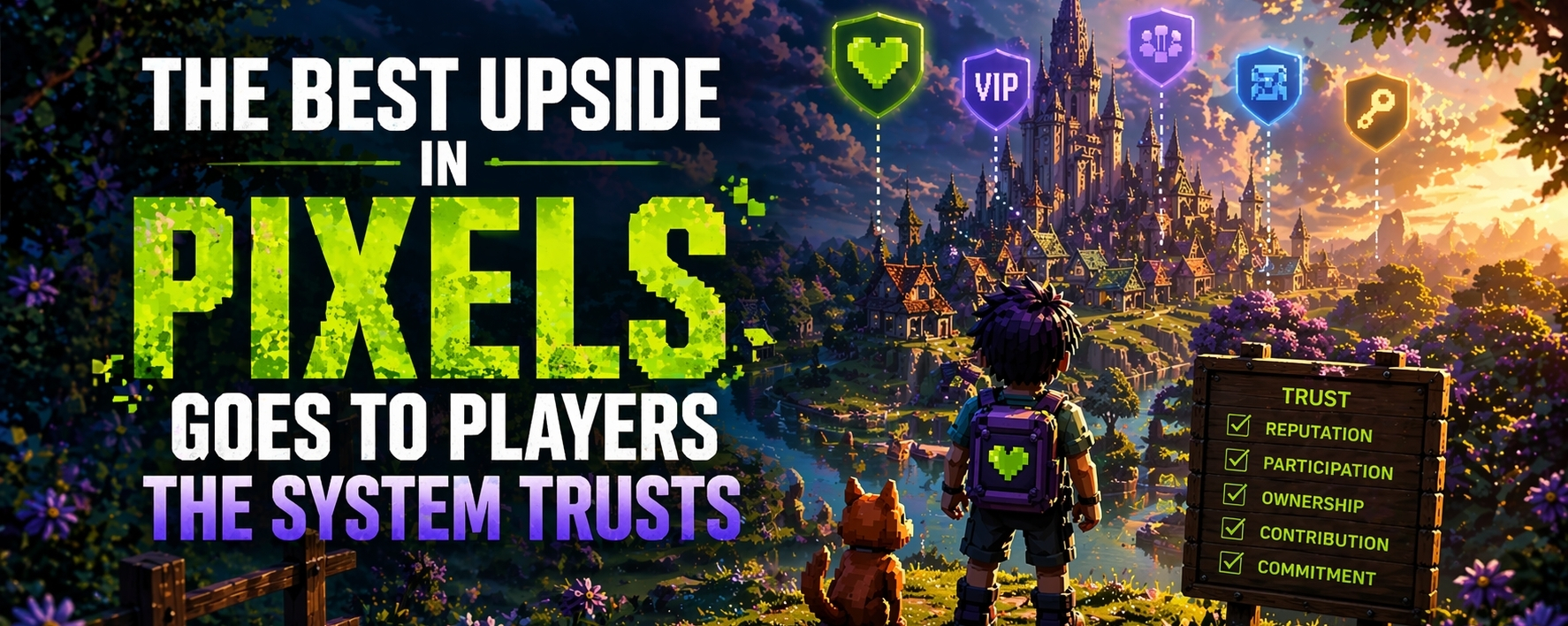

What keeps pulling me back to Pixels is that it does not feel like a game that simply rewards activity. It feels like a game that studies people first.
A lot of crypto games make the same mistake. They see a wallet, a click, a completed task, and they treat that as enough. Pixels feels more skeptical than that. It seems to assume that not every player who shows up deserves the same economic trust, and honestly, I think that instinct is smarter than the industry likes to admit.
The more I look at Pixels, the less I see a cozy farming MMO and the more I see a system for sorting conviction. It is not doing this in a cold corporate way on the surface. Everything still looks playful, soft, and social. But underneath that, the logic is pretty hard-edged. The game keeps asking: who is actually here to build a position inside this world, and who is just here to skim value off the top?
That is why I do not read the Task Board as just a reward mechanic. I read it as a judgment mechanic. Yes, it gives players a path to earn. But it also reveals that Pixels is no longer interested in treating earning as a flat right. Some players get better odds, better access, better consistency, and that is not an accident. The game is increasingly deciding that premium upside should not go to whoever happens to log in. It should go to players who have given the system reasons to trust them.
That is the part I find genuinely interesting. Pixels is not verifying identity in the formal sense. It is verifying seriousness. VIP is one signal. Land is another. Reputation matters. Guild participation matters. Spending matters. Staking matters. Even smaller details around social connection and progression begin to matter. When I step back and look at all of it together, it feels less like a game economy and more like a reputation filter hidden inside a game economy.
I think that is the real design breakthrough here. Most Web3 games try to solve economic fragility at the token level. They tweak emissions, add sinks, adjust incentives, and hope balance appears. Pixels seems to understand that the deeper problem is not just bad token design. It is bad participant selection. If your best rewards are just as accessible to extractive players as they are to committed players, the economy will always struggle. So Pixels is quietly moving the real question upstream. Before rewards, who qualifies?
That framing changes how I see features that are often discussed too narrowly. VIP is not just a monetization layer to me. It is a signal of recurring commitment. Land is not just digital property. It is proof that a player wants durable exposure to the world. Reputation is not just progression garnish. It is the game’s attempt to remember who you are through your behavior. Guilds are not just social decoration. They are evidence that you can embed yourself in collective structures rather than acting like a lone extractor.
What makes this especially compelling is that Pixels does not present this philosophy in a loud way. It does not stand on a table and declare that it is building a hierarchy of trust. It just keeps reorganizing the economy around that idea. Little by little, the best surfaces for upside drift toward players who are legible as long-term participants. That, to me, is much more important than any single update or balancing change. It reveals the worldview behind the game.
And I will be honest, I think this worldview is closer to how real online worlds survive. Not every system should be fully open all the time. Open systems sound fair, but in crypto they often become invitations for short-term extraction. I have seen too many projects mistake openness for health. Pixels seems to understand that a world stays alive not when everyone can take equally, but when the system gets better at identifying who is likely to keep giving something back.
Of course, there is a tension here. Any game that filters too aggressively risks becoming socially rigid. The same signals that protect the economy can also create a ladder that feels harder to climb from the bottom. That is a real danger. But I still think Pixels is directionally right to make this bet. An economy can survive some hierarchy more easily than it can survive total indifference to participant quality.
What I come away with is a pretty simple conclusion. Pixels is not only building reward loops. It is building a theory of who deserves better reward loops. That is what makes it more interesting than the average Web3 game to me. It is trying to replace open extraction with earned economic trust.
So when I think about Pixels, I do not really think of it as a farming game with token rewards attached. I think of it as a world that has started asking for receipts. Not receipts in the financial sense alone, but receipts of commitment, coordination, patience, and presence. The premium upside is still there. The difference is that Pixels increasingly wants proof that you are more than a visitor before it lets you touch the best of it. That shift feels small when you describe it quickly, but I think it may be one of the most important ideas in Web3 gaming right now.