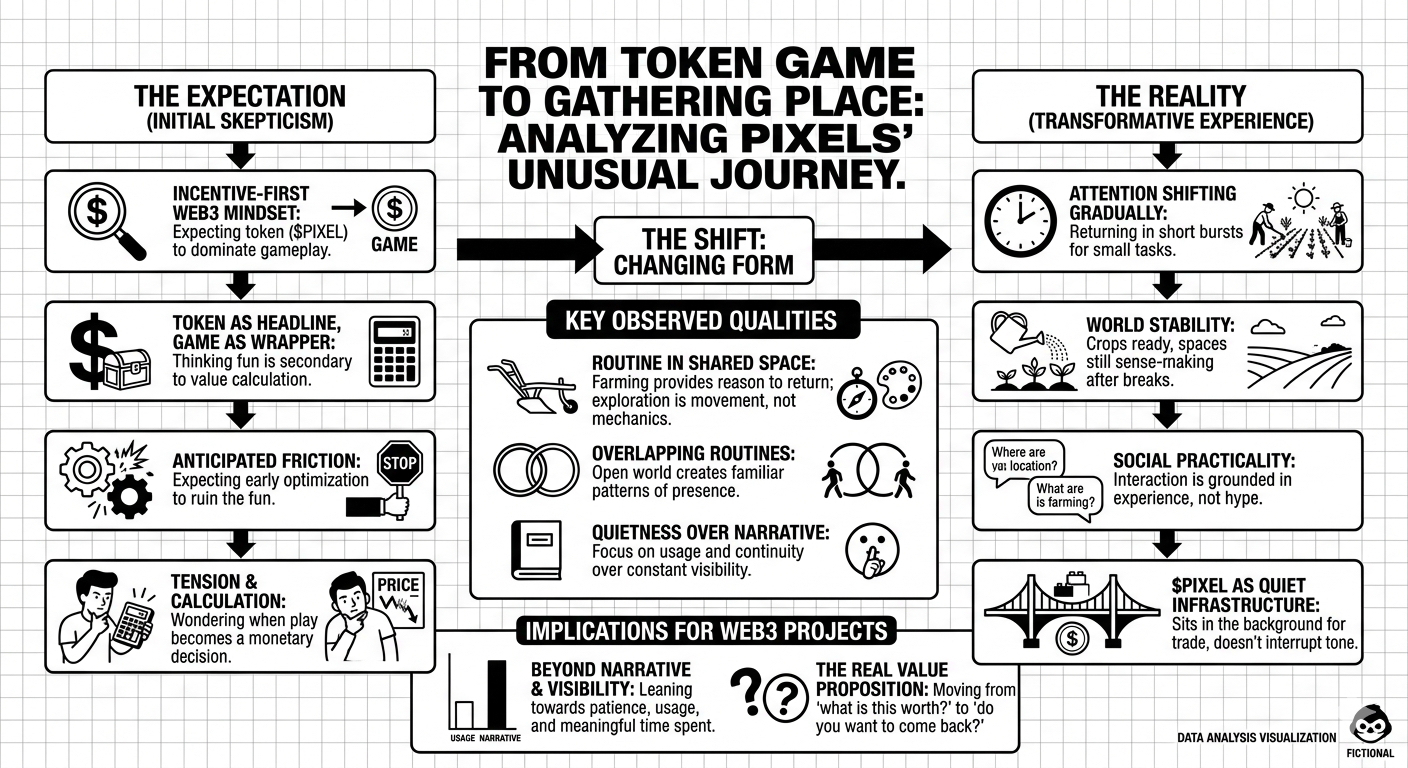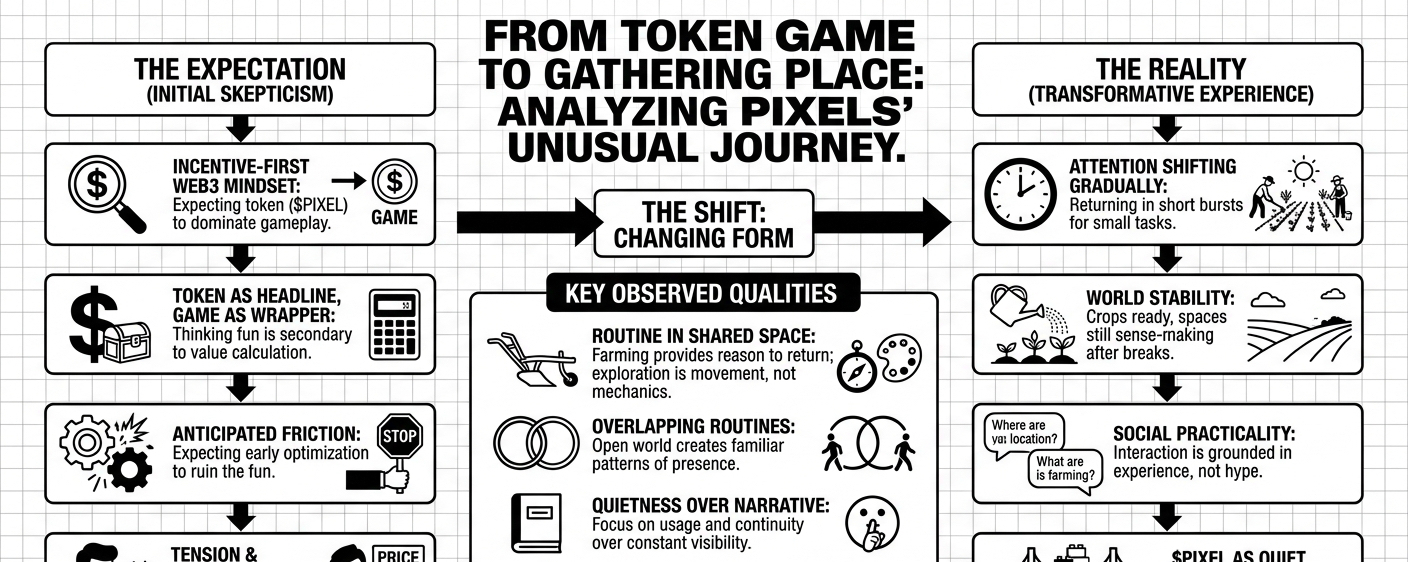
The first time I looked at Pixels, I thought I was seeing the whole thing quickly. It’s a social casual game on Ronin, with farming, exploration, and creation. And there’s $PIXEL, the token that signals value is involved, even if the artwork tries to keep the mood light. My mind did what it usually does in Web3: it reached for the incentive structure first, before I even finished understanding the play loop. I expected the token to be the headline and the game to be the pleasant wrapper.
I also expected the usual tension. Somewhere beneath the cozy visuals, I figured there would be a moment where play becomes a calculation. Whether that calculation is obvious or subtle, it tends to show up. I thought I would notice friction. I thought I would start optimizing too early, and that would be my cue to step back.
Instead, the shift happened slowly, and it didn’t feel like a new piece of information. It felt like my attention changing shape. I kept returning in short bursts rather than trying to stay for hours. I’d handle a small task, check something I’d left earlier, then go back to my day. What stood out was that the world didn’t feel fragile. Crops were ready when they were supposed to be. The open spaces still made sense to me after a break. The experience didn’t require constant re-learning just to stay oriented.
Once I noticed that stability, I started paying closer attention to how people interacted. The social layer wasn’t dominated by hype or arguments. It was mostly practical. Players asked where something could be found, and answers were simple and grounded in experience. When people showed off their farms or layouts, it wasn’t always a performance. Sometimes it sounded like preference. Like, “This is what I chose to build,” not, “This is what you must do.”
That’s when $PIXEL began to look different in my mind. I expected the token to pull my focus toward itself. But in my experience, it often behaved like quiet infrastructure. It mattered when you traded or crafted, and it gave exchanges a shared language. Still, it didn’t constantly interrupt the tone of play. It didn’t turn every action into a statement about worth. Instead, it sat in the background, enough to make ownership and exchange feel coherent, but not enough to demand that I interpret everything through money.
Ronin seemed to contribute to the same feeling by staying out of the way. Because actions happen quickly and costs don’t linger, I didn’t feel as if I was always managing a risk. That low friction changes how you behave. You try things without overthinking them. You help someone because it’s easy to do so, and then you move on. The whole session feels less like a series of decisions and more like time spent in a world.
Beneath the farming, exploration, and creation, Pixels seems to be about routine in a shared space. Farming gives you a reason to return. Exploration gives you movement that isn’t purely mechanical. Creation leaves small evidence that you were there, and that your attention accumulated rather than evaporated. Because it’s open world, those routines overlap. You don’t just meet people once; you encounter familiar patterns of presence.
Why that difference matters to me is that Web3 projects often chase narrative and visibility, because those are easier to measure than patience. Pixels, at least in what I’ve observed, leans toward usage and continuity. The story is present, but it doesn’t require constant telling. It feels like it’s meant to hold quietly, so the question becomes less “what is this worth?” and more “do you want to come back when there’s nothing urgent happening?”
I’m still watching to see how that quietness holds up when expectations rise. But I keep noticing one small shift in myself: my interest is growing most in the moments that don’t ask to be summarized.