
Economy
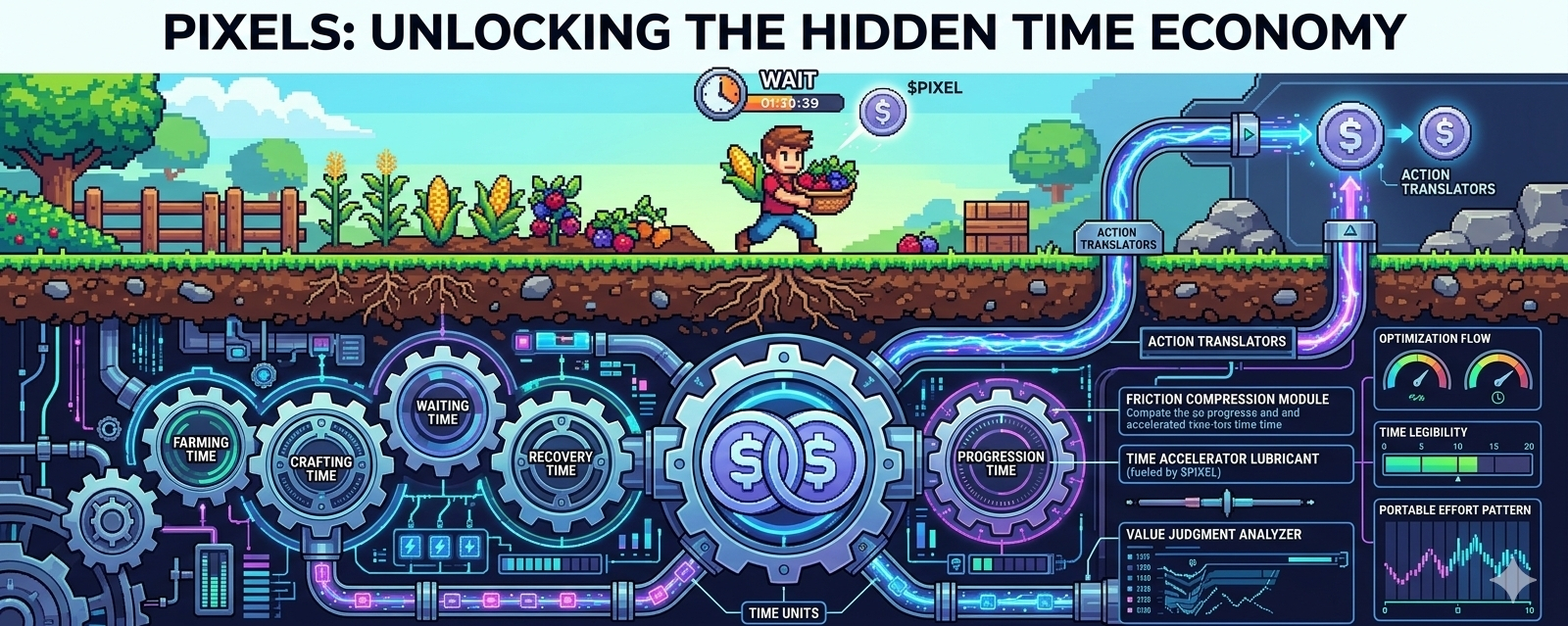
@Pixels At first, Pixels does not look like the kind of game that would make you stop and rethink how value is actually being created inside it. It feels light, familiar, almost harmless in the way it presents itself. You plant, you wait, you harvest, you move through small loops that seem easy to understand, and for a while it is tempting to treat all of that as casual gameplay with no deeper structure underneath. That was my first impression too. Time in games usually feels loose, almost disposable. You log in for a bit, do whatever is in front of you, and leave. It rarely feels like time is being measured with any real precision. But the longer I looked at Pixels, the harder it became to ignore the sense that something more subtle was happening. Not in an obvious or overly designed way, but in the background. Different parts of the game slowly started feeling comparable to each other, even when they should have felt separate. Farming time, crafting time, progression time, waiting time, recovery time, they began to feel like pieces of the same invisible system. That was the moment the game stopped feeling simple to me, because once different activities begin to share the same logic, time itself stops being passive and starts becoming the thing the economy is quietly organizing around.
That shift matters because most games never really solve this problem in a convincing way. They create multiple loops, but those loops often live in isolation. One activity rewards patience, another rewards repetition, another rewards skill, and the economy around them can feel inconsistent or even messy if you look too closely. Players usually accept it because games are not expected to make time legible in a clean way across everything. Pixels feels different. It does not openly tell you that it is building a time market, and that is exactly why the design feels more interesting. It simply creates enough friction, enough progression pacing, and enough small moments of delay that you begin making value judgments without even noticing. You start asking yourself whether waiting here is worth it, whether spending PIXEL to move faster makes sense, whether this task is actually the best use of your next few minutes compared to something else in the game. And once you start thinking like that, the token begins to feel less like a reward and more like an instrument. It is not just something you receive. It becomes something that helps define how your time is priced from one activity to another. That is a very different role from the one most game tokens claim to have, and it gives the whole system a different weight.
What makes it more compelling is that the pressure does not feel loud. Pixels is not constantly forcing the player into a pay-or-stall experience. The friction is lighter than that. It lives in accumulation. A short delay here, a soft slowdown there, another gap that feels manageable on its own, and then one day you realize the entire experience is quietly teaching you to think in terms of pace. Not just what you can do, but how quickly you want to do it and what that speed is worth to you. That is where $PIXEL starts to matter in a deeper way. It is not only attached to rewards or progression in the obvious sense. It begins to sit in the space between intention and delay. It becomes relevant whenever the player wants to reshape the speed of their own experience. That is why the system reminds me less of traditional game economies and more of services that monetize reduced latency. In other environments, people pay to cut waiting time because faster execution has value. Pixels seems to be expressing a softer version of the same logic. The system is not directly selling outcomes as much as it is giving players the option to change the timing of those outcomes, and that changes how the token feels inside the economy.
Once you see that, it becomes harder to treat player time as neutral. Two players can spend what looks like the same amount of time inside the game and still come away with very different results, not only because one played better or got luckier, but because their time moved through the system differently. Their choices shaped how their time was interpreted. One player absorbs friction and moves slowly. Another spends to compress that friction and unlocks a different rhythm of progress. Over time, those differences compound. That is where the game becomes more than a loop and starts feeling like a structure. Time is no longer just passing inside the game. It is being organized, weighed, redirected, and in some cases accelerated. The token becomes part of that process. That does not mean Pixels has fully transformed time into a perfect economic unit, but it does feel like it is closer than most games to making time comparable across the full experience. And when a game reaches that point, the token connected to those decisions starts carrying a different kind of significance. It is no longer just about what the token buys in a literal sense. It is about how it influences the shape of progression itself.
At the same time, this is where the fragility begins. The moment a system gives time a more consistent internal logic, players will start optimizing around it. That is inevitable. They will search for the highest return per minute, the least friction for the greatest output, the most efficient route through the game’s economic design. Every live system drifts in that direction once enough people understand the rules beneath the surface. What begins as a world can slowly flatten into a network of preferred paths. Certain loops become dominant, certain choices become irrational, and the diversity of the experience starts shrinking under the pressure of efficiency. That is not unique to Pixels, but it does matter more here because if the game is indeed making time more legible across activities, then optimization becomes more powerful too. The clearer the pricing logic, the easier it becomes for players to exploit it, map it, and reduce the world into a series of time-adjusted decisions. That can strengthen an economy for a while, but it can also expose its weak points much faster than a messier system would.
There is also the emotional side of it, which may matter just as much as the economics. Even if the structure is technically balanced, players eventually start feeling when a game is shaping their behavior too deliberately. That is where tension creeps in. A delay can feel natural when it supports rhythm, but it can feel manipulative when it seems placed there mainly to create pressure. A progression gap can feel meaningful if it gives weight to decisions, but it can feel artificial if it exists mostly to make acceleration attractive. That line is thin, and players are very sensitive to it, even when they cannot fully explain what feels off. Once they start questioning whether friction exists for gameplay reasons or monetization reasons, the relationship with the system changes. Trust becomes part of the economy. And in a design where time is being quietly structured across many activities, perception matters more than ever. If players believe the world is fair, they engage with the pacing. If they believe the pacing is engineered too heavily, they begin resisting the logic underneath it. That does not destroy a system instantly, but it changes the tone of participation, and over time that can matter a lot.
What keeps this interesting to me is that Pixels may be pointing toward something bigger than a single farming game, even if it is still early and far from settled. If a game can make effort and waiting behave in a more unified way across multiple activities, then the economy attached to that structure becomes more transferable in theory. Not because assets alone move between systems, but because the logic used to value player time starts becoming more portable. That is a very different idea from the usual GameFi obsession with items, land, or inventory. It suggests that what really travels is not the object but the pattern of effort, pacing, and decision-making around time. I do not think Pixels has fully proven that yet, and maybe it is too early to speak with certainty, but the direction feels more important than people realize. The real question may not be what players are earning at each step. It may be how the system is learning to read, standardize, and price their time across everything they do.
That is why I keep coming back to the same feeling every time I look at PIXEL more closely. I do not think its most important role is simply rewarding activity. That is the easy interpretation, and probably the shallow one. What feels more accurate is that the token is sitting at the point where the game translates time into economic choice. It gives players a way to change the speed, weight, and interpretation of their effort inside the system. That is a much quieter function than most token narratives try to sell, but it may be the more real one. And maybe that is why Pixels keeps feeling different to me. On the surface, it still looks like a simple game built around familiar loops. But underneath, it may be doing something more ambitious without saying it too loudly. It may be teaching players to stop thinking only about what they are doing and start thinking about what their time is worth while doing it. Once that shift happens, you are not just playing anymore. You are constantly making decisions about the value of your own attention, your own pace, and your own place inside the system. That is a subtle transformation, but it changes everything.